Featured Industrial Storage & Heavy-Duty Racking Equipment
From high-velocity pallet flow lanes to roll-out steel storage and multi-tier mezzanine frameworks, inspect our certified heavy-duty systems manufactured to exacting industrial tolerances.
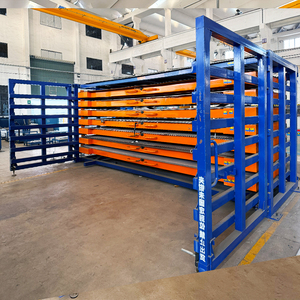
Industrial Steel Sheet Storage Rack with Roll-Out Shelves
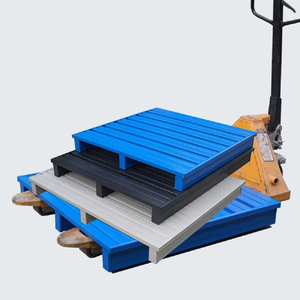
Customizable Single-Faced Euro Pallet Racking Storage
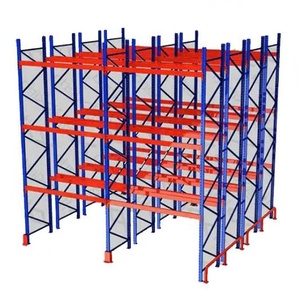
High Density Selective Heavy Duty Pallet Racking System
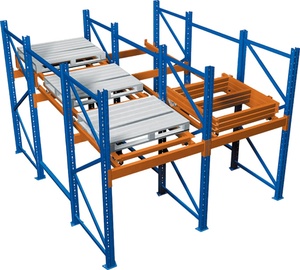
URGO Heavy Duty Push Back Pallet Rack for Intensive Storage
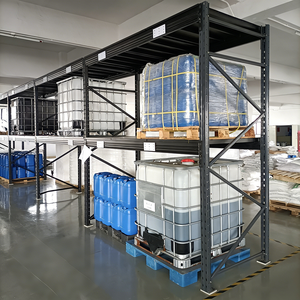
Steel Warehouse Upright Frames & Mesh Shelving Units
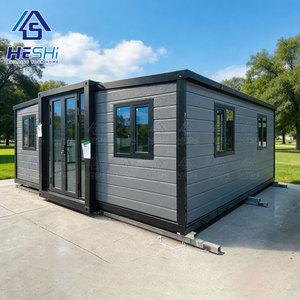
Light Gauge Steel Frame 40Ft Modular Structure Unit
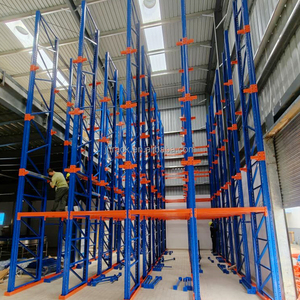
Steel Drive-In Pallet Rack Storage for High-Density Cold Rooms
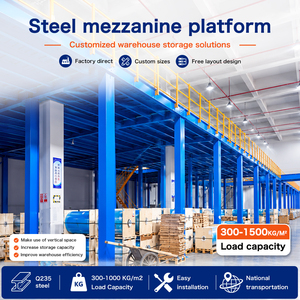
Customized Industrial Mezzanine Floor Heavy Duty Steel Platform
Mechanics, Kinematics, and Structural Dynamics of CE Certified Pallet Flow Racking
In high-throughput distribution environments handling fast-moving consumer goods (FMCG), food processing, pharmaceuticals, and sub-zero cold chain logistics, static storage creates intolerable operational drag. Selective racking demands expansive floor layouts with multiple retrieval aisles, severely diluting volumetric efficiency. Conversely, Drive-In and Push-Back configurations induce stock rotation compromises by defaulting to Last-In, First-Out (LIFO) sequencing. CE Certified Pallet Flow Racking Systems solve this fundamental trade-off by combining high-density lane layouts with strict First-In, First-Out (FIFO) dynamic gravity replenishment.
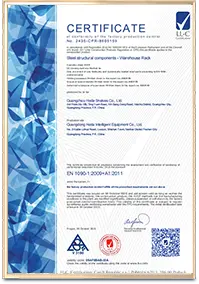
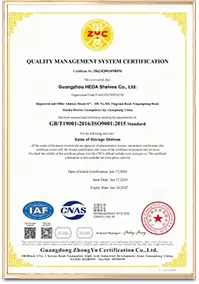
As an engineering-driven manufacturer, Guangzhou Heda Shelves Co., Ltd. (founded 2001) produces pallet flow infrastructures fully accredited under CE Certificate No. 2435-CPR-8605159 and verified through the ISO 9001:2015 Quality Management Framework (Certificate No. 18624Q00169R0M). By calibrating incline gradients, brake roller frequency, and structural column profiles, our systems ensure smooth dynamic rolling action without risking structural fatigue or runaway pallet collisions.
A pallet flow lane operates on gravitational potential energy converted into kinetic velocity across an inclined roller bed. The critical engineering challenge is maintaining uniform descent velocity regardless of pallet payload disparities. An unmanaged descent causes load momentum build-up that threatens upright frames, inventory integrity, and operator safety at the picking face.
Our gravity flow tracks are engineered with precision-milled galvanized steel rollers operating on an incline gradient between 3.2% and 4.0% (1.8° to 2.3°), customized based on bottom-deck runner profiles (GMA, Euro, perimeter base, or Australian 1165 × 1165 mm timber pallets). To eliminate load acceleration hazards, HEDA installs centrifugal friction speed controllers (brake rollers) at calibrated lane intervals. Each centrifugal brake roller incorporates an internal planetary gear mechanism that exerts proportional braking torque against rolling speed:
- Direct Centrifugal Engagement: Below rolling velocities of 0.15 m/s, the brake roller rotates with minimal rolling resistance, preventing pallet stagnation during initial roll-in.
- Terminal Velocity Ceiling: As kinetic acceleration pushes velocity past 0.25 m/s, centrifugal shoes deploy outward against the internal brake drum casing, locking pallet velocity to a controlled 0.30 m/s terminal descent limit throughout the entire track run.
- Pallet Separation & Anti-Backpressure Brakes: At the unload exit face, accumulation forces from rear pallets can exert severe hydrostatic backpressure on the leading pallet, locking it in place and threatening forklift mast stability during extraction. HEDA integrates heavy-duty mechanical separation locks (pallet separators) that isolate the leading pallet from rearward lane pressure until it is extracted, releasing the trailing pallet only after the discharge face clears.
CE marking for storage racking (EN 15512 / Construction Products Regulation CPR 305/2011) mandates strict structural limit state calculations. Unlike static selective racks, pallet flow racking upright frames must endure continuous dynamic cyclic impact loading from rolling payloads, combined with sudden localized horizontal shock forces during loading and braking cycles.
| Engineering Dimension | Standard Selective Racking | Standard Push-Back Racking | HEDA CE Certified Pallet Flow Racking |
|---|---|---|---|
| Stock Turnover Topology | Arbitrary / Random Access | LIFO (Last-In, First-Out) | Strict Dynamic FIFO (First-In, First-Out) |
| Floor Space Utilization | 35% – 42% | 55% – 65% | Up to 82% Cubic Volumetric Density |
| Lane Depth Potential | Single or Double Deep | 2 to 6 Pallets Deep | 2 to 25+ Pallets Deep with Centrifugal Brakes |
| Operating Energy Demand | Zero (Passive) | Zero (Passive) | Zero Power (Dynamic Gravity Kinematics) |
| Structural Standards Baseline | EN 15512, ANSI MH16.1 | EN 15512, AS 4084 | CE CPR 305/2011, EN 15512:2020, AS 4084, FEM 10.2.02 |
| Aisle Segregation | Dual-use shared aisles | Single front access aisle | Dedicated Loading Aisle vs. Picking Aisle (100% Traffic Isolation) |
| Braking Safeguard Systems | N/A (Static storage) | Mechanical stop stops only | Adjustable Centrifugal Brakes + Mechanical Pallet Separators |
To eliminate structural deflection failure under peak live loads, HEDA fabricates upright columns from premium structural steel grades (Q235B and high-yield Q355B cold-rolled profiles). Upright frames feature omega-profile roll-formed sections with continuous triangular bracing, delivering exceptional torsional stiffness. Beam connectors utilize multi-claw interlocking hooks secured by high-shear locking pins, preventing displacement during continuous heavy-cycle gravity movements.
Precision Fabrication, Surface Pretreatment & Traceable Quality
From raw coil slitting to automated cold roll-forming and sub-zero powder finishing, our 30,000 m² factory operates under documented ISO 9001 and CE execution classes.
Mill-Certified Steel Feedstock
We use hot-rolled structural steel coil exclusively sourced from certified Tier-1 mills. Every delivery batch includes EN 10204 3.1 chemical analysis and tensile yield certificates, guaranteeing ductile integrity and load capacity.
Multi-Stage Automated Pretreatment
Before coating, all components undergo an 8-stage automated immersion line: alkaline degreasing, twin water cascades, acid pickling, rust conversion, phosphating, and deionized rinses to ensure 1,000+ hour salt-spray corrosion resistance.
Sub-Zero Electrostatic Finishes
Components receive a thermosetting epoxy-polyester powder layer cured at 200°C. The non-porous 60–80 μm dry film thickness resists scratching, chemical washdowns, and brittle micro-fractures in -30°C cold-store environments.
Biosecurity & Export Stillage Prep
All export consignments destined for international jurisdictions (Australia DAFF, New Zealand MPI, North American ports) use customized steel stillages or ISPM-15 heat-treated dunnage, guaranteeing rapid customs border clearances.
Turnkey 3D CAD Simulation & FEA
Our in-house design engineering office executes Finite Element Analysis (FEA) on structural node points and provides comprehensive 3D CAD warehouse layout models, delivering verified structural calculation packs for local certifiers.
High Output & Project Lead Times
With an in-house manufacturing output exceeding 30,000 metric tons per month across automated rolling, punch-pressing, and robotic welding lines, HEDA guarantees dependable containerized dispatch schedules worldwide.
Independently Audited & Accredited Quality Documentation
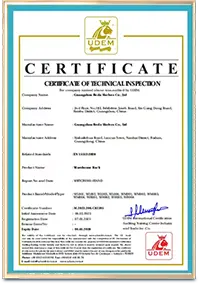
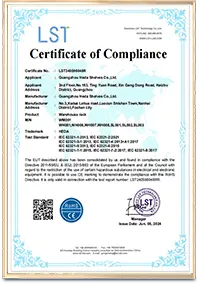
CE CPR 305/2011 structural execution class certificates, ISO 9001:2015 registries, and accredited metallurgical test reports are available on file for rapid regulatory compliance submission.
Future Procurement Trends Shaping Pallet Flow System Specifications
Logistics directors and warehouse procurement teams are adjusting system criteria to match rising square-meter lease costs, aggressive decarbonization goals, and automated fleets.
Zero-Energy Dynamic Warehousing
Escalating electrical utility costs have spurred interest in passive kinetic systems. Pallet flow systems utilize pure gravitational potential energy to transport tons of cargo across multi-deep accumulation tracks, eliminating power lines, track motors, and recharging downtimes common to motorized shuttle systems.
Demarcated Safe-Aisle Traffic Isolation
Modern Occupational Health and Safety (OH&S) mandates require physical segregation between inbound pallet restocking and high-speed outbound order fulfillment. Pallet flow creates separate loading and picking aisles, cutting forklift interaction risks and cross-traffic accidents by up to 75%.
Cold-Chain Density Optimization
Refrigerated warehouse space costs 3 to 5 times more to condition than ambient sheds. Buyers prioritize 10 to 20 pallet deep flow lanes to convert wasted access corridors into frozen storage blocks, maintaining continuous FIFO turnover to prevent perishable batch expiration.
Technological Innovations in Gravity Flow Racking Design
From non-contact eddy-current brake rollers to automated guided vehicle (AGV) load interfaces, explore the next generation of dynamic storage technology.
Non-Contact Magnetic Eddy-Current Braking
Traditional centrifugal brakes rely on friction pads that gradually wear down in continuous round-the-clock operations. HEDA is pioneering magnetic eddy-current brake rollers. These units generate an opposing magnetic counter-torque relative to pallet descent velocity without internal surface friction, eliminating brake pad maintenance in sub-zero applications.
Autonomous Mobile Robot (AMR/AGV) Interfaces
As robotic counterbalanced forklifts replace manually steered vehicles, pick faces require precise pallet centering. We configure entry funnels with optical target markers and heavy-duty centering side-guide rollers to ensure pallet stops remain aligned within a ±3 mm tolerance band for robotic automated forks.
Modular Seismic Dynamic Frame Isolators
In earthquake-prone regions such as New Zealand (NZS 1170.5) and the western Pacific, dynamic live loads within long gravity lanes can intensify sway frequencies. Our latest seismic designs use high-tensile baseplates with slotted friction anchor dissipators and cross-aisle rigid overhead truss ties to dampen seismic wave resonance.
Engineering & Procurement FAQ for Pallet Flow Racking
Detailed answers addressing engineering validation, dynamic braking formulas, pallet deflection thresholds, and logistics clearance.
The ideal gradient balances static breakaway friction for the lightest pallet (e.g., 300 kg) with kinetic runaway containment for the heaviest load (e.g., 1,500 kg). Standard timber pallets on full-width steel rollers require a 3.5% gradient (35 mm vertical drop per 1,000 mm horizontal length). For variable loads, brake rollers are typically installed at an interval of one brake roller every two pallet positions along the lane. For deep lanes (>12 pallets) holding dense goods like liquids, the pitch tightens to one brake roller per pallet position, keeping pallet velocity strictly below 0.35 m/s.
Pallet flow systems rely on true, consistent contact between the pallet's bottom boards and the roller track. Broken, missing, or protruding bottom runners, along with excessive bottom deck deflection (exceeding L/200 under load), increase rolling friction and can cause pallets to drift or hang up mid-lane. When working with non-standard pallets or weak boards, we incorporate multi-track roller assemblies or full-width steel rollers, paired with flared entry guide channels and full-length side-guide channels, ensuring consistent tracking across the entire lane.
HEDA provides a comprehensive Structural Design Calculations Package with every project dispatch. This includes our CE Factory Production Control (FPC) accreditation certificate (No. 2435-CPR-8605159), mill certificates covering the steel chemistry of our uprights and beams, Finite Element Model (FEM) deflection curves adhering to EN 15512:2020 limit-state design, and site-specific seismic baseplate anchoring analyses cross-referenced to AS 4084 / NZS 1170.5 standards for easy verification by local building authorities.
The separator is an automatic mechanical trip-lever lock installed just behind the leading pallet position. As the first pallet rolls into the end stop, it depresses an actuator plate that raises a mechanical brake arm behind it. This blocks the second and trailing pallets, absorbing the collective hydrostatic backpressure of the lane. When a forklift lifts the first pallet off the track, the trip lever releases, allowing the rear queue to roll forward by one pallet position until the next unit re-engages the mechanism.
Low-temperature conditions alter steel ductility and cause moisture condensation that can freeze standard roller bearings. For cold-store projects, HEDA uses specialized cold-temperature structural steels with verified Charpy V-notch impact toughness down to -30°C. Roller tracks feature shielded stainless steel ball bearings packed with low-viscosity synthetic grease rated to -40°C. Centrifugal brakes are equipped with moisture-repellent seals to prevent ice formation inside the planetary braking gears.
Racking components, long upright frames, and heavy roller track profiles are loaded into tailored, heavy-gauge structural steel stillages. If timber dunnage or packaging is used, it undergoes full heat treatment and bears the official ISPM-15 IPPC stamp. Every sea freight consignment includes container packing declarations, certified bills of lading, packing lists, and commercial invoices to simplify customs inspections at international arrival ports.
Request a Certified Dynamic Storage Engineering Consultation
Provide your facility clear height, pallet dimensions, temperature profiles, and daily throughput volumes. Our engineering design team will generate an optimized 3D CAD layout, roller lane elevation diagram, and competitive factory-direct quote within 24 hours.