Industrial-Grade Push Back & Pallet Racking Systems
Explore factory-direct push-back cart configurations (2 to 6 deep) and heavy-duty structural warehouse rack architectures precision-manufactured from high-tensile Q235B/Q355B structural steel.
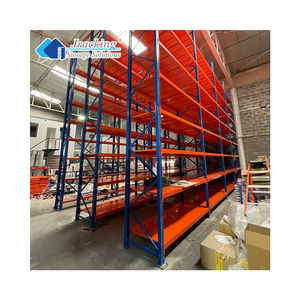
Jracking Dexion Style Warehouse Shelving Heavy Duty Pallet Rack
- Universal Pitch
- Load: Up to 4,500kg/Level
- Q355B Steel
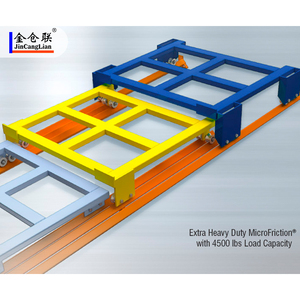
Customized High Density Storage Steel Push-back Racking (2~5 Carts)
- Nested Trolleys
- LIFO Flow
- Low Profile Track
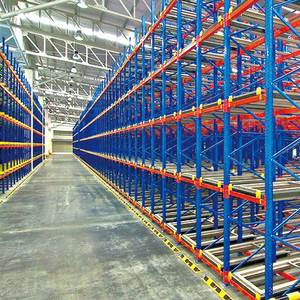
Reinforced Steel 5 Layer Push Back Pallet Racking Efficient Goods Picking
- Multi-Tier Stacking
- 1,500kg/Pallet
- Flanged Steel Wheels
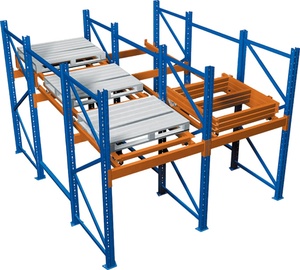
URGO Push Back Racking Heavy Duty Pallet Rack For Intensive Storage
- Heavy Guide Rails
- Precision Bearings
- CE Certified
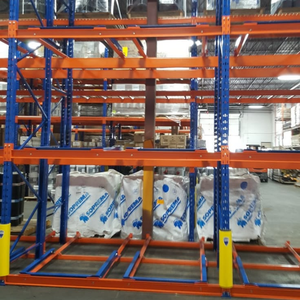
Push Back Pallet Racking Forklift Operated for 3PL Logistics Warehouse
- Batch Turnover
- Aisle Reduction
- Standard Forklifts
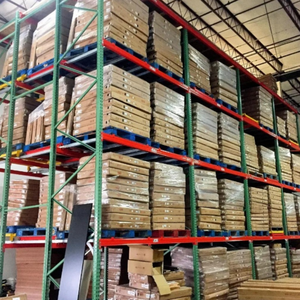
Cost Effective Push Back Pallet Racking LIFO for Small & Medium Warehouses
- Modular Incline
- Fast Payback
- Anti-Rust Finish
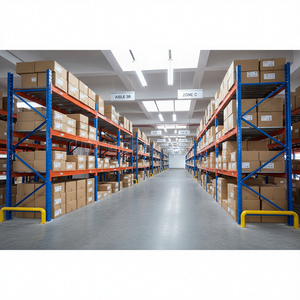
Heavy Duty Metal Iron Push Back Warehouse Storage Pallet Racking System
- Laser Welded
- End-Stop Dampers
- Epoxy Coated
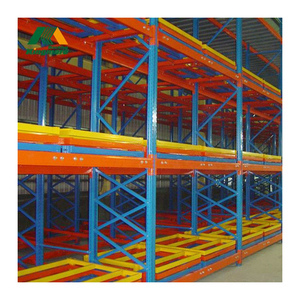
Heavy Duty Push Back Rack Stacking System Industrial Storage Equipment
- Custom Depth (2-6)
- Anti-Derail Carts
- ISPM-15 Packaged
The Mechanical Physics of Push Back Cart-on-Rail Systems
A deep-dive technical assessment into gravitational incline calculations, structural metallurgy, dynamic carriage clearances, and pallet stabilization under seismic loads.
Nested Cart Kinematics & Rail Pitch
Push back racking employs a series of nested, telescoping steel carts that ride along inclined structural steel rails sloping at a precise 2.5% to 3.0% gravitational gradient toward the picking aisle. When loading, the forklift pushes the foremost pallet back, exposing the next underlying nested cart. Upon retrieval, gravitational kinetic energy slowly glides subsequent pallets forward at controlled descent speeds governed by low-friction flanged bearing resistance.
Q355B Cold-Formed Steel & Deflection
Structural upright columns are continuous roll-formed from premium certified Q355B (equivalent to ASTM A572 Grade 50) structural high-yield steel coils. According to European EN 15512 and Australian AS 4084 standards, longitudinal beam deflections under maximum dynamic working load are rigorously constrained within L/200 to L/300 deflection thresholds, preventing rail binding, frame torsion, and wheel track misalignment over decades of rigorous service.
Anti-Derailment & Impact Damper Systems
Every nested cart carriage integrates integrated anti-lift mechanical catches and structural safety drop-stops. In the event of rough forklift placement or irregular pallet bottoms, the anti-derail hooks lock into the structural channel rails, totally eliminating carriage jump. Polyurethane mechanical end-stop bumpers at aisle-face entry dissipate dynamic kinetic inertia when pallets roll down to the picking front.
| Storage Racking System | Floor Space Utilization | Pallet Selectivity | Stock Rotation Strategy | Handling Equipment Required | Forklift Entry into Racks | CapEx per Pallet Position |
|---|---|---|---|---|---|---|
| Push Back Racking (2-6 Deep) | Up to 75% | Lane Selectivity (High) | LIFO (Last-In, First-Out) | Standard Counterbalance / Reach | NO (Aisle-Only Operation) | Moderate ($$) |
| Selective Pallet Racking | 35% – 45% | 100% Direct Access | FIFO or LIFO | Standard Counterbalance | No | Low ($) |
| Drive-In Racking System | Up to 70% | Bay-Level Only (Low) | LIFO Strict | Reach / Counterbalance | YES (High Collision Risk) | Moderate ($$) |
| Gravity Pallet Flow | Up to 80% | Lane Selectivity | FIFO Strict (First-In, First-Out) | Counterbalance / Reach | No (Separate In/Out Aisles) | High ($$$$) |
| Radio Shuttle Cart Racking | Up to 85% | Automated Lane Batch | FIFO & LIFO Flexible | Automated AGV / Shuttle | No | Very High ($$$$$) |
Selecting the Optimal Push-Back Depth for Your Facility
Comparing engineering load dynamics and warehouse clearance requirements across 2-deep, 3-deep, 4-deep, and 5-6 deep nested carriage profiles.
2-Deep Push Back
Configuration: 1 Mobile Cart + 1 Base Rail Position.
Best For: High SKU variety warehouses transitioning from selective racking. Increases pallet capacity by 35% using standard forklift reach trucks without altering existing aisle layouts.
3-Deep Push Back
Configuration: 2 Nested Carts + 1 Base Rail Position.
Best For: Fast-moving retail distribution and food FMCG warehouses. Balances density with selectivity, offering an optimum 50% density gain with minimal vertical profile loss.
4-Deep Push Back
Configuration: 3 Nested Carts + 1 Base Rail Position.
Best For: Moderate batch manufacturing and cold storage chiller environments where aisle reduction yields drastic HVAC and refrigeration thermal savings.
5~6 Deep Heavy Lanes
Configuration: 4~5 Heavy Nested Carts + Rail Position.
Best For: Large-lot manufacturing, raw paper reels, and beverage container storage. Features reinforced steel wheels with sealed double ball bearings to resist rolling fatigue.
Strategic Procurement Trends in High-Density Warehouse Storage
Macro shifts impacting intralogistics procurement: automation synergy, seismic structural resilience, cold chain expansion, and ESG decarbonized steel sourcing.
1. AGV & AMR Integration
Warehouses are increasingly pairing push-back racking with vision-guided Automated Guided Vehicles (AGVs) and Autonomous Reach Trucks. Push-back eliminates the need for robots to navigate narrow, high-risk interior rack tunnels, creating a safe, high-speed interface directly at the aisle boundary.
2. Cold-Chain Thermal Efficiency
With industrial power tariffs climbing, refrigerated warehouses (-25°C to -30°C) must minimize air volume per pallet. Push back racking condenses footprint by eliminating multiple access aisles, cutting energy consumption per stored pallet by up to 35% compared to selective rack layouts.
3. Finite Element Seismic Analysis
Modern building codes across New Zealand (NZS 1170.5), Australia (AS 4084:2023), and the Americas demand verified seismic resilience. Buyers now require FEA dynamic spectrum simulations, enlarged ductile baseplates, and high-tensile anchor engineering calculations before signing contracts.
4. Scope 3 Carbon Tracking
Global procurement teams now evaluate the environmental footprint of heavy structural steel. We utilize scrap-recycled EAF (Electric Arc Furnace) steel and heavy metal-free powder coatings, supporting corporate sustainability and European CBAM carbon tax compliance.
25 Years of Precision Storage Racking Manufacturing
Founded in 2001, Guangzhou Heda Shelves Co., Ltd. has established itself as an engineering-focused manufacturing powerhouse in heavy-duty intralogistics infrastructure. Operating a 30,000 square meter intelligent manufacturing base equipped with advanced automated roll-forming lines, laser profiling centers, and robotic welding stations, our facility achieves a monthly production capacity exceeding 30,000 metric tons.
We provide full-spectrum engineering lifecycle support for commercial warehouse operators, 3PL logistics corporations, and international racking distributors across Australia, New Zealand, Europe, and the Pacific Islands. Every push-back system is tailored to precise pallet specs (such as Australian 1165×1165mm standard or Euro 1200×800mm), ensuring flawless gravity glide dynamics and structural safety.
10-Step Controlled Manufacturing Loop
Quality is baked directly into our production lines: Spectrometric Raw Coil Verification → High-Speed Roll Forming → Robotic Column Punching → Cold Bending → Automatic Profile Roll-Forming → Shot Blasting & Pickling → 9-Stage Phosphate Pretreatment → Electrostatic Polyester Powder Line → CMM Laser Dimensional QC → ISPM-15 Biosecurity Packing.
Result: Zero on-site binding during cart installation, 100% bolt alignment accuracy, and ultra-smooth carriage gliding under full load.
Frequently Asked Questions on Push Back Racking Procurement
Direct, highly authoritative engineering answers addressing load limits, pallet compatibility, seismic compliance, operational clearance, and export customs clearance.
How does push back racking compare to drive-in racking regarding warehouse safety and forklift cycle times?
Push back racking dramatically improves warehouse safety because the forklift operator never drives into the rack structure itself; all pallet placement and retrieval occurs exclusively at the front aisle face. In drive-in racking, up to 90% of column damage occurs inside narrow drive-in channels due to mast sway and tire scrubbing. By contrast, push back racking reduces forklift travel and cycle times by 30% to 45% while practically eliminating expensive upright structural collisions.
What pallet types and bottom runner configurations can be handled by push back nested carts?
Our push back systems are custom-engineered to handle wooden Australian Standard (1165×1165mm), Euro pallets (1200×800mm), ISO Industrial pallets (1200×1000mm), plastic perimeter-base pallets, and custom skids. Because the pallet rests on a full perimeter-welded steel cart frame rather than individual rollers, poor-condition wooden pallets, broken bottom boards, or two-way entry skids that fail in pallet flow racks function securely in push back systems.
Can HEDA Shelves push back racking be certified to Australian AS 4084 and New Zealand seismic standards?
Yes. Guangzhou Heda Shelves Co., Ltd. calculates section modulus, frame buckling ratios, and beam connection stiffness in strict accordance with AS 4084:2023 (Steel Storage Racking) and New Zealand NZS 1170.5 seismic provisions. We supply complete structural engineering calculation dossiers, steel mill certificates (Q235B / Q355B yield certs), and anchor bolt pull-out calculations so your chartered professional engineer (CPEng) can sign off on local council permits.
What are the critical ceiling height and vertical lift clearances required for nested push back carts?
Because push back carts nest inside each other on a sloping incline (typically 2.5% to 3.0%), each deeper lane position requires approximately 20mm to 35mm of additional vertical height profile per level compared to a flat selective beam level. During layout planning, our engineers allocate 150mm to 200mm of vertical lift clearance above the top load to ensure the forklift driver can raise the pallet clear of the carts during loading without catching the overhead beam level.
How does push back racking perform inside cold storage and deep freeze facilities (-30°C)?
Push back racking is one of the highest-ROI configurations for cold rooms because chilled cubic volume is extremely costly to cool. For sub-zero operations, we equip our carts with low-temperature synthetic food-grade lubricating grease rated to -40°C, sealed flanged bearings, and cryo-tolerant powder coatings that resist embrittlement and micro-cracking caused by rapid thermal fluctuations during defrost cycles.
What documentation and biosecurity packing standards are supplied for overseas container shipping?
Every international export consignment ships with full commercial documentation: Bill of Lading, Packing List with itemized member weights, Commercial Invoice, and Certificate of Origin (enabling preferential tariff treatment under ChAFTA, RCEP, and the NZ-China FTA). All packaging uses certified ISPM-15 fumigated timber dunnage or custom-welded steel stillages to ensure rapid clearance through Australian DAFF and New Zealand MPI quarantine inspection.
What is the typical manufacturing lead time and sea freight transit schedule?
Standard fabrication for a multi-tier push back project (1,000 to 5,000 pallet positions) takes between 20 to 30 working days from final CAD layout sign-off. Direct ocean transit from Guangzhou / Nansha / Shenzhen ports takes approximately 14 to 22 days to Australian East Coast ports (Sydney, Melbourne, Brisbane), 24 to 28 days to New Zealand (Auckland, Tauranga), and 28 to 35 days to European main base ports (Rotterdam, Hamburg).
How are replacement parts, cart wheel replacements, and layout expansions handled after delivery?
All HEDA Shelves components follow universal precision engineering tolerances with traceable batch serial numbering. We maintain digital archives of your building CAD plans, beam connection punch dies, and cart track dimensions. If you need replacement cart wheel bearings, anti-derailment clips, column upright guards, or additional extension bays years later, components are dispatched with guaranteed dimensional compatibility.
Request Your Free 3D CAD Warehouse Racking Layout
Our senior structural engineering team prepares comprehensive DWG layouts, volumetric storage calculations, and load capacity tables tailored to your facility floor plan, clear roof height, and forklift specifications—typically delivered within 24 hours.