High-Performance Warehouse Racking Systems
Precision-manufactured with premium high-tensile cold-rolled steel, calibrated load profiles, and durable anti-corrosion finishes for critical industrial logistics hubs.
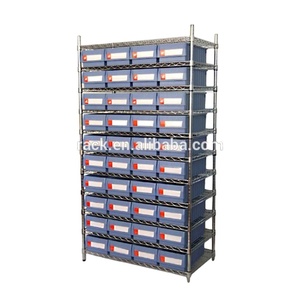 NSF Certified
Multi Layers 800lbs Factory Office Wire Racking with NSF Parts
Ultra-clean, open-wire design promoting full light penetration, continuous air circulation, and sprinkler passage. Certified for sanitary processing, cleanrooms, and retail stockrooms.
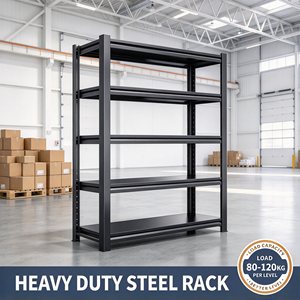 Retail & Depot
Heavy Duty Steel Supermarket Shelving 6 Shelf Adjustable Single Sided
Commercial-grade gondola rack engineered with reinforced uprights and backboards for high-capacity warehouse-style retail, trade depots, and hardware stores.
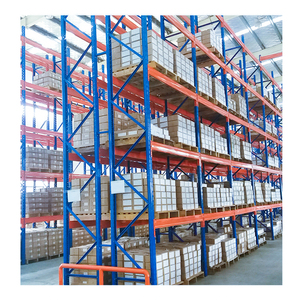 CE / AS 4084
Heavy Duty Selective Steel Pallet Racking System
The benchmark for 100% individual pallet selectivity. Manufactured with Q235B/Q355B high-tensile upright frames and interlocking box beams with high structural safety margins.
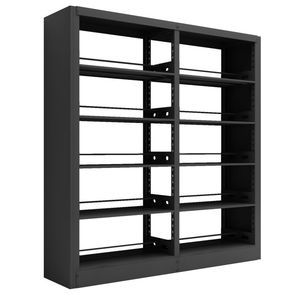 Archive & Retail
Floor Standing Multi-Tier Shelves & Cabinet Storage Unit
Versatile floor-standing unit for institutional archives, corporate distribution hubs, technical document rooms, and bulk institutional procurement contracts.
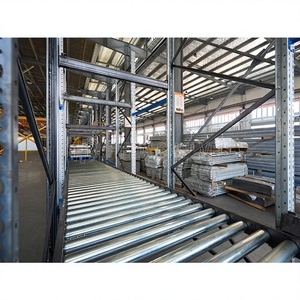 Dynamic FIFO
Customized Heavy Duty Gravity Carton Flow Roller Racks
Dynamic, zero-energy FIFO roller track system designed to separate replenishment loading from picking faces, dramatically cutting transit times in high-velocity fulfillment lines.
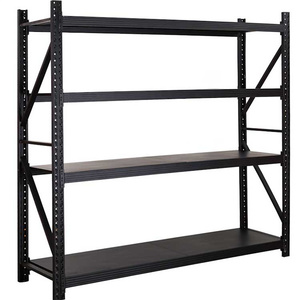 Heavy Structural
Custom Industrial Heavy-Duty Pallet Rack System
Reinforced column profiles with welded footplates, certified row spacers, and diagonal bracing. Customized precisely for specific reach truck mast constraints and slab load capacities.
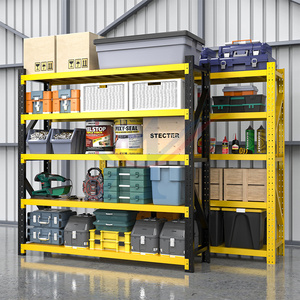 Longspan System
Medium Duty 4-Tier Industrial Steel Shelving (200 kg/Layer)
High-rigidity boltless step-beam shelving featuring cold-rolled steel drop-in shelves. Ideal for automotive spare parts, parcel sorting facilities, and industrial workshop staging.
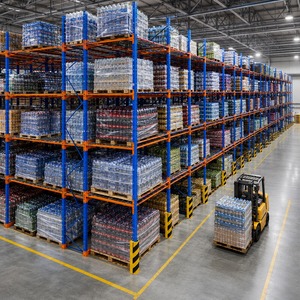 Chemical / HazMat
Q235B Steel Pallet Flow Racking for Chemical & HazMat Plants
Specialized gravity pallet flow with centrifugal speed controllers, entry guides, and automatic separator brakes. Configured for drums, chemical IBC containers, and bulk raw materials.
Engineering Compliance: Demystifying CE Certification (EN 15512 & CPR 305/2011)
In modern industrial warehouse infrastructure, obtaining authentic CE Certification is not merely an administrative formality—it is a rigorous, legally mandated structural assurance. Under the European Union Construction Products Regulation (CPR No. 305/2011), static steel storage systems are classified as structural building products. When procurement directors and supply chain engineers evaluate international racking manufacturers, understanding the foundational compliance framework between harmonized European norms (EN 15512, EN 15620, EN 15629, EN 15635) and global equivalents like the Australian AS 4084-2023 and American RMI (Rack Manufacturers Institute) standards is essential for legal compliance, site safety, and insurance validation.
Critical Harmonized Standards Governing High-Density Storage Racks
Industrial racking systems operate under complex structural loading combinations, including permanent dead loads (self-weight), variable live loads (palletized freight), horizontal forklift impacts, placement dynamics, and, where applicable, seismic ground accelerations. Compliant manufacturers design their racking systems based on a multi-standard engineering continuum:
| Standard Reference | Scope & Regulatory Focus | Engineering Significance in Manufacturing |
|---|---|---|
| EN 15512:2020 | Steel static storage systems – Adjustable pallet racking – Principles for structural design | Mandates limit state design (LSD), partial load safety factors ($\gamma_M$), stub column compression tests, and beam-to-column connector rotational stiffness testing ($C_D$). |
| EN 15620:2021 | Steel static storage systems – Tolerances, deformations and clearances | Specifies strict structural deflection limits (e.g., maximum beam deflection under safe working load of $L/200$), slab flatness tolerances, and forklift operating clearances. |
| EN 15629:2008 | Steel static storage systems – Specification of storage equipment | Defines the engineering boundary conditions that purchasers and specifiers must provide, including soil bearing, floor slab specs, and mechanical handling equipment (MHE) envelopes. |
| AS 4084:2023 | Steel storage racking (Australia / New Zealand reference) | Sets down under-aisle impact resistance, frame upright splice engineering, post-impact residual strength, and seismic loading according to AS/NZS 1170.2/5. |
| ISO 9001:2015 | Certified Quality Management System (Cert No. 18624Q00169R0M) | Ensures batch traceability from primary steel mill heat certificates through automated punching, cold roll forming, powder curing, and non-destructive weld testing. |
Metallurgical Selection: Why Cold-Rolled Q235B and Q355B Steel Define Longevity
A structural failure in a 12-meter high-bay warehouse almost never begins at the center of a beam—it initiates at stress concentration nodes, such as micro-cracks in substandard sheet steel, excessive punched hole deformation, or brittle heat-affected zones (HAZ) adjacent to beam connector welds. At our 30,000 m² automated production facility, every structural beam, upright column, and seismic diagonal brace is formed from mill-certified high-ductility structural carbon steel (predominantly grades Q235B and Q355B, corresponding to European S235JR and S355JR).
The yield strength ($R_e$) of Q355B (minimum 355 MPa) provides substantial load-bearing capacity without excessive dead weight, reducing foundation anchoring strain. Conversely, Q235B provides high elongation properties ($A \ge 26\%$), absorbing elastic kinetic shocks during accidental forklift docking collisions without catastrophic brittle fracture. All raw steel coils undergo spectrographic chemical analysis and tensile yield verification before roll forming begins.
Strategic Procurement Trends in Warehouse Storage (2025–2030)
How industrial supply chains, automated logistics, cold-chain expansions, and sustainability mandates are reshaping international racking procurement.
Shift from Capital Cost to TCO Optimization
Procurement teams are moving away from the "lowest price per ton" model. Total Cost of Ownership (TCO) now prioritizes rack durability, modular re-configurability, galvanized footplate longevity, and standardized connector interchangeability, which slashes lifecycle maintenance budgets by up to 40%.
Automation-Ready Hybrid Racking Infrastructure
Modern distribution hubs are adopting hybrid selective racks pre-engineered with precise deflection tolerances ($< L/300$) to allow retrofitting of Autonomous Mobile Robots (AMRs), automated pallet shuttles, and automated guided vehicles (AGVs) without tearing down existing steel structures.
Cold-Chain Optimization for Perishable Logistics
With real estate costs soaring for refrigerated and sub-zero ($-25^\circ\text{C}$) facilities, buyers are rapidly transitioning from standard wide-aisle configurations to high-density semi-automated Radio Shuttle, Gravity Pallet Flow, and Drive-In systems that condense the footprint by up to 60%.
Direct Factory Engineering Collaboration
Middlemen and third-party trading agents are being replaced by direct-to-factory technical engagement. Enterprise buyers now require direct access to factory CAD engineers, customized 3D finite element modeling (FEA), and bilingual engineering documentation within 24 hours.
Stringent Traceability & Biosecurity Compliance
Ocean freight to regions like Australasia, Europe, and the Americas now demands zero-delay clearance: ISPM-15 heat-treated crating, certified steel stillages, non-toxic lead-free thermoset powder coats, and preferential FTA certificate of origin verification for tariff optimization.
Sustainable Eco-Friendly Surface Finishing
Industrial ESG initiatives require factories to phase out heavy chemical degreasing baths. Modern procurement contracts stipulate closed-loop automated pickling, zero VOC emissions, and non-heavy metal powder coatings compliant with EU RoHS and REACH regulations.
Technological Evolution: From Static Steel to Smart Racking Ecosystems
Warehouse racking is transforming from passive steel structures into active, sensor-monitored distribution assets. As warehouse heights exceed 15 to 30 meters in modern logistics parks, structural performance during dynamic cycles must be calculated with precision.
1. Finite Element Analysis (FEA) and Seismic Dynamic Modeling
In accordance with EN 15512:2020 Annex A and New Zealand NZS 1170.5 seismic provisions, structural racking must withstand dynamic horizontal accelerations without joint uncoupling or column buckling. Our design team uses advanced 3D FEA simulations to model the rotational flexibility of our 5-claw and 6-claw cold-stamped beam connectors.
By simulating earthquake ground motions, baseplate anchor pull-out limits, and second-order P-$\Delta$ elastic deformation effects, we optimize the upright profile thickness (from 1.5 mm up to 3.0 mm) and brace angle configurations. This provides maximum structural strength with minimal steel consumption, saving clients substantial shipping tonnage costs.
2. Advanced Surface Treatment: Multi-Stage Phosphating vs. Hot-Dip Galvanizing
Corrosion resistance determines whether a racking installation lasts 5 years or 30 years. Our factory deploys specialized finishing technologies adapted to specific operational environments:
- Electrostatic Powder Coating: Applied via automated reciprocator spray guns after an 8-stage pre-treatment cycle (degreasing, water rinsing, acid pickling, surface conditioning, and zinc phosphating). The thermoset epoxy-polyester powder is cured at 180°C–200°C, producing an abrasion-resistant finish 60–80 microns thick that resists acid, alkali, and forklift scuffing.
- Hot-Dip Galvanizing (ISO 1461): For outdoor lumber yards, coastal port warehouses, and high-humidity chemical storage, components are submerged in molten zinc at 450°C, forming a metallurgically bonded zinc-iron alloy coating over 85 microns thick that prevents rust for decades.
3. Structural Redundancy & Impact Dissipation Systems
Forklift impacts account for over 85% of warehouse racking damage. Modern warehouse layouts incorporate integrated impact protection: heavy-gauge floor-anchored column protectors, wrap-around poly-urethane polymer guards, reinforced double-C upright base profiles, and heavy tubular end-of-row barrier frames designed to absorb dynamic impact energies exceeding 400 Joules without transferring stress to the pallet-carrying uprights.
Inside HEDA's 30,000 m² Advanced Production Facility
A look at our integrated production line: 30,000 tons monthly capacity, 300+ skilled personnel, and strict quality control at every stage.
Raw Material QC
Ultrasonic thickness checks and chemical spectrographic analysis on prime Q235B/Q355B steel strip coils.
Precision Slitting
Automated uncoiling and CNC high-speed longitudinal slitting to strict width tolerances ($\pm 0.1\text{ mm}$).
Automated Punching
Continuous hydraulic CNC multi-station punch lines press pitch holes (50 mm/75 mm) with zero pitch drift.
Cold Roll Forming
Continuous 22-stand cold-roll forming machines shape complex multi-rib upright columns and closed box beams.
Profile Precision Cut
Flying hydraulic saws slice formed structural sections to specified project lengths with square, burr-free edges.
Robotic Welding
Automated multi-axis robotic welders join beam-end connectors under high-purity argon shielding gas.
Surface Conditioning
Mechanical shot blasting and deburring polish welded assemblies, removing all scale prior to chemical pre-treatment.
Pickling & Phosphating
Multi-stage immersion cleaning, acid derusting, and micro-crystalline zinc phosphating ensure long-term coating adhesion.
Electrostatic Coating
Fully enclosed conveyorized powder application line followed by computer-controlled 200°C infrared baking ovens.
Final QC & Crating
Cross-hatch adhesion testing, load deflection verification, and steel stillage packing for secure international transit.
Frequently Asked Questions on CE Certified Racking Procurement
Straightforward answers to the structural, logistical, and compliance questions supply chain directors ask most.
1. How do I verify whether a manufacturer's CE Certification for pallet racking is genuine?
Under EU Regulation No. 305/2011 (CPR), storage racks must carry an authentic Declaration of Performance (DoP) tied to a specific Notified Body. To verify validity: request the Notified Body's identification number (e.g., NB 2435 for HEDA's certificate 2435-CPR-8605159), review the factory's annual Factory Production Control (FPC) audit documentation, and confirm that test reports follow standard EN 15512:2020 limit state protocols rather than obsolete static tests. Beware of non-structural "CE certificates" issued under the Machinery Directive, which do not cover structural warehouse racking.
2. What is the fundamental structural difference between EN 15512 and AS 4084-2023?
Both standards rely on Limit State Design (LSD) principles, but they differ in specific partial load factors, dynamic placement impact allowances, and splice connection requirements. AS 4084-2023 (Australia) specifies strict minimum shear pin capacities and upright splice placement rules relative to beam locations, while EN 15512:2020 (Europe) focuses heavily on beam-to-column connector rotational spring stiffness ($C_D$) and semi-rigid structural frame analysis. Our engineering department calculates layouts to satisfy both design methodologies concurrently, supplying stamped structural computation packages for local engineer sign-off in any jurisdiction.
3. What input parameters does your engineering team require to deliver a free 3D CAD layout?
To produce an engineered 3D CAD layout within 24 hours, our structural team requires six key parameters: (1) Architectural floor plan showing column grids, building clear heights, fire egress corridors, and overhead obstructions like sprinklers and lights; (2) Pallet specifications (width, depth, height including cargo overhanging edges); (3) Maximum weight per pallet; (4) Material Handling Equipment (MHE) data, specifically forklift mast collapsed height, maximum lift height, and minimum right-angle stacking aisle width (AST); (5) Stock rotation methodology (FIFO vs. LIFO); and (6) Jobsite geographic location to determine relevant seismic acceleration coefficients ($S_s, S_1$ or $Z$-factors).
4. How do you engineer pallet racks for seismic zones (e.g., New Zealand, Western USA, Japan)?
For seismic regions, we calculate dynamic response spectra using modal analysis in line with NZS 1170.5, Eurocode 8, or ASCE 7. Engineering modifications typically include: widening and thickening column baseplates to distribute ground-shearing loads, doubling the number of M12/M16 chemical undercut anchors, increasing the gauge and profile cross-section of lower upright columns, installing heavy-duty K-bracing or X-bracing in the rear spine planes, and reinforcing beam-connector claw assemblies to prevent disengagement during vertical seismic accelerations.
5. How do you protect overseas shipments from corrosion, humidity, and biosecurity rejections?
International shipments endure salt fog, condensation cycles, and strict biosecurity inspections upon port arrival (such as Australian DAFF and New Zealand MPI). We pack all structural uprights and beam bundles into custom fabricated steel stillages or ISPM-15 compliant heat-treated and debarked timber cradles. Every bundle is wrapped in heavy-duty polyethylene stretch film with desiccant packs, protecting beam connector claws and powder-coated surfaces from rubbing friction, moisture accumulation, and sea spray during transshipment.
6. Can you design storage racks to accommodate non-standard pallets and specialized bulk containers?
Yes. While standard European (1200 x 800 mm), ISO (1200 x 1000 mm), and Australian (1165 x 1165 mm) pallets account for most installations, we regularly engineer customized accessories for non-standard loads. These include drop-in welded wire mesh decks with reinforcing channels, heavy steel pallet support cross-bars, skid channels, fork-entry clearance bars for bottomless skids, cradle supports for cylindrical steel coils and cable drums, and spill-containment sump bunds for liquid chemical storage.
7. What are the typical ocean freight transit times and trade documentation provided?
From our southern China port facilities (Guangzhou/Shenzhen), ocean freight transit times generally range from 12–18 days to major Australian ports (Sydney, Melbourne, Brisbane), 16–22 days to New Zealand (Auckland, Tauranga), 20–28 days to the US West Coast (Los Angeles, Long Beach), and 28–35 days to Western Europe (Rotterdam, Hamburg, Felixstowe). Every shipment includes complete customs clearance paperwork: Commercial Invoice, Detailed Packing List with itemized bundle numbers, Ocean Bill of Lading, Mill Test Certificates (MTRs), and relevant Preferential Certificates of Origin (e.g., ChAFTA, RCEP) to minimize or eliminate import duty tariffs.
8. What are the load deflection limits under EN 15620, and why do they matter to forklift operators?
EN 15620 specifies that under full rated safe working load (SWL), the maximum vertical elastic deflection ($\delta$) of a horizontal pallet beam must not exceed $1/200$ of its clear span length ($L$) for standard systems, and $L/300$ or tighter for automated VNA or shuttle installations. Keeping deflection within these parameters ensures that pallets remain level. It prevents forklift forks from catching bottom boards during loading cycles and keeps upper-level pallets from wedging into adjacent bays.
9. How does our site engineering team verify warehouse concrete slab capacity before installation?
Every racking system transfers massive concentrated point loads through its upright baseplates to the building floor slab. As part of our layout design documentation, we provide maximum unfactored point loads ($P_{\text{dead}} + P_{\text{live}}$) for every column position. Your project structural engineer or flooring contractor reviews these values against the slab's compressive strength (e.g., C25/30 or 32 MPa concrete), thickness, sub-base modulus of subgrade reaction ($k$), and mesh reinforcement to ensure the floor will not punch shear or experience differential settlement.
10. Do you support OEM / ODM private labeling for regional racking distributors?
Yes. A substantial portion of our 30,000-ton monthly capacity serves local racking brands, commercial integrators, and distributors worldwide under OEM and ODM agreements. We can fabricate upright columns with proprietary punching pitch configurations, stamp client logos onto beam safety connectors, match custom RAL powder coat colors, and print localized, client-branded load signage cards to help you grow your brand presence in your home market.
Plan Your Warehouse Storage Layout with HEDA Engineers
Send your floor plan, pallet dimensions, and storage targets. Our technical team will return a complete 3D design, structural engineering review, and itemized factory-direct quote within 24 hours.