Precision Heavy-Duty Racking & Dynamic Live Storage Systems
Direct from our 30,000 m² Guangzhou production facility: tested dynamic flow beds, heavy structural steel frames, and modular high-throughput intralogistics systems.
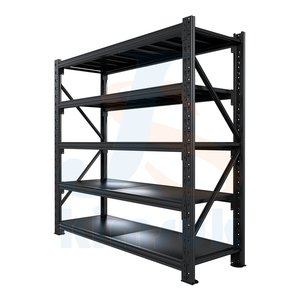
Industrial Warehouse Gravity Flow Pallet Storage Rack
- Capacity: 500 – 1,500 kg / pallet
- Pitch: 3.5% calibrated gravity incline
- Brake: Centrifugal speed retarders
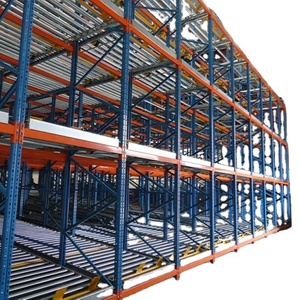
URGO Professional Intensive Storage Flow Roller Pallet Racking
- Steel: High-tensile Q235B cold rolled
- Tracks: Reinforced galvanized rollers
- Separator: Mechanical entry lock device
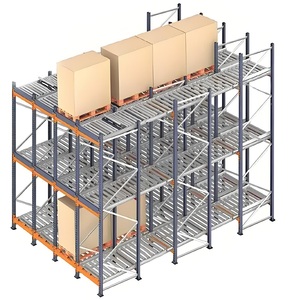
CE Certificated Steel Roller Gravity Pallet Flow Rack System
- Standard: CE No. 2435-CPR-8605159
- Frame: 80–120mm Omega uprights
- Safety: Pallet end-stop buffer plates
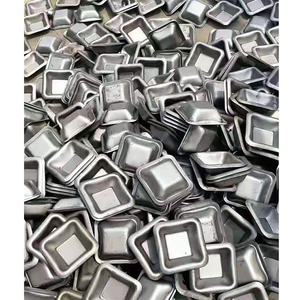
Heavy-Duty Metal Pallet Feet & Detachable Stillage Stacking Racks
- Stacking: 4 to 5 tiers static capacity
- Feet: Die-formed heavy cast steel cup
- Finish: Hot-dip zinc / electrostatic coat
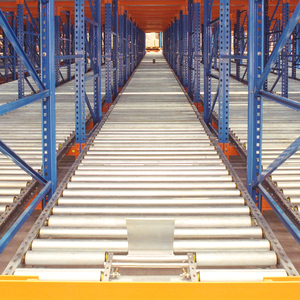
High-Capacity Q235B Phosphorized Gravity Roller Flow Racking
- Treatment: 10-stage acid phosphating
- Coating: Anti-corrosion epoxy powder
- Rollers: Dual-bearing high-load hubs
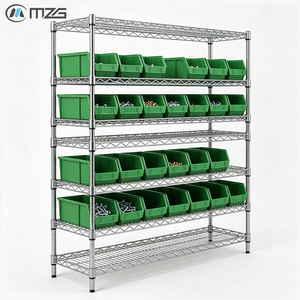
MZG Industrial Electronics Wire Shelving with Plastic Bins
- Adjustment: 25mm increment slots
- Level Load: 150 – 350 kg UDL
- Application: Fast picking & spare parts
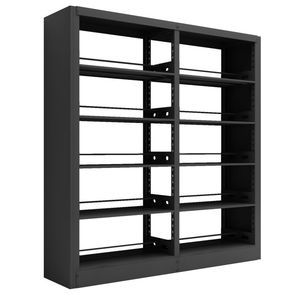
Floor-Standing Modular Storage Rack Units for Bulk Distribution
- Type: Single & double-sided uprights
- Assembly: Boltless interlocking brackets
- Utility: Archives, retail, light logistics
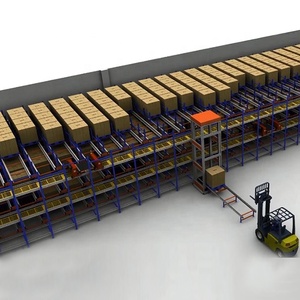
Automatic Radio Shuttle Rack System Heavy Duty Storage
- Modes: Semi-auto FIFO & LIFO logic
- Speed: Up to 1.1 m/s empty traverse
- Power: Fast-charging LiFePO4 pack
Mechanical Kinematics of Dynamic Gravity Pallet Flow Racking Systems
Pallet Flow Racking (commonly categorized as Gravity Flow Racking, Live Storage, or Dynamic Roll Racking) operates as an autonomous, gravity-powered material handling solution. Utilizing sloping roller tracks aligned on a calibrated gradient—typically engineered between 3.5% and 4.5% (approx. 2.0° to 2.6°)—the system converts the potential energy of palletized unit loads into controlled kinetic motion. This ensures strict First-In, First-Out (FIFO) stock rotation, eliminating aisle congestion by structurally segregating the loading (induction) face from the retrieval (picking) face.
In high-density industrial logistics, where facility land costs and cool-store operating expenditures run at historic premiums, Pallet Flow Racking achieves up to 60% greater floor-space utilization compared with standard selective pallet racking. However, the integrity and safe operation of gravity dynamic storage rely on rigorous mechanical engineering calculations that prevent uncontrolled acceleration, dynamic load collision, and line pressure surging at the discharge terminal.
Deceleration & Retardation Physics: Without dynamic retarding mechanisms, a 1,200 kg pallet travelling along a 30-meter lane would accumulate catastrophic kinetic momentum ($E_k = \frac{1}{2}mv^2$). Guangzhou Heda Shelves Co., Ltd. integrates internal centrifugal brake rollers designed to maintain a uniform terminal velocity between 0.25 m/s and 0.30 m/s, irrespective of lane depth.
Dynamic Hydrostatic Pressure Relief: Mechanical Pallet Separators
When multiple unit loads accumulate in an extended gravity lane (e.g., 10 to 20 pallets deep), the combined forward thrust acting on the first pallet at the pick face—termed line hydrostatic back-pressure—can exceed 15 to 25 kN. Under this accumulated force, standard forklift operators are unable to safely lift and extract the lead pallet without causing load snags, friction wear on upright stops, or structural shock to forklift mast bearings.
Heda Shelves engineers and installs positive-locking mechanical pallet separators. When the lead pallet arrives at the picking face, it triggers an mechanical escapement latch that locks all trailing pallets 450 mm behind it. The physical gap absorbs and isolates the line pressure, allowing the forklift operator to extract the target pallet freely. Once the lead pallet is removed, the separator releases, allowing the trailing queue to step forward exactly one position in a controlled, fail-safe cycle.
Centrifugal Brake Rollers
Internally geared planetary brake assemblies expand against the roller shell as angular velocity rises, maintaining self-regulated dynamic deceleration without electrical wiring.
Full-Width vs. Split Rollers
Configured using high-load cylindrical steel rollers with welded labyrinth seals or multi-track poly wheels depending on whether wood, plastic, or metal stillages are conveyed.
Heavy-Duty Impact Buffers
Discharge stops engineered from cold-formed 5mm high-grade carbon steel with elastomer cushions, absorbing repeated impact cycles without column deformation.
Guangzhou Heda Shelves Co., Ltd.: Global Manufacturing Authority
Founded in 2001, Guangzhou Heda Shelves Co., Ltd. has established itself as an engineering-driven leader in heavy-duty warehouse storage and automated intralogistics infrastructure. Operating from our modernized 30,000 m² factory campus in Guangzhou, China, our team of more than 300 certified engineers, CNC technicians, and structural designers delivers over 30,000 tons of precision-engineered racking per month to warehouse operators, system integrators, and racking distributors in more than 130 countries worldwide.
Unlike trading intermediaries, Heda Shelves controls the entire manufacturing chain from steel mill coil slitting to pre-shipment bundle packaging. We supply rigorous third-party accredited solutions backed by CE Certification No. 2435-CPR-8605159, ISO 9001:2015 Quality Management System No. 18624Q00169R0M, and continuous RoHS Compliance testing. For clients operating in seismic zones across Oceania, Southeast Asia, and the Americas, our structural designs reference AS 4084:2023, EN 15512:2020, and RMI MH16.1 design codes, supplying verified moment calculations, upright section modulus documentation, and stamped base-plate anchor configurations.
In-House 10-Step Precision Manufacturing Process
Precision is non-negotiable in dynamic flow systems. If an upright column exhibits pitch deviations or if a gravity roller bed deviates by even 1.5 millimeters across its diagonal, pallets will drift toward the rack frame, causing severe friction binding. Heda Shelves implements a closed-loop, automated ten-step manufacturing protocol:
Raw Steel Assay
Spectral and tensile verification of certified Q235B and Q355B hot-rolled steel strip directly from primary domestic mills.
Precision Slitting
High-speed CNC slitting lines slice continuous steel coils into exact strip widths with ±0.1mm edge tolerance.
CNC Column Punching
Automated punch presses stamp 50mm or 75mm teardrop and diamond pitches with flawless cumulative pitch precision.
Continuous Roll Forming
24-station rolling mills cold-roll open Omega (Ω) profiles with multiple stiffening ribs to maximize section modulus.
Robotic Laser & Welds
6-axis robotic welding cells assemble 3-claw and 4-claw connector beam brackets with complete joint penetration.
Roller Bed Fabrication
Automated assembly of zinc-plated steel roller tubes, spring-loaded hex shafts, and precision grease-packed bearings.
Pickling & Phosphating
Submersion in automated 9-tank chemical baths to strip mill scale, de-rust, and deposit a micro-crystalline zinc-phosphate conversion layer.
Electrostatic Coating
GEMA automated powder spray booths apply 60–80 micron high-durability epoxy-polyester powder cured at 200°C.
Dynamic Load QC
Random sample bay assembly under 1.5× proof load testing to verify deflection limits (L/250) and roller track speed stability.
Biosecure Packing
Bundling on custom steel stillages or ISPM-15 heat-treated skids with heavy corner protectors and moisture-barrier shrink wrap.
Technical System Matrix: High-Density Storage Trade-Off Analysis
Logistics directors and warehouse design consultants must evaluate trade-offs between capital expenditure (CapEx), operational throughput, inventory spoilage risks, and rack maintenance downtime. The table below delineates the comparative engineering parameters between Pallet Flow Racking and other prevalent dense storage configurations:
| Evaluation Parameter | Pallet Flow Racking | Drive-In Racking | Push-Back (Cart Type) | Radio Shuttle Racking |
|---|---|---|---|---|
| Inventory Rotation Logic | Strict FIFO (First-In, First-Out) | LIFO (Last-In, First-Out) | LIFO (Last-In, First-Out) | Both FIFO & LIFO Capable |
| Volume Utilization Ratio | Up to 80% effective density | Up to 75% effective density | Up to 65% (max 5-6 deep) | Up to 85%+ ultra-high density |
| Throughput Productivity | High (Simultaneous Put/Pick) | Low (Forklift drives into rack) | Medium (Forklift stays in aisle) | High (Autonomous shuttle transit) |
| Forklift Rack Strike Risk | Extremely Low (Aisle-only work) | Extremely High (Mast strikes inside) | Low (Aisle-only interaction) | Extremely Low (Aisle-only loading) |
| Power & Battery Dependency | None (100% Gravity Driven) | None (Pure Structural Steel) | None (Mechanical Springs/Carts) | Requires Li-ion charging infrastructure |
| Cold Storage Applicability | Superior (Synthetic roller grease) | Moderate (Challenging drive paths) | Moderate (Cart freeze risks) | High (Cold-rated electronics needed) |
| Total Cost of Ownership (TCO) | Low maintenance, high ROI | High repairs from upright impacts | Medium maintenance on cart tracks | Higher initial CapEx & battery upkeep |
Future Sourcing Trends in Dynamic Pallet Flow Racking (2025–2030)
The global warehousing landscape is experiencing seismic transformations propelled by escalating labor scarcity, high industrial rents, and rigorous ESG carbon disclosure mandates. Procurement executives sourcing industrial pallet racking from China are no longer merely comparing price per kilogram of structural steel; they are evaluating holistic lifecycle engineering. Key market trends reshaping procurement include:
1. Seamless Robotic & AMR/AGV Interfacing at Induction/Discharge
Autonomous Mobile Robots (AMRs) and Automated Guided Vehicles (AGVs) are replacing manually piloted counterbalanced forklifts in tier-1 distribution centers. Because AGV optical and LiDAR navigation systems require millimeter-level positioning tolerances, dynamic flow pick faces must deliver repeatable, stationary pallet presentation. Heda Shelves has pioneered optical-reflector aligned entry funnels, precision centering guide rails, and zero-rebound terminal stops that ensure AMRs can grasp pallets reliably on every single cycle without camera sensor misalignments.
2. Condition-Monitored IoT Smart Roller Beds
As mega-fulfillment hubs operate 24/7/365, unexpected roller bearing seizure can halt an entire picking lane, necessitating complex manual intervention inside dense racking. Next-generation pallet flow lanes are adopting low-power vibration and magnetic thermal sensors embedded within key centrifugal brake assemblies. These telemetry devices transmit bearing drag warnings to the warehouse facility maintenance management system (CMMS) prior to catastrophic mechanical failure.
3. Low-Carbon High-Tensile Steel & Eco-Certified Coatings
International infrastructure projects under European and Oceanic sustainability protocols require audited Environmental Product Declarations (EPDs). Heda Shelves is leading the transition toward micro-alloyed Q355B and high-strength thermo-mechanically rolled steels. By increasing the yield strength from 235 MPa to 355+ MPa, beam and upright profiles achieve equivalent moment resistance with up to a 14% reduction in raw steel mass, slashing cradle-to-gate carbon emissions. Concurrently, our zero-VOC, heavy-metal-free thermosetting powder coating lines meet strict RoHS and REACH directives.
4. Modular Gravity Pick Wings in Multi-Tier Mezzanine Complexes
Modern e-commerce and retail fulfillment hubs are transitioning away from monolithic high-bay silos toward hybrid multi-tier mezzanine layouts. In these installations, upper floors utilize pallet flow dynamic beds feeding split-case carton flow tracks and pick-to-light picking tunnels, maximizing vertical cube density without requiring expensive automated storage and retrieval system (ASRS) crane hardware.
Frequently Asked Questions: Technical Engineering & Export Verification
Technical guidance compiled by Guangzhou Heda Shelves Co., Ltd.'s Senior Engineering Group for warehouse architects, procurement directors, and structural certifiers:
How do you calculate the precise roller track incline angle for varying pallet types?
How are centrifugal brake rollers spaced along long gravity lanes?
Can Heda Shelves pallet flow racking operate reliably inside -30°C cold storage freezers?
What structural data and certification does Heda Shelves provide for local engineering sign-off?
How do you handle biosecurity and timber packaging compliance for Australian and New Zealand customs?
What is the standard production lead time and container packing efficiency?
Request Your Free 3D CAD Warehouse Flow Rack Layout
Share your architectural floor plans, ceiling clear heights, pallet specifications, and throughput targets. Guangzhou Heda Shelves Co., Ltd.'s structural engineers will compute optimal lane inclinations, calculate roller track quantities, and provide a full bill of materials with direct factory-gate pricing.
Send an Inquiry