Featured Industrial Gravity Feed & Pallet Flow Systems
Precision-engineered for distribution centers, cold chain freezers, and intensive fulfillment hubs. Explore our top 8 high-density gravity flow and dynamic structural rack solutions manufactured to global ISO and CE specifications.
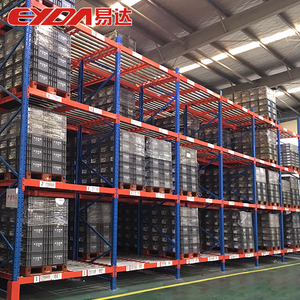
5 Layer Metal Pallet Flow Rack Multi-Level Heavy Duty System
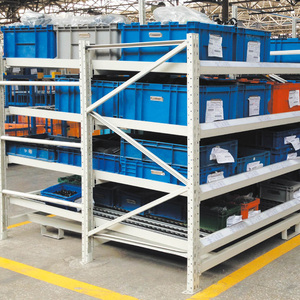
High Density Cold-Rolled Powder Coated Pallet Gravity Rack
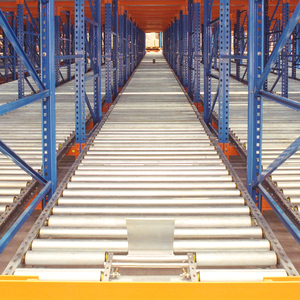
ISO/CE Phosphorized Gravity Roller Pallet Flow System
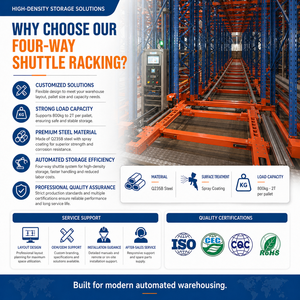
Automated Four-Way Shuttle & Flow Mezzanine ASRS System
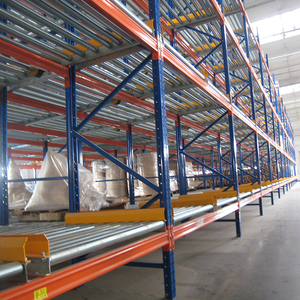
High-Capacity Structural Selective Gravity Pallet Rack
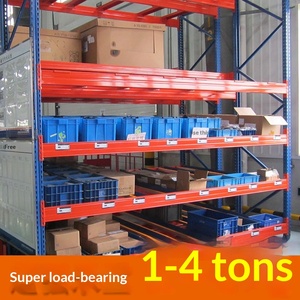
Thickened Large-Scale Custom Heavy-Duty Structural Flow Rack
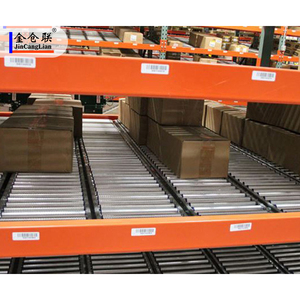
Live Cooler & Deep Freezer Gravity Pallet Flow System
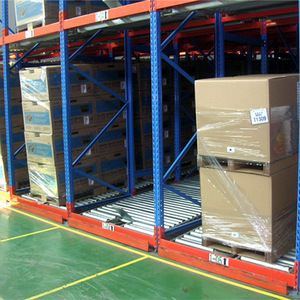
Customizable ESD Heavy Duty Boltless Gravity Pallet Rack
Kinematic Dynamics & Gravity Roller Calibration
Gravity feed pallet racking (commonly classified as live storage or pallet flow racking) is an engineered dynamic storage structure operating on inclined roller tracks. The system harnesses natural gravitational acceleration to transport palletized unit loads automatically from an elevated replenishment charge face (loading side) down to a lower retrieval discharge face (picking side).
Unlike static selective racking or semi-automated drive-in racks, the engineering integrity of a gravity flow lane depends entirely upon precise mechanical equilibrium. Balancing gravitational kinetic force ($F_g = m \cdot g \cdot \sin\theta$) against calculated friction resistances and mechanical deceleration guarantees predictable, controlled pallet velocities between 0.25 m/s and 0.35 m/s, avoiding runaway collisions and impact fatigue on structural uprights.
- Gradient Slope Optimization: Precision-calculated incline typically set between 2.8% to 3.5% (approx. 1.6° to 2.0°) engineered around pallet bottom runners and unit load weights.
- Centrifugal Speed Controllers: Direct internal gear-driven or indirect brake rollers deployed every 1 to 2 pallet depths along the lane to counteract uncontrolled acceleration.
- Mechanical Pallet Separators: Ergonomic automatic trip-stops isolate the lead pallet from backline line pressure ($F_{pressure} = n \cdot m \cdot g \cdot \sin\theta$), preventing binding on forklift forks during extraction.
- Cold-Formed High-Tensile Steel: Fabricated exclusively from certified Q235B and Q355B structural steel to maintain beam deflection under $L/200$ under full seismic test loadings.
High-Density Storage Economics: FIFO vs. Alternative Racking
Floor footprint real estate is often the single highest recurring operating cost in global logistics. Examine how Gravity Feed Pallet Flow systems dramatically minimize travel aisles, consolidate cubic storage space, and accelerate throughput compared with conventional storage topologies.
| Storage System Type | Stock Rotation Strategy | Floor Space Utilization (%) | Forklift Travel Distance | Throughput Pallets/Hr | Cold Store Energy Efficiency |
|---|---|---|---|---|---|
| Gravity Feed (Pallet Flow) | Strict FIFO (100%) | 80% - 90% (Ultra High) | Reduced by 40% - 60% | High (Continuous) | Maximized (Smallest Cube) |
| Standard Selective Racking | Configurable (FIFO/LIFO) | 35% - 45% (Low Density) | Baseline Travel (100%) | Moderate (Single Pallet) | Low (Large Heated/Cooled Airspace) |
| Drive-In Racking | LIFO Only | 65% - 75% (High) | High (Tractor in Aisle) | Slow (Deep Maneuvering) | Moderate |
| Push-Back (Cart Type) | LIFO Only | 60% - 70% (Medium) | Moderate (Front Access) | Moderate (2-6 deep max) | Moderate |
| Radio Shuttle Racking | FIFO or LIFO | 80% - 88% (High) | Low (Aisle Face Only) | High (Battery Dependent) | High |
Absolute FIFO Compliance
For temperature-controlled perishables, pharmaceuticals, dairy, and FMCG goods with firm expiration dates, pallet flow guarantees that initial loaded stock is inevitably first out. Eliminates human stock-rotation errors and pallet expiration write-offs.
Segregated Traffic Channels
Separation of charge and discharge aisles completely uncouples forklift loading activities from order-picking machinery. Operators load trucks and replenish stock simultaneously without aisle congestion, mitigating pedestrian and forklift collisions.
Substantial Cold Chain ROI
Operating an industrial deep-freeze warehouse (-18°C to -30°C) requires exorbitant power consumption per cubic meter. By concentrating thousands of pallet positions into an unbroken block, gravity racking reduces refrigeration overhead by up to 30%.
Engineering Leadership & Direct Manufacturing Excellence
Established in 2001, Guangzhou Heda Shelves Co., Ltd. has grown from a specialized cold-rolled steel fabricator into a world-renowned intralogistics manufacturer, deploying turnkey racking systems across Oceania, Europe, the Americas, and Southeast Asia.
Stringent Quality & CE/ISO Registrations
Fully registered with CE Certification No. 2435-CPR-8605159 and ISO 9001:2015 Quality Management System No. 18624Q00169R0M. Complete steel material mill test certificates (MTC) and non-destructive weld testing reports accompany every export container.
Automated 10-Stage Precision Production
In-house continuous roll-forming lines, automated CNC upright perforation punches, robotic seam welding, multi-stage acid pickling & phosphating, and electrostatic powder coating assure flawless finish adhesion and ultra-tight tolerances under 0.5mm.
Oceania & Global Seismic Engineering
Custom engineering calculated according to Australian Standard AS 4084 (Steel Storage Racking) and NZS 1170.5 seismic regulations. We supply full finite-element calculations, structural section properties, and certified load capacity signage directly for building certifiers.
Future Procurement Trends in Gravity Pallet Flow Racking
As warehouse operations embrace autonomous mobile robots, real-time inventory telematics, and stringent ESG decarbonization mandates, the engineering of gravity feed storage systems is evolving rapidly. Review the major technological shifts shaping global racking tenders through 2030.
1. Autonomous Robot (AGV/AMR) Interface Stations
Traditional gravity feed systems were configured primarily for human-operated counterbalanced and reach forklifts. Modern fulfillment architectures increasingly specify optical and mechanical entry alignment guides for Automated Guided Vehicles (AGVs) and autonomous stackers. Precision tolerances at pick faces have tightened from ±10mm to ±2mm to permit robotic vision-guided fork engagement without snagging pallet runners.
2. Contactless Magnetic Eddy-Current Braking
Mechanical internal gear friction brakes suffer gradual wear, oil seal deterioration, and thermal degradation in ultra-cold freezer environments. Next-generation gravity flow lanes are adopting frictionless magnetic eddy-current brake rollers. These solid-state speed governors generate braking resistance proportional to pallet velocity through electromagnetic induction without physical contact, achieving maintenance-free life cycles exceeding 10 years.
3. Modular Universal Bed Assemblies
Procurement contracts now heavily prioritize operational flexibility over rigid single-purpose designs. Modern roller beds feature snap-in modular tracks with variable wheel spacing. This allows distribution centers to alternate freely between Australian standard pallets (1165 × 1165 mm), Euro pallets (800 × 1200 mm), and American GMA pallets (40 × 48 in) simply by reconfiguring roller channels on site without structural cutting or beam re-welding.
4. Dynamic Seismic Damping Stop Brakes
Regions along the Pacific Rim—notably New Zealand, Japan, and Western North America—face stringent building code updates for seismic ground acceleration (NZS 1170.5, IBC 2024). Traditional rigid end-stops risk shearing anchor bolts when subjected to resonant kinetic surges of multiple stored pallets. Modern systems employ spring-damped hydraulic impact isolators at discharge positions to dissipate kinetic shock waves smoothly.
5. IoT Ultrasonic Flow & Jam Telematics
In high-bay deep flow tunnels exceeding 15 pallets in length, visually verifying whether pallets have hung up due to broken bottom boards can be difficult. Procurement teams are incorporating self-powered solar or battery ultrasonic lane sensors. These devices detect stagnant pallets, monitor descent speeds, and feed real-time visual alerts into the Warehouse Management System (WMS) to prevent blind charge-loading against blocked channels.
6. Low-Carbon Green Steel & Eco Coatings
Global multinational enterprise clients are bound by Scope 3 greenhouse gas reporting. Procurement specifications now stipulate certified low-carbon recycled scrap content (Electric Arc Furnace - EAF steel) along with heavy-metal-free, low-VOC TGIC-free polyester powder coatings. Long-term corrosion resistance is augmented by eco-friendly ZAM (Zinc-Aluminum-Magnesium) alloy coatings providing 3x the galvanic lifespan of standard hot-dip galvanizing.
Frequently Asked Technical & Procurement Questions
Clear, objective answers addressing structural engineering, pallet suitability, biosecurity customs protocols, import duties, and commissioning logistics for international warehouse buyers.
Ready to Design Your High-Density Gravity Racking System?
Provide our structural team with your warehouse layout (CAD/PDF), clear internal building heights, pallet specifications (length, width, height, gross weight), and forklift parameters. Our senior intralogistics engineers will return a complete 3D spatial layout, load analysis, and competitive factory-direct wholesale pricing within 24 hours.