Dynamic FIFO
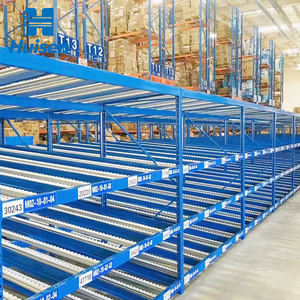
Automated Adjustable Heavy Duty High Density Gravity Roller Flow Rack System
FIFO Flow
Speed Controllers
Up to 1,500kg/Pallet
Precision-formed roll profiles fabricated from high-tensile structural steel (Q235B / Q355B). Built for maximum payload capacity, dynamic throughput speed, and zero wasted vertical airspace.
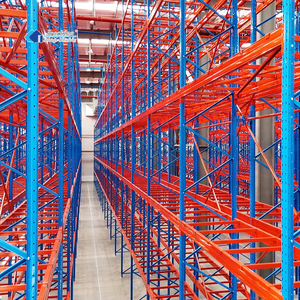
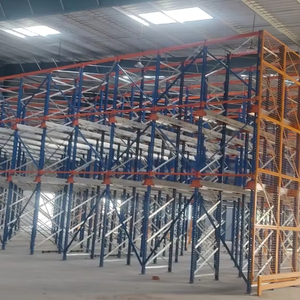
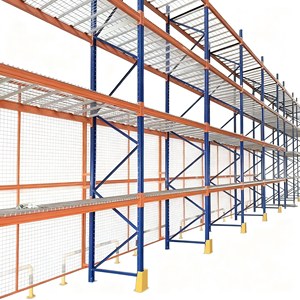
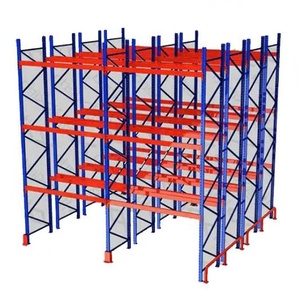
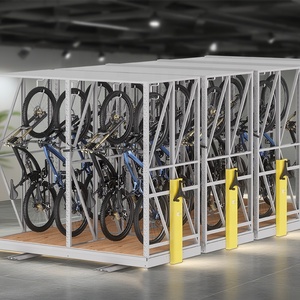
Industrial warehouse development in 2026 and beyond faces an unforgiving macroeconomic equation: escalating urban land acquisition costs, soaring commercial energy tariffs, and the compression of delivery SLAs. Traditional selective pallet racking, while offering unrestricted SKU access, suffers from a fatal physical flaw: between 55% and 65% of the total warehouse floor footprint is consumed by non-revenue operating aisles required for forklift articulation.
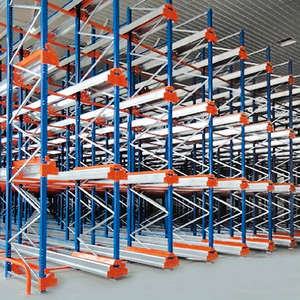
As a premier China OEM/ODM high density racking manufacturer, Guangzhou Heda Shelves Co., Ltd. re-engineers floor geometry into volumetric storage. High-density racking architectures—specifically Radio Shuttle Racking, Drive-In/Drive-Through, Gravity Flow, and Push-Back configurations—eliminate dedicated internal access aisles. By converting travel space into continuous multi-deep storage lanes, warehouse operators achieve a 60% to 85% reduction in dedicated aisle cubic footage, practically doubling or tripling total pallet position density within identical exterior building envelopes.
Engineering Metric: Transitioning a 5,000 m² distribution center from standard selective racking to an automated Radio Shuttle high-density array increases unit holding capacity from approximately 4,200 pallet positions to over 9,800 positions while lowering per-pallet energy consumption by up to 48% in refrigerated applications.
Structural integrity within deep-lane storage systems requires elevated metallurgical control. Unlike low-density shelving, multi-tier compact systems subject upright columns and beam connectors to cumulative harmonic vibrations, torsional loading from high-bay forklift operations, and intense point-load transfers.
Heda Shelves utilizes certified Q235B and Q355B hot-rolled structural coil steel (conforming to EN 10025-2 and ASTM A36/A572 equivalents). Our cold-roll-forming profiles feature computerized punching pitches (50mm, 75mm, and 76.2mm) with multi-bend omega (Ω) cross-sections. This geometric stiffening ensures superior moment resistance against horizontal cross-aisle drift and satisfies the demanding safety criteria established by AS 4084:2023 (Australia), FEM 10.2.02 (Europe), and ANSI/RMI MH16.1 (United States).
Every load-bearing component undergoes Finite Element Method (FEM) computer simulation prior to roll-forming, confirming that frame deflection limits remain strictly within $L/200$ under full structural payload rating.
Quantitative assessment of high-density storage technologies for global supply chain procurement teams.
| Storage System Type | Space Utilization | Selectivity Level | Inventory Rotation | Forklift Travel Time | Optimal Industry Application |
|---|---|---|---|---|---|
| Radio Shuttle System | Extreme (85%+) | Lane Dependent | LIFO or FIFO Automated | Minimal (High Velocity) | Cold Storage, FMCG, Beverage, 3PL Buffering |
| Gravity Pallet Flow | Ultra-High (80%) | Per Lane Pick Face | Strict FIFO (Gravity) | Reduced (Dedicated Faces) | Perishables, Pharmaceuticals, Food Processing |
| Drive-In / Drive-Through | High (70-75%) | Low (Per Lane) | LIFO (Drive-In) / FIFO | Moderate (Internal Aisle) | Raw Materials, High Volume / Low SKU Batches |
| Push-Back Cart Racking | Medium-High (70%) | Moderate (Per Level) | LIFO (2–6 Deep) | Low (Single Aisle Pick) | Medium SKU Velocity, Staging Buffers |
| Standard Selective Rack | Low (40-45%) | 100% Direct Access | Any (Unrestricted) | High (Wide Travel Grid) | E-Commerce Fulfilment, Retail Distribution |
Procurement leaders are navigating structural industry transformations. As autonomous materials handling converges with cold chain resilience, sourcing criteria are shifting beyond initial steel unit price toward lifetime engineering ROI.
Autonomous mobile robots (AMRs) and automated guided vehicles (AGVs) demand extreme dimensional precision. Future high-density racking projects require tighter beam deflection parameters and laser-leveled rail tolerances within ±1.5mm across entire runs to accommodate robotic optical centering.
Global warehouse EPC contractors and tier-1 3PLs are bypassing local trading middlemen. By sourcing directly from large-scale Chinese manufacturing plants with in-house structural engineering teams, procurement directors capture a 25% to 42% reduction in capital expenditure (CAPEX).
Refrigeration costs account for up to 65% of cold storage operational expense. High-density shuttle and mobile systems minimize refrigerated cubic footage per pallet, directly compressing daily kilowatt-hour demand and mitigating thermal losses through smaller building envelopes.
Scope 3 carbon reporting is becoming mandatory for international logistics firms. Procurement tenders now prioritize racking factories that employ recyclable structural steel coils and zero-VOC heavy-metal-free electrostatic powder coating lines with low thermal curing cycles.
Standard static calculation methods are being phased out in favor of dynamic non-linear pushover seismic modeling. Racking designs for New Zealand (NZS 1170.5), the US West Coast (ASCE 7), and Japan feature energy-dissipating ductile baseplates and high-strength back-to-back bracing trusses.
To address the rapid rise of omnichannel micro-fulfillment, facilities are integrating multi-tier rack-supported mezzanine floors directly with high-density ground pallet tracks, allowing bulk deep storage below and fast multi-level carton pick shelves above.
Founded in 2001, Guangzhou Heda Shelves Co., Ltd. operates state-of-the-art roll-forming lines, automated punching centers, and robotics welding cells. Our 30,000 tons/month output powers warehouse projects across Oceania, the Americas, Europe, and Southeast Asia.
Our in-house design engineering department of over 300 specialists utilizes AutoCAD, SolidWorks, and proprietary structural FEA software to provide custom warehouse layout schematics within 24 hours. From evaluating floor slab deflection capacities to verifying reach-truck turning radius clearance (AST) and rack flue dimensions, we ensure zero installation friction at job sites.
Ocean freight shipping requires meticulous nesting to optimize container volume without causing profile damage. Uprights, box beams, and shuttle guide rails are color-coded, bundled on heavy-duty custom steel skids, and wrapped with waterproof multi-layer stretch film and corner guards.
Shipments include full commercial documentation: Mill Test Certificates (MTC), Bill of Lading, Certificate of Origin (supporting FTA preferential tariffs like ChAFTA and NZ-China FTA), and detailed component erection drawings with corresponding numbered bolt tags.
Spectrographic analysis & tensile yield testing of incoming Q235B/Q355B steel coils.
Automated uncoiling and high-speed rotary slitting to strip width tolerances within ±0.1mm.
Continuous hydraulic CNC punch press guaranteeing uniform hole pitch across 12-meter single uprights.
18 to 24 progressive roll-forming stations shaping proprietary omega upright profiles.
Robotic dual-wire submerged arc welding joining twin C-sections into heavy-load interlocking box beams.
Mechanical surface scale removal and de-burring achieving Sa 2.5 cleanliness standard.
9-stage acid pickling, pre-degreasing, and zinc phosphating for long-term anti-rust chemical adhesion.
Automated Swiss Gema electrostatic spray booths applying 60–90μm durable thermoset epoxy powder.
200°C curing tunnel followed by cross-hatch paint adhesion tests and dimensional caliper verification.
Steel-banded stillage crating, biosecurity compliance inspection, and export container loading.
Critical technical, engineering, and regulatory insights addressing the primary due diligence questions posed by international supply chain directors and structural engineers.
Our structural engineering department designs all pallet racking systems strictly utilizing the limit-state calculation principles set out in Australian Standard AS 4084:2023 (Steel Storage Racking), European Standard EN 15512 (FEM 10.2.02), and American RMI MH16.1.
Before fabrication, we furnish comprehensive structural calculation packages detailing upright section modulus, polar moment of inertia, frame stability, and connector shear strengths. These packages allow your local registered structural engineer (or Building Certifier) to independently perform site certification and approve building permits. Standardized safe working load plaques and load warning signs matching national statutory regulations are supplied with every order.
We source raw structural steel coils exclusively from premier domestic state steel producers (such as Baosteel, Shougang, and Ansteel). Primary uprights and critical load-bearing members are manufactured using high-yield Q355B steel (minimum yield strength of 355 MPa, tensile strength up to 510 MPa, comparable to European S355 and ASTM Grade 50). Secondary members, footplates, and spacers utilize certified Q235B steel.
Genuine EN 10204 Type 3.1 Mill Test Certificates are attached to every production heat number, documenting exact chemical composition (carbon, manganese, phosphorus, sulfur) and mechanical elongation/yield parameters.
For projects in high seismic regions (such as New Zealand under NZS 1170.5 or the Western USA under ASCE 7 / IBC), static weight analysis is insufficient. We perform dynamic Response Spectrum Analysis (RSA) based on the specific ground acceleration coefficients ($C_h(T)$) of your facility's postal district.
To resist lateral and longitudinal seismic drift, we engineer:
Biosecurity rejections cause catastrophic customs holding fees and demurrage. Heda Shelves eliminates this operational risk at the packing origin. Our factory utilizes 100% certified ISPM-15 compliant heat-treated wood skids (stamped with official IPPC markings) or, preferably, all-steel welded transport stillages.
Steel stillages entirely eliminate timber quarantine protocols at destination ports like Sydney, Melbourne, Auckland, Long Beach, and Rotterdam. Shipping containers are thoroughly swept, clean-air cleared, and desiccant packs are placed throughout to prevent mold formation during humid equatorial sea transit.
Standard production cycles for typical high-density warehousing projects (5 to 20 forty-foot high-cube containers) require approximately 20 to 28 calendar days from finalized 3D CAD approval.
Transit lead times from our Guangzhou / Nansha or Shenzhen ports to major global destinations typically average:
Yes. Guangzhou Heda Shelves Co., Ltd. serves as an OEM/ODM manufacturing backbone for dozens of prominent material handling equipment dealers worldwide. We provide custom tool profiling for proprietary beam connectors, match corporate RAL color powder codes, and laser-cut your brand's trademark into safety upright protectors, row spacers, and packaging labels. Complete confidentiality agreements (NDAs) are routinely executed.
To produce an accurate structural design proposal and competitive pricing estimate within 24 hours, our engineering department requires:
Connect directly with our senior intralogistics structural engineering team in Guangzhou. Receive a preliminary 3D warehouse layout, detailed load table, and factory FOB/CIF price quotation within 24 hours.
Direct communication with certified structural engineers.
Send an Inquiry