High-Density FIFO & Heavy-Duty Warehouse Storage Range
Engineered to optimize volumetric cube utilization, accelerate inventory throughput, and safeguard perishable stock rotation. Built from high-tensile Q235B and Q355B structural steel under strict international racking design codes.
1. Mechanical Architecture of FIFO Pallet Racking Systems
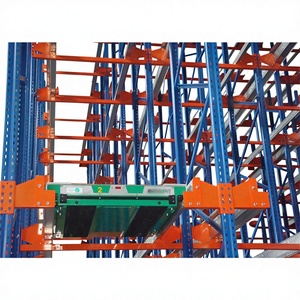
In contemporary high-velocity supply chain hubs, the First-In, First-Out (FIFO) material handling methodology is an operational prerequisite for eliminating product obsolescence, enforcing strict lot and batch control, and complying with global regulatory mandates (including FDA 21 CFR Part 11, European Good Distribution Practice, and Australian TGA requirements). While traditional static selective pallet racking demands extensive forklift access aisles—consuming up to 60% of total facility floor area—engineered FIFO systems employ dynamic gravity roller beds or automated deep-lane radio shuttle carriers to condense storage density while guaranteeing pure stock rotation.
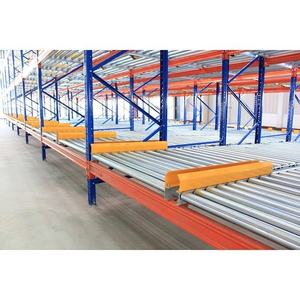
Dynamic pallet flow systems (also referred to as gravity flow racking) operate on an engineered inclined roller track, typically configured between a 3.0% and 3.5% downward slope (1.7° to 2.0°). Pallets are inducted at the elevated loading charge face and roll by natural gravitational force toward the discharge picking face at a strictly controlled terminal velocity. The core engineering complexity of heavy-duty gravity flow racking resides in dynamic braking mechanics: uninhibited gravitational acceleration of a 1,200 kg unit load across a 20-pallet-deep lane generates immense kinetic momentum that would cause catastrophic impact damage at the picking face without mechanical dissipation.
Furthermore, custom OEM FIFO pallet racking manufactured by Guangzhou Heda Shelves Co., Ltd. incorporates heavy-duty load separators (pallet extractors) positioned at the discharge terminal. When a forklift operator extracts the leading pallet from the pick face, the separator mechanism mechanically holds back the second and trailing pallets in the lane. Only after the leading pallet clears the discharge point does the separator release the line, preventing the cumulative static back-pressure of 15–25 trailing pallets from binding against the front pallet or crushing the forklift mast during extraction.
Centrifugal Speed Regulation
HEDA's gravity flow beds feature dynamically balanced centrifugal brake rollers with internal dampening fluids that automatically modulate braking torque relative to pallet velocity, maintaining constant transit stability across thermal ranges from -30°C to +45°C.
Zero-Backpressure Extraction
Equipped with integrated mechanical treadle separators that isolate the lead pallet by 300mm to 450mm from the queue, allowing clean forklift extraction without load pinching, mast friction, or pallet runner delamination.
Q355B Structural Omega Columns
Roll-formed from certified high-strength structural grade steel, our vertical upright columns exhibit superior yield strength (>355 MPa) and torsional rigidity, engineered to withstand continuous dynamic vibration and side-thrust impact.
FIFO vs LIFO Storage Technologies: Comprehensive Comparison
Selecting the correct high-density racking topology requires balancing stock rotation requirements, floor area utilization, capital expenditure per pallet position, and forklift operating cycle times.
| System Architecture | Rotation Logic | Space Utilization | Throughput Velocity | Forklift Interaction | Lane Depth Limit | Suitability Level |
|---|---|---|---|---|---|---|
| Gravity Pallet Flow | Strict FIFO (100%) | Up to 85% volumetric density | Extremely Fast (Continuous pick) | Separated Charge & Pick aisles | 2 to 25+ Pallets deep | High-throughput perishables, FMCG |
| Radio Shuttle Pallet Rack | Dual FIFO / LIFO | Up to 90% volumetric density | High (Automated carrier travel) | Aisle-face loading/unloading | Up to 40+ Pallets deep | Cold storage, mega distribution hubs |
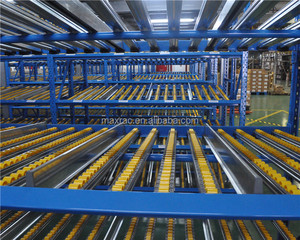
| Carton Flow Shelving | Strict FIFO (100%) | High SKU pick-face density | Maximum manual picking speed | Dedicated replenishment aisle | 1.5m to 3.5m Track depth | E-commerce split-case, pharma picking |
| Push-Back Racking | LIFO Only | Up to 75% volumetric density | Moderate (Forklift pushing required) | Single operating aisle | 2 to 6 Pallets deep | Medium rotation non-perishables |
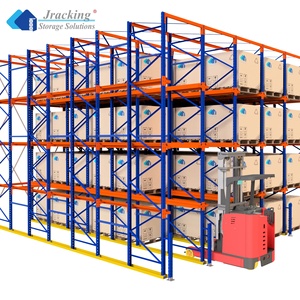
| Drive-In Racking | LIFO Only | Up to 70% volumetric density | Slow (Mast entry inside racking) | High forklift impact exposure | 4 to 12 Pallets deep | Single-SKU batch processing, low turnover |
| Standard Selective Racking | Any (Manual FIFO) | Low (35% to 45% floor area) | High selectivity, low density | Wide operating aisles (3.2m+) | 1 to 2 Pallets deep | Low-density multi-SKU retail inventory |
2. Strategic Sourcing & Procurement Trends (2025–2030)
Procurement directors and supply chain engineers evaluating intralogistics infrastructure are navigating a profound structural shift driven by e-commerce parcel volume surges, escalating cold-chain operating power costs, and severe warehouse labor shortages across Australia, North America, and Western Europe. Over the coming 2025–2030 procurement cycle, five transformative trends will dictate the design and specification of industrial FIFO racking systems:
1. Convergence with Autonomous Mobile Robots (AMRs) and AGVs: The traditional boundary between passive steel racking and mobile robotics has dissolved. Modern FIFO layouts are engineered from the outset with reinforced floor tracks, optical sensor mounts, and high-precision entry guide chamfers specifically designed to interface with counterbalanced AGVs and automated reach trucks. HEDA Shelves engineers custom entry guides with tolerances held within ±1.5 mm, ensuring automated AGV forks seamlessly acquire pallet skids without structural impact.
2. Decarbonization and Refrigeration Thermal Efficiency: In refrigerated and blast-freezer warehouses (holding temperatures between -20°C and -30°C), cooling an empty cubic meter of air costs up to four times more than ambient facility cooling. Consequently, high-density FIFO pallet systems that reduce aisle volume by 55% directly decrease cooling power consumption. Leading cold storage 3PL operators are standardizing on deep-lane Radio Shuttle FIFO arrays that double facility pallet storage capacity within existing thermal building envelopes, eliminating the need for multi-million-dollar real estate expansions.
3. Advanced Metallurgy & Cold-Roll Profiling Precision: The volatility of raw hot-rolled coil (HRC) commodities has reinforced the requirement for high-strength steel grades such as Q355B (equivalent to ASTM A572 Grade 50 and European S355JR). By utilizing advanced roll-forming technology with multi-stage cold bending passes, HEDA produces thinner yet mechanically superior upright profiles that achieve equal or greater load resistance while cutting total dead-weight steel consumption by 12–18%, significantly lowering international ocean freight expenses.
4. Modular Scalability and Retrofittable Componentry: Sourcing managers are increasingly avoiding rigid, proprietary warehouse automation systems that become obsolete within 7–10 years. Instead, procurement strategies favor modular OEM steel structures that can transition seamlessly from manual gravity roller operation to semi-automated radio shuttle lanes or fully automated Crane AS/RS interfaces with minimal structural rework.
Why Global Importers Partner with HEDA Shelves
Established in 2001, Guangzhou Heda Shelves Co., Ltd. operates as an engineering-driven primary manufacturer, combining certified structural design with high-capacity robotic fabrication.
Verified Structural Certifications
All racking profiles are backed by third-party testing and verified credentials: CE Certification No. 2435-CPR-8605159, ISO 9001:2015 No. 18624Q00169R0M, and RoHS adherence. Structural calculation dossiers comply with AS 4084-2023, FEM 10.2.02, and RMI MH16.1.
Turnkey 3D CAD & Load Verification
Our internal design team of 30+ licensed structural engineers provides comprehensive warehouse spatial layouts, 3D CAD modeling, clearance analysis, and localized seismic calculation reports within 24 hours of receiving site drawings.
Biosecurity & Heavy Export Packaging
To prevent port clearance delays and customs fumigation quarantine, shipments to Australia (DAFF), New Zealand (MPI), and North America are bundled on all-steel stillages or certified ISPM-15 heat-treated wood with full export documentation.
HEDA's 10-Step Precision Quality Control & Fabrication Process
Every structural beam, upright column, roller rail, and pallet cart passes through an automated 10-stage fabrication workflow within our 30,000 m² facility:
Step 1: Raw Material Spectroscopy & Tensile Testing: Certified Baosteel and Shougang Q235B/Q355B coils verified for chemical composition and yield limits.
Step 2: CNC Multi-Axis Steel Slitting: High-precision continuous coil uncoiling and precision slit-edge trimming.
Step 3: Automated CNC Column Punching: Pitch accuracy held within ±0.1 mm on 50mm and 75mm teardrop/diamond holes.
Step 4: Continuous Multi-Pass Cold Roll-Forming: Upright profiles formed across up to 24 rolling passes to eradicate internal residual stress.
Step 5: Profile Roll Calibrating & Plasma Cutting: Exact cut-to-length tolerances held within ±0.5 mm for vertical alignment.
Step 6: High-Frequency Robotic Welding: Automated robotic welding stations fusing box beam end connectors with deep weld penetration.
Step 7: Mechanical Shot Blasting & Surface Polishing: Removal of mill scale, rust, and surface grease to Sa 2.5 cleanliness standards.
Step 8: 9-Stage Pickling & Zirconium Silane Pre-Treatment: Environmentally compliant nano-conversion chemical coating for exceptional paint adhesion.
Step 9: Automated Electrostatic Thermoset Powder Coating: Swiss GEMA powder application curing at 200°C for high impact and scratch durability (film thickness 70–90 µm).
Step 10: Final Dimensional Audit, Pallet Load Testing & Ocean Bundling: Batch load testing under destructive hydraulic press rigs before steel-banded bundle packaging.
Frequently Asked Questions (Technical & Sourcing FAQ)
In-depth technical answers addressing structural engineering, safety redundancy, seismic mitigation, and international standards for FIFO warehouse racking.
How do you calibrate gravity roller track slope and brake spacing for non-standard or varying wooden and plastic pallets?
What structural engineering measures are required for high-density FIFO racking in seismic regions (e.g., New Zealand NZS 1170.5 or US UBC Zones)?
How do extreme cold storage environments (-20°C to -30°C) impact roller bearings, steel ductility, and lubricant performance?
How does HEDA guarantee compliance with AS 4084, EN 15512, and US RMI standards for overseas engineering sign-off?
What fail-safe mechanisms prevent pallet runaway or jamming inside deep-lane FIFO gravity flow channels?
What are the standard production lead times, shipping transit schedules, and containerization packing methods?
Plan Your High-Density FIFO Warehouse System Today
Submit your warehouse layout, clear ceiling heights, and pallet payload parameters. Our senior structural engineers will prepare an optimized 3D CAD proposal, load capacity calculations, and factory-direct pricing within 24 hours.