[email protected] Supplying Australia, New Zealand & the Pacific Islands
ISO 9001:2015 & CE Certified Manufacturer Since 2001

OEM/ODM Big Industrial Racking Manufacturer & Suppliers

Global Heavy-Duty Pallet Racking, Multi-Tier Mezzanine Engineering & High-Density Intralogistics Storage Systems Direct From Our 30,000 m² Facility.

30,000m²
Advanced Production Facility Area
25+ Yrs
Structural Engineering Expertise (Est. 2001)
30,000T/Mo
Certified High-Tensile Monthly Output
300+
Metallurgists, CAD Designers & Riggers
Engineered Product Portfolio

Industrial Heavy-Duty Racking & Warehouse Steel Structures

Direct factory-manufactured industrial storage installations custom engineered for high-density logistics, palletized automated handling, and extreme structural load tolerances.

Manufacturing Authority & Quality Systems

Why Global Supply Chains Rely on HEDA Industrial Racking

With over two decades of dedicated steel fabrication excellence, our engineering infrastructure eliminates supply chain friction, verifies structural calculations, and ensures compliance with cross-border safety standards.

Certified Structural Engineering

All designs reference Australian AS 4084-2023, European EN 15512 (FEM 10.2.02), and American RMI ANSI MH16.1. We supply stamped section properties, static load tables, frame deflection formulas, and FEA finite-element simulations for seamless local council and insurer sign-offs.

Primary Steel Grade Metallurgical Rigor

We exclusively source certified prime coil stock from Baosteel and Shougang (Q235B, Q355B, and S355JR structural steels). Complete mill test certificates (MTC) confirm exact yield strength, ultimate tensile modulus, and elongation properties before coil roll-forming begins.

Export Phytosanitary & Biosecurity

Engineered bundles are packed onto heavy steel stillages or ISPM-15 heat-treated dunnage, eliminating costly DAFF (Australia), MPI (New Zealand), or USDA biosecurity quarantine hold-ups. We provide packing cube optimization to fit up to 26 metric tons into each 40HQ container.

Quality Assurance Lifecycle

10-Stage Precision Heavy Racking Manufacturing Process

Step 01
Spectrometry QC

Chemical and tensile coil metallurgical verification prior to feeding.

Step 02
Precision Slitting

CNC rotary shears split wide coils to strip tolerances under ±0.15mm.

Step 03
Continuous Punch

High-speed hydraulic press punches pitch patterns (50mm/75mm/76.2mm).

Step 04
Cold Roll-Forming

24 to 28-station sequential roll stands shape high-stiffness omega profiles.

Step 05
Box Beam Seaming

Interlocking dual C-channels twin-roll formed into ultra-rigid closed box beams.

Step 06
Robotic Welds

Automated Panasonic robotic arms weld multi-claw beam connector plates.

Step 07
Pre-Treatment

Multi-tank immersion: alkaline degrease, pickling, and zinc phosphating.

Step 08
Electrostatic Coat

Automated Swiss Gema powder line deposits 60-80μm durable epoxy-polyester.

Step 09
200°C Curing Oven

Precision temperature zones ensure molecular crosslinking and impact finish.

Step 10
Packaging & Stillage

Corner-cushioned steel strapping and palletized container stowage systems.

Procurement Intelligence

Emerging Trends Shaping B2B Industrial Racking Procurement

Strategic warehouse investments are shifting from raw steel tonnage pricing toward life-cycle agility, robotic automation readiness, and resilient carbon-transparent supply networks.

Automation Synergy

Migration to Automation-Ready Infrastructure

Tier-1 logistics operators are demanding that standard selective and drive-in racks incorporate precision tolerances capable of retrofitting AMR (Autonomous Mobile Robot) under-runners, 4-way pallet shuttles, or automated crane pickers without structural replacement.

Buyer Strategy: Procure upright frames with standardized hole arrays, reinforced bottom-level guide rails, and minimum deflection box beams.
Climate & Resiliency

Seismic-Dynamic Load Engineering (AS 4084 / NZS 1170.5)

Seismic compliance is no longer localized to active rift zones. Insurers now mandate dynamic acceleration testing (P-Delta effects, ductility classes, and cyclic joint fatigue analysis) to protect expensive inventory, sprinkler lines, and life safety during minor building settling.

Buyer Strategy: Demand verified non-linear FEA static and dynamic load simulations with certified anchor shear safety factors exceeding 2.0.
Total Lifecycle TCO

Modular Demountability & Circular Asset Resale

Given fluctuating leasing environments, enterprise warehouse tenants avoid welded site fixtures. Modern procurement prioritizes boltless, bolt-adjustable beam-to-frame connections and structural mezzanines that can be disassembled, transported, and recertified in new premises.

Buyer Strategy: Standardize on globally recognized pitch profiles (such as 76.2mm or 50mm) to protect second-hand residual value and expansion ease.
R&D & Tech Roadmap

Next-Generation Industrial Racking Engineering Trends

How structural metallurgy, robotic material handling integration, and sensor-driven structural monitoring are redefining warehouse heavy storage.

High-Yield Micro-Alloy Steel

Transition from standard Q235 carbon steel to Q355B and S355 high-strength micro-alloy coils treated with vanadium and niobium. Thinner wall profiles achieve 25% higher structural yield strength with 15% reduced deadweight, directly lowering ocean freight costs per pallet position.

4-Way Shuttle High-Bay Density

Replacing conventional drive-in lanes with multi-level autonomous 4-way radio shuttles that traverse along X and Y axes on precision cold-rolled rails. Eliminates forklift impact in storage flues while boosting cube density by up to 85% compared to wide-aisle configurations.

IoT Structural Health Monitoring

Integration of low-power wireless strain-gauge sensors and tri-axial impact accelerometers mounted directly to aisle-end base uprights. Transmits instant overload warnings, out-of-plumb deflections, and collision alerts directly to warehouse management dashboards.

Cryogenic Cold-Chain Coatings

Specialized zinc-rich silane primers combined with elastomeric thermoset powder formulas designed to withstand blast-freezer thermal shock down to -35°C without micro-cracking, flaking, or zinc embrittlement in food-contact cold stores.

System Selection Guide

Industrial Racking Systems Engineering Comparison

Evaluate critical trade-offs between storage floor density, operational throughput, forklift aisle requirements, and initial capital investment parameters.

Racking Architecture Pallet Selectivity Floor Space Utilization Stock Rotation Logic Aisle Width Req. Max Load / Level Typical Applications
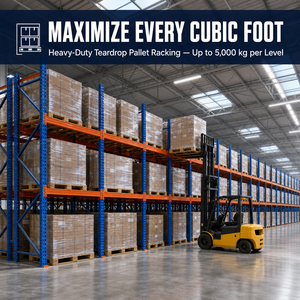
Selective Pallet Racking 100% Direct Access 40% – 50% FIFO / LIFO Flexible 3.0m – 3.8m (Standard) 1,000kg – 4,500kg FMCG, 3PL Distribution, Omnichannel Retail
Double-Deep Pallet Rack 50% Semi-Selective 60% – 65% LIFO Operational 3.0m – 3.4m (Pantograph) 1,000kg – 3,000kg Dry Goods, Reserve Pallet Buffers, Packaging
Drive-In / Drive-Through Low (Single SKU Lane) 70% – 80% Strict LIFO (FIFO Through) Forklift Drives Inside 1,000kg – 2,000kg Cold Storage, Seasonal Produce, Beverage Bulk
Radio Shuttle Racking Medium-High By Lane 80% – 85% FIFO & LIFO Programmed 2.8m – 3.2m (Outside Rack) 1,500kg – 2,500kg Frozen Meat/Dairy, High-Volume Manufacturing
Heavy Cantilever System 100% Frontal Access 50% – 60% Unrestricted Pick 3.2m – 4.5m (Side Loader) 500kg – 5,000kg/Arm Timber, Structural Steel, PVC Pipe, Sheet Metal
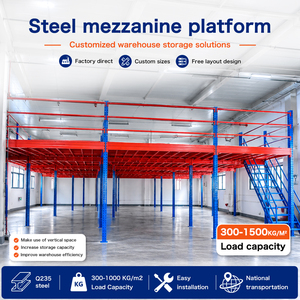
Rack-Supported Mezzanine 100% Multi-Tier Access 150% – 250% (Volume) Continuous Zoned Pick Integrated Catwalks 300kg – 1,000kg/m² Auto Spare Parts, Fashion Pick-Pack, Garments
Automated AS/RS High-Bay 100% Automated Digital 90% – 95% Dynamic WMS Algorithm 1.4m – 1.6m (Crane Rail) 500kg – 3,000kg Pharmaceuticals, High-Throughput E-Com hubs
Procurement Due Diligence

Frequently Asked Questions by Industrial Racking Buyers

Essential technical, compliance, and logistic insights addressing load certifications, factory tolerances, custom roll-forming, and international maritime shipping protocols.

How do you verify compliance with AS 4084, FEM 10.2.02, and RMI standards?
Our engineering department employs specialized cold-formed structural analysis software cross-verified against finite element modeling (FEA). We calculate section modulus ($Z_x, Z_y$), radius of gyration ($r_x, r_y$), torsional-flexural buckling limits, and connection looseness parameters. For Australian, European, and US projects, we provide complete calculation dossiers, certified beam deflection limits of $\leq L/200$, and safety factor ratios of $\geq 1.65$ under maximum design working loads.
What specific steel grades and roll-forming tolerances do you guarantee?
We fabricate using verified structural steel grades Q235B (yield strength $f_y \geq 235 \text{ MPa}$) and high-load Q355B/S355JR ($f_y \geq 355 \text{ MPa}$). Our continuous roll-forming lines feature laser-guided straightness correction, maintaining upright camber and sweep tolerances within $\pm 1.0\text{mm}$ per 10 meters, upright pitch slot accuracy within $\pm 0.2\text{mm}$, and beam connector weld penetration exceeding 85% of parent metal thickness.
Can you manufacture custom pitch uprights (e.g. 76.2mm Dexion or 50mm SSI Schaefer)?
Yes. As an OEM/ODM specialist, our tooling library includes modular punch tooling sets for standard Australian 76.2mm (3-inch) pitch teardrop or diamond uprights, European 50mm and 75mm metric pitch profiles, and American teardrop punched configurations. We can match existing warehouse installations for seamless expansion without forcing clients to scrap legacy inventory.
How does HEDA handle export packaging to prevent container transit damage?
Heavy structural racking components are vulnerable to chafing and shifting during multi-week ocean transit. We bundle upright frames and box beams with protective plastic corner guards, wrapped in heavy polyethylene stretch film, and secured to custom heavy-gauge steel stillages with 32mm high-tensile steel banding. All timber bracing complies strictly with ISPM-15 heat-treatment standards with stamped certifications.
What warehouse slab specifications are required for high-bay racking?
For standard heavy-duty selective racking up to 8 meters, concrete floor slabs must exhibit minimum compressive strength of $f'_c \geq 25 \text{ MPa}$ and minimum slab thickness of 180mm. For high-bay and VNA applications exceeding 10 meters, floor flatness must meet DIN 18202 Table 3 Group 4 or TR34 FM2 specifications, preventing dynamic tipping forces during elevated mast travel.
What documentation is provided to support preferential trade tariffs?
Every overseas export shipment includes fully authenticated commercial invoices, itemized packing lists with gross/net container weights, bills of lading, Mill Test Certificates (MTC), quality inspection sign-off sheets, and official Certificates of Origin (such as ChAFTA Form R for Australia or Form E for ASEAN) to ensure eligible buyers receive reduced or zero-tariff customs clearance.
Direct OEM/ODM Collaboration

Request a Certified 3D CAD Warehouse Storage Layout

Provide your facility dimensions, floor slab specifications, and handling machinery profiles. Our senior structural logistics engineers deliver complete layout drawings, load calculations, and competitive factory-direct quotations within 24 to 48 hours.

Detailed CAD 2D/3D DWG Plan
Static & Dynamic Load Tables
Seismic Zone Engineering Pack
40HQ Container Load Plan
Connect Directly with Factory Engineers
Guaranteed response within 12 business hours. No broker markups. Direct Guangzhou factory delivery.
Inquire Now
Confidentiality Guaranteed • Stamped Structural Certifications