Engineered Heavy Duty Warehouse Rack Series
Explore our certified cold-rolled and structural steel storage solutions. Every racking system is custom-fabricated to match specific floor-plate kinematics, seismic ratings, clear-ceiling heights, and unit-load configurations.
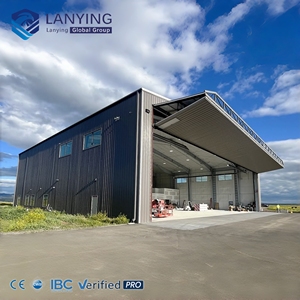 Industrial Prefab
Fireproof Prefab Metal Frame Building Heavy-Duty Industrial Storage Workshop Garage Shed Steel Structure Warehouse Hangar
High-tensile portal-frame engineered steel buildings integrated directly with structural rack-supported mezzanine envelopes. Class A fireproof thermal insulation.
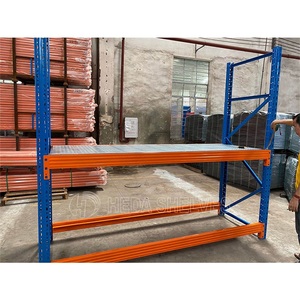 Selective Beam
1500kg Per Layer Heavy Duty Shelves Storage Rack Warehouse Steel Pallet Racking System Industrial Racks
High-capacity adjustable upright beams engineered for 1500kg+ per bay level. Interlocking 3-to-4-claw safety hook connectors with drop-in locking pins prevent accidental beam dislodgement.
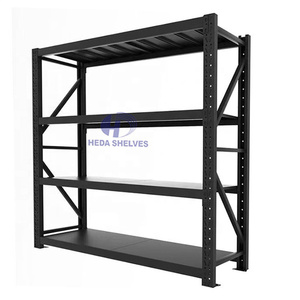 Boltless Stacking
Garage Warehouse Rack Adjustable Storage Stacking Racks Pallet Steel Metal Shelving Shelves
Multi-tier versatile longspan shelving designed for medium-duty order picking, inventory staging, and automated tote buffering. Toolless modular assembly.
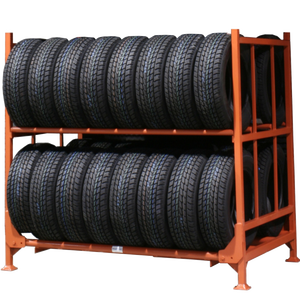 Collapsible Post
Steel Foldable Stacking Rack | Collapsible Stackable Storage Shelf | Heavy Duty Industrial Rack Corrosion Protection
Portable nesting stillages offering dynamic 4-to-6 tier stacking without requiring permanent floor anchoring. Folds compact to maximize reverse logistics efficiency.
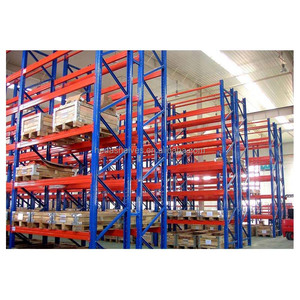 Heavy Palletizing
Warehouse Rack Heavy Duty Rack Shelf Storage Shelves Heavy Duty Warehouse Racking Storage Shelf Pallet Shelving System
Rigid roll-formed omega post profiles cold-formed with reinforced web ribbing. Perfect for selective pallet staging across FMCG, retail distribution, and 3PL warehouses.
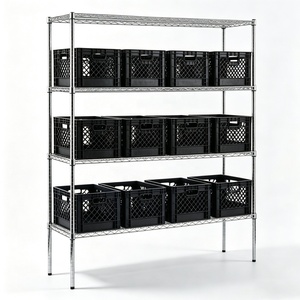 Wire Decked
Commercial Warehouse Storage Rack Adjustable 4 Tiers Industrial Heavy Duty Galvanized Metal Wire Shelving
Welded steel wire waterfall decking provides fire code compliance, allowing internal sprinkler penetration while eliminating dust collection on bulk split-case bays.
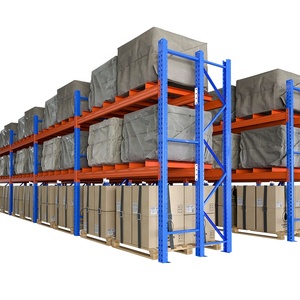 Custom OEM/ODM
Custom Adjustable Pallet Rack Warehouse Storage Heavy Duty Shelving Pallets Racking for Warehouse Storage
Bespoke structural racking profiles designed to customer-specified column matrices. Configurable for narrow-aisle (VNA), drive-in, push-back, or gravity-flow pallet handling.
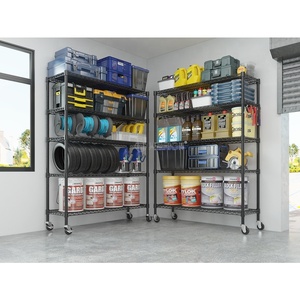 Multi-Tier Pick
Heavy Duty 5 Tiers Epoxy Black Steel Racking Garage Storage Workshop Shelf Wire Corner Warehouse Shelving Garage Rack
Premium thermoset black epoxy powder-coated multi-level rack, combining heavy mechanical resilience with aesthetic industrial styling for workshop stores and parts counters.
Established Year
Modern Manufacturing Plant
Monthly Steel Output
Global Projects Completed
Why Global Supply Chains Trust Our Factory Engineering
Guangzhou Heda Shelves Co., Ltd. operates as an end-to-end original equipment manufacturer (OEM) and original design manufacturer (ODM). Backed by 300+ structural engineers, automated roll-forming lines, and rigorous metallurgy certifications, we eliminate supply chain middlemen to supply direct from the mill.
Compliant Structural Engineering
Designs engineered specifically to international rack design building codes: Australian Standard AS 4084-2023 (Steel Storage Racking), European EN 15512 / FEM 10.2.02, and US RMI ANSI MH16.1. Full calculations and section properties supplied for third-party certifier sign-off.
CE & ISO 9001:2015 Accredited
Independently verified under CE Certification No. 2435-CPR-8605159 and ISO 9001:2015 Certificate No. 18624Q00169R0M. Full chemical composition analysis, tensile yield testing, and RoHS compliant finishing protocols are archived with traceable lot numbers.
Free 3D & CAD Layout Consultation
Send us your building envelope dimensions, dock leveller locations, forklift turn radiuses, and pallet specs. Within 24 hours, our engineering department provides comprehensive AutoCAD plan views and 3D spatial simulations to maximize pallet position count.
Biosecurity & Export Packaging
Experienced with strict quarantine standards including Australian Department of Agriculture, Fisheries and Forestry (DAFF) and New Zealand Ministry for Primary Industries (MPI). Shipments are nested in custom heavy steel stillages or ISPM-15 heat-treated dunnage.
Seismic Engineering Verification
Customised seismic footing assemblies, widened footplates, oversized chemical drop-in anchors, and extra X-bracing geometries engineered to meet demanding lateral acceleration requirements, including New Zealand NZS 1170.5 and US Seismic Design Categories C through E.
Preferential Tariffs & Direct Price
Direct mill sourcing of prime Q235B and Q355B coils coupled with high-speed automated punch lines eliminates broker commissions. Complete paperwork (ChAFTA, RCEP Certificates of Origin) provided to ensure zero or minimized customs tariff exposure.
The 10-Step Heavy-Duty Racking Manufacturing Process
Structural integrity under dynamic forklift loading demands flawless cold-forming, precise punching, and automated coating. Review our audited 10-step fabrication cycle.
Raw Material Mill QA
Spectrometric verification of yield strength, carbon equivalent, and elongation for high-grade Baosteel Q235B/Q355B strip steel.
Precision Slitting
High-speed rotary shear slitting lines cut wide master coils to micrometer strip width tolerances with zero burr deformation.
CNC Column Punching
Automated multi-stage hydraulic die punching stations punch 50mm, 75mm, or 76.2mm pitch slots with cumulative pitch error < 0.5mm across 12 meters.
Continuous Cold Roll
24 to 28 sequential roller forming passes form complex omega (Ω) column profiles, retaining residual ductility and boosting yield strength.
Profile Verification
Laser alignment calipers ensure straightness, camber, and twist deviation conform strictly to EN 15512 and AS 4084 tolerance envelopes.
Beam Cold Seaming
Interlocking twin-C box beam section roll-forming. Dual seam mechanical clinching delivers exceptional torsional rigidity and deflection control.
Robotic Arc Welding
Panasonic multi-axis robotic welders bond forged 3-to-4-claw end connectors onto beam ends using shielding gas metal arc welding (GMAW).
Chemical Pre-treatment
An intensive 6-stage surface immersion: alkaline degreasing, clean water rinse, acid pickling, rust stripping, and nanoceramic phosphating passivation.
Electrostatic Powder
GEMA automatic electrostatic spray guns deposit 60-90µm pure polyester/epoxy powder coating cured at 200°C for exceptional chip and scratch resilience.
Final QC & Bundling
Coating thickness testing, cross-hatch adhesion verification, batch labeling, and heavy-duty ocean transit bundling onto protective steel frames.
Warehouse Storage Systems: Comparative Technical Matrix
Selecting the optimal pallet racking configuration requires balancing floor-area utilization, selective SKU accessibility, forklift mast kinetics, and structural total cost of ownership (TCO).
| System Architecture | Space Utilization | Pallet Selectivity | FIFO / LIFO Rotation | Typical Beam Load (UDL) | Forklift Compatibility | Ideal Industry Use-Cases |
|---|---|---|---|---|---|---|
| Selective Pallet Racking | 40% - 50% | 100% Direct Access | FIFO / LIFO Flexible | 1,000 - 4,500 kg / level | Counterbalance, Reach Truck | General 3PL, FMCG, Multi-SKU E-Commerce |
| Double Deep Racking | 55% - 65% | 50% Direct Access | Strict LIFO | 1,000 - 3,000 kg / level | Pantograph Double-Reach Truck | Dry Groceries, Paper Products, Batch SKU Storage |
| Drive-In / Drive-Through | 70% - 80% | Low (Per Lane Batch) | LIFO (Drive-In) / FIFO | 1,000 - 2,000 kg / pallet | Counterbalance, Narrow Reach | Cold Storage, Deep Freeze, Seasonal Homogeneous Goods |
| Radio Shuttle Racking | 80% - 88% | Channel Independent | Programmed FIFO or LIFO | 500 - 2,000 kg / pallet | Standard Reach (No Mast Entry) | Beverage Distribution, Cold Chain, High-Volume DCs |
| Heavy Cantilever Racks | 60% - 75% | 100% Open Face | Manual / FIFO Flexible | 500 - 3,000 kg / arm | Side Loader, Multi-Directional | Structural Steel, Timber Yards, Extruded PVC Pipes |
| Structural Steel Mezzanine | Doubles Floor Area | 100% Hand Pick | Continuous Manual Pick | 300 - 1,200 kg / m² | Pallet Jacks, Vertical Cargo Lift | Automotive Spare Parts, Apparel Sorting, Archive Bins |
Warehouse Rack Procurement & Technology Trends (2025–2030)
Modern distribution facilities are evolving rapidly under pressure from labor shortages, escalating commercial real-estate costs, and warehouse automation. Consider these strategic engineering trends when drafting racking tenders.
Convergence of Racking with Autonomous AMR & ASRS
Traditional heavy-duty racking is shifting toward hybrid designs ready to integrate Autonomous Mobile Robots (AMRs), robotic pickers, and automated shuttle systems. Deflection limits are tightening from standard manual limits (L/200) to stringent automated tolerances (L/400 or L/500). Suppliers must execute millimetric hole-pitch calibration and zero-sway torsional rigidity to prevent sensor faults in automated storage and retrieval systems.
Direct Factory OEM/ODM Disintermediation
Global warehouse logistics operations and Tier-1 3PLs are bypassing trading intermediaries to contract directly with verified Chinese manufacturing facilities. By leveraging factory-engineered 3D CAD modeling, direct-billed container logistics, and pre-negotiated bilateral trade documentation, facility owners regularly save 25% to 40% on capital outlays while retaining direct access to mill test certificates.
High-Strength Cold-Formed Steels with Lower Carbon Footprint
Procurement teams now prioritize micro-alloyed, high-yield hot-rolled coils (such as Q355B and specialized cold-formed boron-alloyed steels) over conventional low-tensile structural grades. Thinner, highly configured cold-formed profiles yield equal or superior moment capacity with lower gross dead weight. This directly slashes ocean freight emissions and overall container freight costs.
Cold Storage Resilience & C5 Anti-Corrosion Systems
With rapid cold-chain expansion for chilled logistics and pharmaceuticals, racking finishes face severe thermal cycling and condensation. Standard coatings can flake and rust in deep-freeze environments (-25°C to -30°C). Demand has surged for double-pass thermoset polyurea coatings and hot-dip galvanized uprights compliant with ISO 12944 C4/C5 atmospheric classifications.
Data-Driven Load Signage & Digital Inspection Logging
Modern regulatory frameworks (e.g., SafeWork Australia, OSHA, and European EN 15635) require traceable, permanent load-signage placards at every aisle head. Procurement contracts now mandate factory-supplied UV-resistant load capacity plaques, RFID tracking tags per upright frame, and digital fabrication documentation to simplify annual structural safety audits.
Demountable, Modular & Relocatable Architectures
Because fast-growing retailers frequently lease rather than own logistics parks, racking systems must be fully modular. Factory-punched uprights featuring universal teardrop, diamond, or metric slot patterns enable warehouses to quickly alter beam clearance levels, add rack-supported mezzanines, or disassemble and transport the entire installation when relocating.
Frequently Asked Questions by Industrial Buyers
Essential answers covering structural testing, international code compliance, shipping lead-times, and customization parameters for procurement managers, structural engineers, and logistics directors.
What essential warehouse data is required to engineer a custom OEM/ODM racking layout?
To produce a comprehensive, structurally validated 3D layout and precise quotation, our structural engineers require six critical data points:
1. Building Envelope: Exact CAD floor plans indicating internal clear height (clearance to underside of rafters, fire sprinklers, or lighting), column grid locations, dock levelers, fire egress paths, and floor slab specifications (thickness, compressive strength $f'_c$, and rebar layout).
2. Unit Load Parameters: Pallet dimensions (width, depth, overall height including cargo overhang) and maximum gross weight per pallet position.
3. Inventory Profiling: Total SKU count and required pallet capacity, plus whether operations require First-In, First-Out (FIFO) or Last-In, First-Out (LIFO) inventory turns.
4. Material Handling Equipment (MHE): Forklift make, model, minimum aisle turning clearance ($A_{st}$), maximum mast lift height, and top-tier residual capacity.
5. Environmental & Seismic Criteria: Operating temperatures (e.g., ambient vs. -30°C cold storage) and local seismic site class / spectral response accelerations ($S_s, S_1$).
6. Finish Preferences: Standard interior powder coating (AkzoNobel RAL color codes) or heavy hot-dip galvanizing for corrosive or washdown spaces.
How does your factory ensure compliance with regional standards such as AS 4084, EN 15512, and RMI?
Racking compliance cannot be established solely through static finite element software; it mandates physical stub-column compression, beam-to-column connector shear testing, and rotational spring-stiffness ($K_b$) verification.
Our production batches are tested in accordance with AS 4084-2023 (Australia/New Zealand), EN 15512:2020 (Europe), and ANSI MH16.1 (RMI) (United States). We calculate effective section properties accounting for cold-work perforations and local/distortional buckling modes. With every custom OEM/ODM contract, we issue certified engineering calculation packs, steel mill test reports (MTRs), and verified safe working load (SWL) charts to facilitate rapid structural certification by your local engineers.
What are the production lead times and ocean shipping timelines for volume orders?
Standard production turnaround for standard selective pallet racking orders (2 to 10 forty-foot containers) is typically 15 to 25 working days following CAD approval. Highly customized automated radio shuttle tracks or high-rise structural mezzanines require 25 to 35 days depending on raw material coil schedules and custom tooling requirements.
Ocean freight from our South China port terminal (Guangzhou/Shenzhen) delivers dependable transit times:
• Australia / New Zealand Major Ports (Sydney, Melbourne, Brisbane, Auckland): 14 to 24 days.
• Southeast Asia (Singapore, Port Klang, Jakarta): 5 to 10 days.
• Western Europe (Rotterdam, Hamburg, Felixstowe): 28 to 36 days.
• North America West Coast (Long Beach, Seattle, Vancouver): 16 to 22 days.
How do you protect exported steel racking against rust, scratching, and biosecurity rejections during transit?
Ocean container environments expose raw steel to high humidity, ocean spray, and broad temperature swings that cause internal condensation ("container rain"). We apply a robust three-tier protective packaging protocol:
1. Pre-Treatment & High-Build Coating: Components undergo immersion zinc-phosphating or nanoceramic passivation, followed by thermoset polyester powder coating cured to 60-90 microns dry film thickness (DFT).
2. Component Cushioning: Uprights, beams, and brace channels are interleaved with micro-foam sheeting and wrapped in multi-layer water-resistant shrink film to prevent metal-on-metal abrasion.
3. Heavy Steel Frame Stilling: Shipments avoid untreated timber pallets that trigger border biosecurity delays (such as Australian DAFF or New Zealand MPI quarantine). Goods are secured to custom-engineered, heavy steel base frames that forklifts can discharge smoothly, or packed using certified ISPM-15 compliant heat-treated wood with visible IPPC stamps.
Can your factory provide custom branding, private-label manufacturing, and bespoke RAL colors?
Yes. As an OEM/ODM manufacturing partner for global storage distributors and racking integrators, we offer complete private-label manufacturing:
• Custom Tooling & Profile Geometry: We can replicate or integrate with your proprietary hole punches (teardrop, box column, slotted hex) to match your legacy product systems.
• Custom Color Coordination: Powder coatings are accurately mixed to your preferred RAL, Pantone, or corporate color specifications (e.g., standard Safety Orange RAL 2004, Ultramarine Blue RAL 5002, Signal Yellow, or Anthracite Grey).
• Embossing & Brand Stamping: Uprights and beams can be laser-etched or roll-die stamped with your corporate logo, load rating indications, and production traceability tracking numbers.
What structural grade of steel is used, and how do you prevent upright buckling under heavy loads?
We manufacture using prime, high-tensile hot-rolled strip steel grades Q235B (yield strength $f_y \ge 235 \text{ MPa}$, ultimate tensile $370\text{–}500 \text{ MPa}$) and Q355B (yield strength $f_y \ge 355 \text{ MPa}$, ultimate tensile $470\text{–}630 \text{ MPa}$), equivalent to ASTM A36 and ASTM A572 Grade 50.
Upright buckling is prevented through complex omega-profile roll forming incorporating 10 to 14 stiffening return folds along the flange and web. These folds raise the second moment of area ($I_x, I_y$) and shift the shear center, dramatically elevating resistance to both torsional-flexural buckling and distortional buckling. Diagonal and horizontal bracing panels are bolted in an alternating triangulated truss geometry, transferring seismic and impact stresses into oversized floor baseplates anchored directly to the warehouse slab.
What installation documentation and on-site support does your factory provide?
Every international shipment includes detailed installation documentation:
• Detailed Layout Drawings: Stamped architectural plan views detailing exact aisle dimensions, anchor bolt positioning, run-spacer gaps, and flue clearances.
• Step-by-Step Erection Manuals: Component callout schedules, bolt torque parameters (e.g., Grade 8.8 structural bolt torque ratings), and diagonal bracing assembly diagrams.
• Component Identification Tagging: All upright bundles, beams, and shelf decks carry heavy-duty weather-resistant barcoded labels matching the bill of materials (BOM).
• Remote & On-Site Engineering Assistance: Our bilingual project management team provides video-call erection verification, with experienced site installation supervisors available on-site for major multi-tier mezzanine and automated shuttle installations worldwide.
Request Your Custom Engineering Layout & Direct Factory Quotation
Collaborate directly with our engineering department. Share your warehouse floor dimensions, pallet configuration details, and storage requirements to receive a comprehensive 3D CAD design proposal and cost estimation within 24 hours.
Send an Inquiry