Direct-Factory Heavy Duty Pallet & Shelving Systems
Explore our core industrial racking and structural shelving series manufactured to rigid international standards (AS 4084, FEM 10.2.02, RMI MH16.1), configured for high-density logistics, pallet turnover speed, and long-term yield strength.
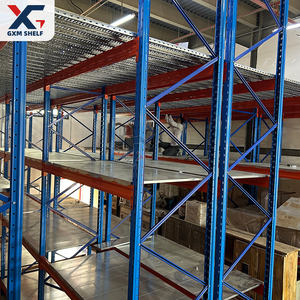
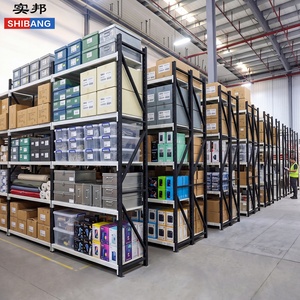
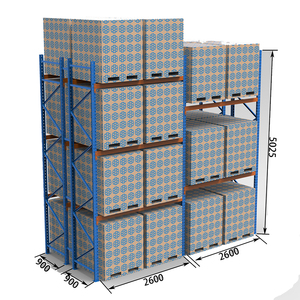
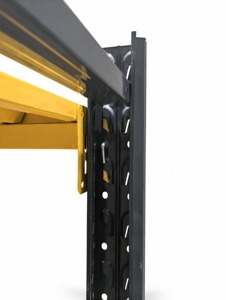
Industrial Pallet Storage Racking: Engineering Standards, Structural Mechanics, and Metallurgical Controls
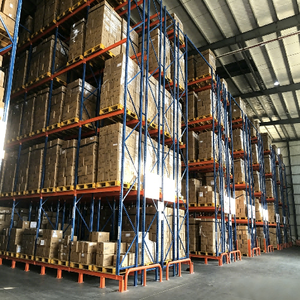
In modern high-throughput intralogistics ecosystems, selecting warehouse pallet storage racking is no longer a simple procurement of static steel shelves. It is an engineering commitment directly governing warehouse safety, structural longevity, and operating margins. Modern distribution centres, fast-moving consumer goods (FMCG) cold storage networks, and third-party logistics (3PL) hubs demand racking systems capable of bearing extraordinary live loads, enduring mechanical cycles from reach trucks and autonomous mobile robots (AMRs), and remaining safe under dynamic seismic horizontal accelerations.
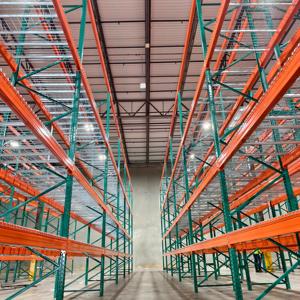
Yield strength and cold-formed profile integrity form the absolute foundation of heavy-duty industrial storage safety. When engineering pallet racks, steel grades such as Q235B and Q355B (equivalent to European S235JR and S355JR, or ASTM A36 and A572 Grade 50) must undergo continuous structural finite element analysis (FEA). Upright columns manufactured by Guangzhou Heda Shelves Co., Ltd. are engineered with multi-bend omega profiles, dispersing axial compression forces evenly across roll-formed corners and eliminating localized torsional-flexural buckling under rated loads up to 24,000 kg per upright frame.
| Racking Architecture | Typical Load Rating | Aisle Width Requirement | Density vs Selectivity | Governing Structural Standards | Recommended Applications |
|---|---|---|---|---|---|
| Selective Pallet Racking | 1,000 – 4,500 kg / level | 3.0m – 3.8m (Counterbalance) | 100% Selectivity / Standard Density | AS 4084 / FEM 10.2.02 | 3PL hubs, retail consolidation, diverse SKU portfolios |
| Double Deep Racking | 1,500 – 3,200 kg / level | 2.8m – 3.2m (Reach Truck) | 50% Direct Selectivity / +40% Density | RMI MH16.1 / EN 15512 | Cold storage, dry FMCG, homogeneous multi-pallet batches |
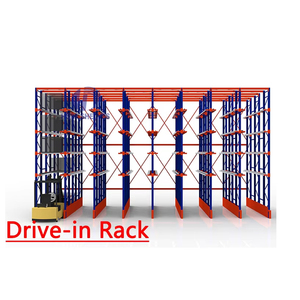
| Drive-In / Drive-Through | 1,000 – 2,000 kg / pallet | Dedicated entry lane | LIFO or FIFO / Ultra-High Density | ISO 9001 / CE 2435 | Cold rooms, beverage distribution, bulk raw packaging |
| Radio Shuttle Automation | 500 – 2,500 kg / pallet | Direct aisle entry only | Automated FIFO/LIFO / Maximum Cubing | EN 15620 / AS 4084 | Deep lane cold logistics, pharmaceutical reserve buffers |
| Rack-Supported Mezzanine | 300 – 1,200 kg / m² deck | Integrated picking lanes | Vertical Space Multiplier (2 to 4 Tiers) | CE CPR-8605159 / AS 4084 | E-commerce fulfillment, spare parts picking, archive depots |
Beyond static vertical compression, the fundamental failure mode in high-bay pallet racking is beam deflection and end-connector teardown under cyclical stress. In accordance with strict international deflection criteria ($L/200$ under FEM standards or $L/300$ under critical seismic codes), beam calculations must factor in not only static dead load (the beam and decking weight) but dynamic live load (forklift entry, sudden drop decelerations, and uneven load distributions). Our beam connectors utilize cold-formed 3-claw and 4-claw wrap-around interlocking heads with integrated spring-loaded safety pins, preventing accidental dislodgement during aggressive pallet retrieval operations.
Factory-Direct Heavy Manufacturing & Global OEM/ODM Mastery
Why Tier-1 logistics developers, overseas warehouse operators, and racking distributors partner with HEDA Shelves for turnkey structural infrastructure.
Full-Chain Precision Roll Forming
Equipped with computerized cold-bending lines and 64 automated punch presses, we convert Baosteel prime high-tensile hot-rolled steel coils directly into zero-burr, pitch-accurate upright profiles and box beams with zero thermal distortion.
30,000 m² Facility FootprintDocumented Structural Certification
Every structural profile is validated and third-party verified under CE Certification No. 2435-CPR-8605159 and ISO 9001:2015 Quality Management System No. 18624Q00169R0M, complying with RoHS environmental thresholds.
AS 4084 • CE • ISO CertifiedBespoke OEM/ODM Tooling & Punching
We tailor hole punch geometries across worldwide regional architectures: classic teardrop punch for North American markets, 50mm/75mm euro pitch for European systems, and butterfly / diamond slots for Oceania and Southeast Asian contractors.
Custom Tooling & Private LabelEco Electrostatic Powder Coating
Our automated 14-stage pickling, silane pre-treatment, and electrostatic powder coating line delivers uniform 60–80 micron dry film thickness (DFT), passing 500-hour neutral salt spray tests for rustproof long-term service.
Salt Spray • Extreme DurabilityPre-Engineered 3D CAD & Load Verification
Our in-house design engineering department of over 300 technical specialists delivers parametric 3D CAD drawings, fluespace compliance modeling, and full engineer load capacity calculation packs within 24 hours of brief submission.
Complimentary Layout EngineeringGlobal Export Packaging & Biosecurity
All shipping consignments are banded to custom steel transport stillages or ISPM-15 heat-treated skids, meeting strict quarantine mandates from Australian DAFF, New Zealand MPI, and USDA, ensuring delay-free clearance.
Zero-Damage Containerization10-Stage Precision Industrial Racking Production Process
From raw steel chemical spectroscopy to robotic weld testing, view how our 30,000-ton monthly capacity maintains sub-millimeter tolerances.
Technological Evolution & Future Procurement Trends in Industrial Storage
How warehouse automation, seismic engineering revisions, and supply chain decarbonization are reshaping capital expenditure decisions for global logistics facilities.
1. Migration to Autonomous & Semi-Automated High-Density Systems
Rising land lease rates and acute warehousing labor shortages across Europe, North America, and Australia are driving rapid conversion from standard selective racking to 4-way radio shuttle systems and Automated Storage and Retrieval Systems (ASRS). Buyers are specifying tighter manufacturing tolerances (within ±1.0mm per bay) to enable robotic shuttles to traverse 100-meter deep lanes without optical deviation or mechanical jam risks.
Trend: ASRS & Shuttle Ready2. Dynamic Seismic Engineering & Stricter Regional Audits
Seismic compliance standards, such as the revised AS 4084:2023 in Australia and NZS 1170.5 in New Zealand, require dynamic cyclic modeling under full pallet load. Procurement teams must move away from generic unverified steel frames toward site-specific engineering designs featuring oversized base plates, chemical anchor embedment depths exceeding 120 mm, reinforced diagonal lattice bracing, and specialized top tie beams designed to absorb lateral shear wave energy.
Trend: AS 4084:2023 • NZS 1170.53. Cold-Chain Resiliency & Sub-Zero Metallurgical Ductility
With explosive growth in pharmaceutical temperature-controlled logistics and frozen meal distribution, cold-room racking operates continuously between -25°C and -40°C. Conventional carbon steels can experience cold-embrittlement transitions under shock loading. Global procurement contracts now demand fine-grained, micro-alloyed low-carbon steel with guaranteed Charpy V-notch impact toughness values at sub-zero temperatures, paired with moisture-impervious powder resins.
Trend: Cryogenic Steel Formulation4. Total Cost of Ownership (TCO) vs. Initial Capital Outlay
Smart procurement executives no longer evaluate suppliers solely on FOB container prices. Total Cost of Ownership models include: shipping container packing density (optimizing upright bundle nesting to save up to 22% in ocean freight), ease of field erection using patented boltless locking clips, and lifetime resistance against upright impact damage through factory-integrated floor-mounted column bullnoses and heavy wraparound guards.
Trend: Freight Cubing & TCO5. Decarbonization, ESG Audits & Green Recycled Content
International corporate ESG directives require logistics facilities to report embodied Scope 3 carbon metrics across warehouse structural racking. Procurement guidelines are establishing minimum thresholds for scrap steel circularity (EAF steelmaking integration) and requiring non-toxic, TGIC-free powder coatings that release zero volatile organic compounds (VOCs) during baking or operational lifetimes.
Trend: Low-Carbon Steel & Zero-VOC6. Digital Twin Integration & Structural Health Telemetry
The convergence of industrial IoT and warehouse asset management is driving adoption of digital twin 3D models embedded with load limits, beam elevation records, and periodic inspection checkpoints. Next-generation racking tenders frequently mandate QR/RFID tagging per upright and beam level, establishing a verifiable traceability chain from the steel coil heat number directly into the facility WMS database.
Trend: QR/RFID Traceability & WMSFrequently Asked Questions for Industrial Racking Buyers
Technical clarity on compliance, engineering parameters, international freight, and structural safety.
What primary structural data is required to generate an accurate 3D CAD layout and quotation?
To produce an engineered proposal within 24 hours, our engineering team requires six foundational parameters:
1. Architectural Floor Plan: CAD drawing or dimensional sketch indicating clear internal length, width, building columns, dock doors, electrical panels, and in-slab expansion joints.
2. Clear Warehouse Height: Distance from the finished concrete floor to the lowest overhead obstruction (sprinkler heads, roof trusses, crane rails, HVAC ducts).
3. Unit Load Specifications: Exact pallet dimensions (width × depth × overall height including cargo overhang) and maximum gross weight per unit load.
4. Material Handling Equipment (MHE): Make and model of forklifts, reach trucks, or VNA turret trucks, including mast collapsed height, maximum lift height, and minimum right-angle stacking aisle width (AST).
5. Environmental & Seismic Criteria: Operating temperature range (ambient vs. -25°C freezer) and project geographic coordinates for seismic zone spectral acceleration ($S_s, S_1$) verification.
6. Inventory Velocity Profile: Target SKU count and throughput velocity to balance selective direct access against high-density push-back, drive-in, or radio shuttle automation.
How does HEDA Shelves ensure compliance with regional standards like AS 4084, RMI MH16.1, and EN 15512?
We do not treat engineering standards as an afterthought. Our production profiles are manufactured from certified Q235B and Q355B coil stock tested to ensure yield strength, elongation, and ultimate tensile capacity align with standard section-property requirements.
For Australian and New Zealand projects, layouts follow AS 4084 principles (including beam deflection limits of $L/200$, permissible frame shear, and upright base anchoring). We provide comprehensive mechanical calculation dossiers, cross-sectional properties, and moment connection values, allowing your locally chartered structural engineer (CPEng or RPEQ) to sign off on installation certificates without delays. For European clients, our CE Certification (No. 2435-CPR-8605159) confirms full conformity with EN 1090-1 and EN 15512 structural steel manufacturing guidelines.
What are the key technical differences between Q235B and Q355B steel in racking design?
The distinction lies primarily in the minimum yield strength ($f_y$) and chemical alloy formulation:
Q235B Steel: Offers a guaranteed minimum yield strength of 235 MPa (Megapascals) and ultimate tensile strength of 370–500 MPa. It delivers excellent ductility, cold bending performance, and weldability, making it ideal for standard warehouse pallet beams, medium-duty shelving, and non-critical braces.
Q355B Steel (Low-Alloy High-Strength): Delivers a guaranteed minimum yield strength of 355 MPa (approx. 51% higher than Q235B) and tensile strength of 470–630 MPa. We utilize Q355B for high-bay upright columns exceeding 9 meters in height, heavy-duty cantilever columns, drive-in support arms, and cold-storage mezzanines where high axial loads require thinner gauge walls without sacrificing structural safety margins.
How are products packaged to prevent ocean corrosion, scratching, and biosecurity rejections?
International sea transport exposes steel to extreme humidity, salt spray, and rough wave movement. Our export packing protocols feature:
• Heavy-Duty Steel Transport Cradles: Upright frames and beams are nested on custom-welded steel stillages rather than bare wood wherever possible, completely eliminating pest contamination risks.
• ISPM-15 Certified Timber: Where dunnage or timber bearers are required, only IPPC heat-treated and certified wood bearing official stamp marks is utilized, passing Australian DAFF and NZ MPI biosecurity audits seamlessly.
• Multi-Layer Protective Wrap: Roll-formed profiles are bundled with corrugated edge board protection, high-density polyethylene film wrapping, and steel strap tensioning with rubber buffer pads, preventing paint chipping and moisture condensation.
What is the standard production lead time and maritime transit duration?
Our monthly production throughput of 30,000 tons allows rapid manufacturing turnarounds. Standard project lead times are as follows:
• Engineering & Shop Drawing Approval: 2 to 4 business days.
• Factory Production: 15 to 25 business days depending on volume (typically 2 to 10 forty-foot high cube containers) and custom color requirements.
• Maritime Shipping: From South China deep-water ports (Nansha, Shenzhen), sea transit typically takes 12–18 days to Southeast Asia and Oceania (Sydney, Melbourne, Auckland), 22–28 days to the US West Coast, and 28–35 days to European base ports (Rotterdam, Hamburg).
Can HEDA Shelves manufacture customized OEM replacement components for existing racking brands?
Yes. As an advanced OEM/ODM manufacturer, we maintain CNC tooling libraries capable of reproducing standard and obsolete upright and beam profiles. By supplying a physical sample or detailed dimensional cross-section with hole pitch measurements, our CNC tool-and-die workshop can configure roll-forming dies and stamping dies to produce fully compatible drop-in replacement beams, upright frames, column protectors, and wire mesh decks matching your existing system.
Transform Your Warehouse Cubing Efficiency Today
Partner directly with Guangzhou Heda Shelves Co., Ltd. for factory-direct engineering, certified structural reliability, and cost-optimized supply chain infrastructure. Receive a complimentary 3D layout design and quotation tailored to your warehouse parameters.