System Specification Analysis
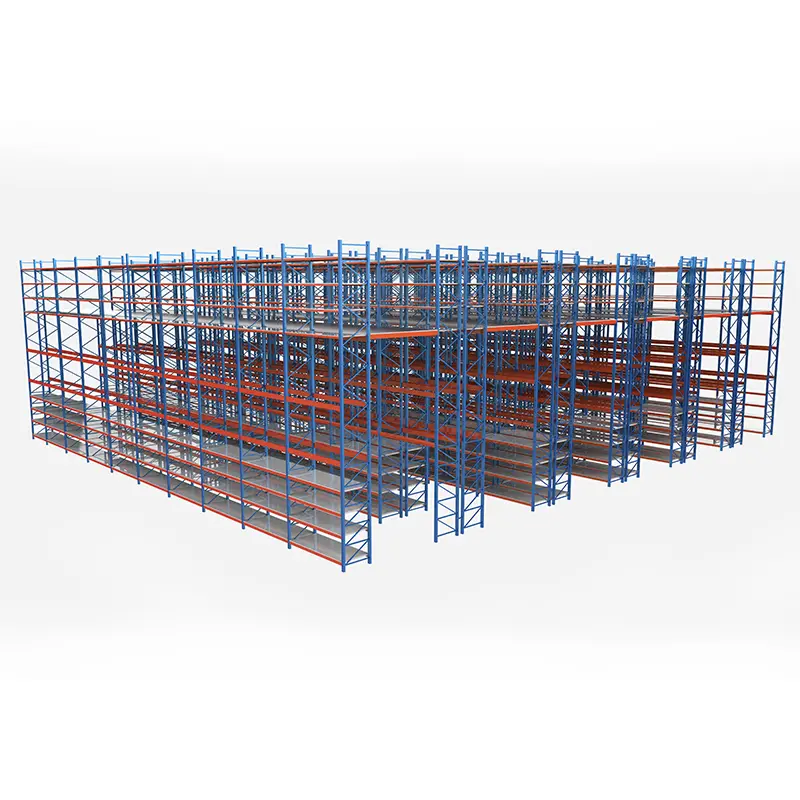
Warehouse Racking Architectural Selection Matrix
Consult this structural benchmark to match pallet throughput volume, building ceiling clearances, and handling equipment investment against the ideal storage typology.
Strategic Market Intelligence
Key Procurement Trends Reshaping Industrial Warehouse Shelving (2026–2030)
Global supply disruptions, steep industrial land costs, and workforce shortages are driving monumental changes in how international enterprise procurement leads specify steel storage systems.
1. The Transition to Semi-Autonomous Shuttle Systems
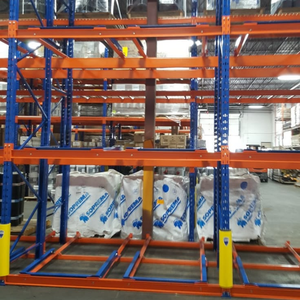
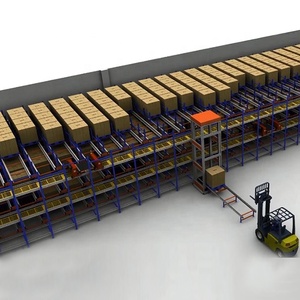
Rising industrial land valuations across Oceania, Europe, and North America have made low-density single-deep racking unsustainable for enterprise facilities. Procurement teams are bypassing manual drive-in systems in favor of high-density Radio Shuttle automation. Shuttles reduce internal forklift collisions by 94%, decrease aisle space requirements, and boost pallet cycle times to over 1.2 m/s, yielding full capital amortization within 18 to 24 months.
2. Stringent Seismic Integrity & Strict Engineering Sign-Offs
In high-risk earthquake zones such as New Zealand (NZS 1170.5) and the US West Coast (RMI MH16.1), buyers can no longer rely on uncertified commodity steel imports. Tier-1 buyers demand full engineering section properties, custom-simulated finite element analysis (FEA), upgraded ductile upright footings, cold-formed Q355B high-tensile steels, and localized professional engineer (CPEng/PE) calculations before approving factory deposits.
3. Low-Carbon Steel & Eco-Compliant Surface Chemistries
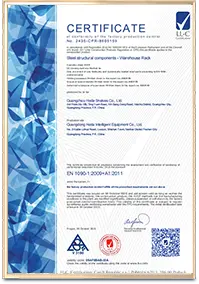
Environmental, Social, and Governance (ESG) mandates have filtered into logistics infrastructure capital expenditure. Progressive buyers mandate verified supply chain tracing for hot-rolled steel coils, strict non-toxic heavy-metal-free pre-treatments (zero chromate conversion coatings), and advanced powder recovery systems that limit volatile organic compounds (VOCs). Dual certification under CE and ISO 14001 has transformed from a differentiator into an absolute bidding prerequisite.
Engineering Material Science: How Structural Deflection Limits Dictate System Lifespan
In structural warehouse racking design, the difference between an installation that functions trouble-free for decades and one that risks catastrophic upright buckling lies in beam deflection criteria ($L/200$ vs $L/300$) and steel yield tensile boundaries. At Guangzhou Heda Shelves Co., Ltd., all load-bearing profiles are roll-formed from certified Q235B (yield strength $\ge 235 \text{ MPa}$) and Q355B low-alloy high-strength structural plate (yield strength $\ge 355 \text{ MPa}$).
Continuous 10-Stage CNC Forming
Profiles undergo progressive roll forming to eliminate micro-fractures in the steel grain structure, preserving high cold-worked yield strengths through all radius corners.
Pickling & Phosphating Pre-Treatment
Before electrostatic spraying, parts undergo multi-stage chemical degreasing, acid pickling, and microcrystalline phosphating to ensure exceptional powder coat adhesion.
Hot-Dip Galvanizing ($>65\,\mu\text{m}$)
For high-humidity port facilities, outdoor lumber yards, or cold storage facilities reaching $-30^\circ\text{C}$, our hot-dip zinc baths form metallurgical zinc-iron alloys that prevent corrosion for over 30 years.
Manufacturing Powerhouse
Direct Factory Strengths & International Export Authority
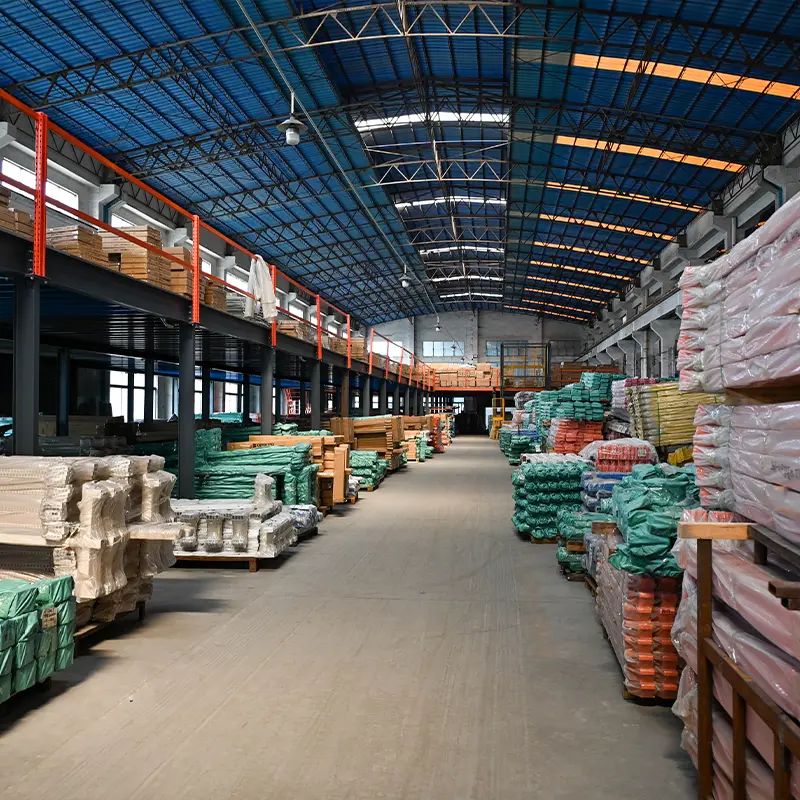
Operating a dedicated 30,000 square meter production complex in Guangzhou, China. Supplying end-to-end turnkey engineering layouts, OEM/ODM manufacturing, and door-to-port export services since 2001.
Procurement Knowledge Base
Frequently Asked Questions on Heavy-Duty Racking Procurement
Technical, logistical, and compliance questions answered directly by our senior structural engineering team.
How do you verify racking structural compliance against Australian AS 4084 and NZ seismic standards?
Our engineering team designs every installation using finite element structural modeling adhering directly to AS 4084-2023 (Steel storage racking) standards and NZS 1170.5 earthquake design principles. We deliver full engineering packages including section properties (moments of inertia $I_x, I_y$, elastic section modulus $Z$), certified steel mill test certificates (MTRs), connection moment capacity data, and load configuration plaques ready for local chartered professional engineer (CPEng) sign-off.
What are the maximum allowable deflection limits for warehouse storage beams?
Under AS 4084, EN 15512, and RMI standards, the maximum allowable vertical beam deflection under full rated Uniformly Distributed Load (UDL) cannot exceed $L/200$, where $L$ represents the clear beam span between upright columns (e.g., maximum 13.5 mm on a 2700 mm standard beam). For semi-automated systems or robotic shuttle tracks, we engineer to a stiffer threshold of $L/300$ or $L/400$ to prevent track bowing and cart navigation stalls.
How does HEDA Shelves manage ocean freight corrosion and strict biosecurity regulations (DAFF/MPI)?
To prevent rust during maritime container transits, all steel parts are coated with high-durability electrostatic epoxy-polyester powder ($80\text{–}120\,\mu\text{m}$) and wrapped in moisture-resistant bubble film, corner guards, and plastic strapping. For timber dunnage, we use exclusively ISPM-15 heat-treated, certified, and officially stamped wood or heavy-duty recyclable steel stillages, eliminating costly quarantine fumigation delays upon arrival in Sydney, Melbourne, Brisbane, Auckland, or Tauranga.
What critical warehouse parameters are required to generate an accurate 3D layout and quotation?
To prepare a complimentary 3D CAD design within 24 hours, our engineering department needs:
(1) Architectural warehouse floor plan indicating columns, dock doors, lights, and fire hose reels;
(2) Clear ceiling height to the lowest obstacle (sprinklers or lighting trusses);
(3) Pallet specifications (dimensions $W \times D \times H$ inclusive of overhang and total weight);
(4) Handling equipment specifications (forklift mast type, minimum turning radius, and maximum reach height);
(5) Environmental requirements (ambient, cooler, or blast freezer at $-25^\circ\text{C}$).
Can HEDA Shelves provide OEM/ODM custom branding and custom powder-coating colors for regional distributors?
Yes. Over 40% of our production volume operates under OEM and private-label agreements for racking distributors across Oceania, North America, Southeast Asia, and Europe. We support custom punch profiles (teardrop, diamond, keyhole, and hexagonal patterns), custom beam connector tab geometries, and custom electrostatic RAL powder-coating colors matched precisely to your brand guidelines.
What is the typical manufacturing lead time and ocean shipping transit duration?
Standard manufacturing lead times for customized containerized orders (up to 10 $\times$ 40ft HQ containers) are typically 15 to 25 business days following CAD drawing sign-off and deposit receipt. Ocean transit time from our base in Guangzhou/Shenzhen to major Australasian ports (Sydney, Melbourne, Brisbane, Auckland) ranges between 14 and 22 days, offering one of the swiftest global delivery cycles in the heavy storage industry.