Industrial-Grade Heavy Duty Pallet Racking Systems
Manufactured using high-yield Q235B/Q355B structural steel, automated continuous roll forming, and electrostatic powder coating compliant with international durability benchmarks.
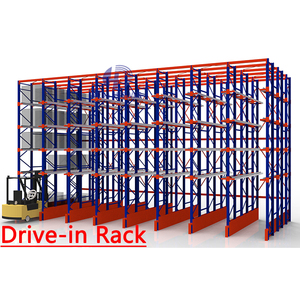
High Density Heavy Duty Drive-in Rack System
Maximizes spatial utilization up to 85% by eliminating picking aisles. Engineered specifically for high-volume cold storage and homogenous batch inventory.
Product Engineering Specs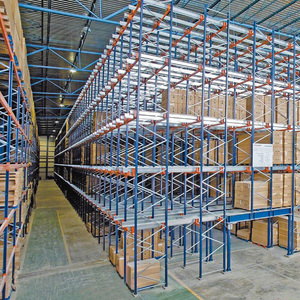
Heavy Duty Radio Shuttle Racking System
Semi-automated deep-lane pallet shuttle system. Minimizes forklift transit inside channels, significantly curbing upright impact and accelerating throughput.
Product Engineering Specs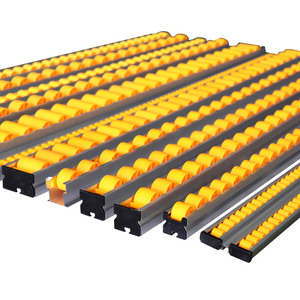
Gravity Flow Rail Carton Flow Rack (FIFO)
Equipped with wear-resistant PE/ABS roller tracks. Engineered with strict FIFO dynamic gravity gradients for assembly lines and high-velocity picking modules.
Product Engineering Specs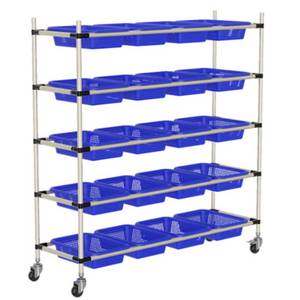
Heavy Duty Warehouse Picking & Sorting Trolley
Industrial ergonomic material transfer trolley built with structural steel framing, directional braking castors, and custom secondary sorting shelves.
Product Engineering Specs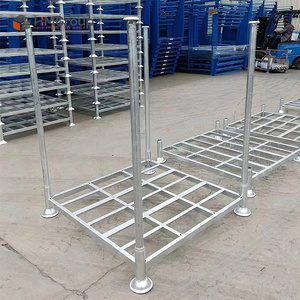
Galvanized Steel Stacking Pipe Stillages
Heavy duty hot-dip galvanized post pallets designed for dense vertical stacking of tubular profiles, pipes, and irregular building fabrication materials.
Product Engineering Specs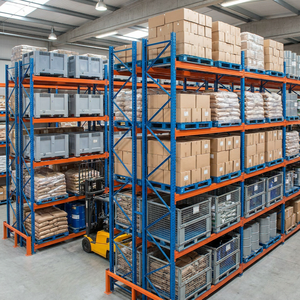
Industrial Selective Pallet Racking (Q235B)
Universal 100% individual selectivity storage. Configured with teardrop or diamond punching, multi-hook connectors, and customizable clear entry beams.
Product Engineering Specs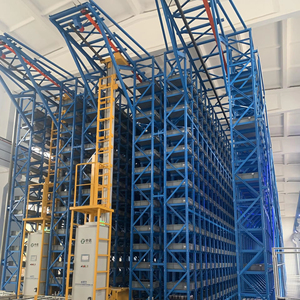
Automated Storage & Retrieval System (ASRS)
Integrated automated racking racking matrix built with precise millimetre-level tolerances to interface seamlessly with high-bay automated stacker cranes.
Product Engineering Specs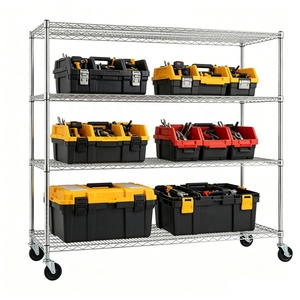
Commercial 4-Tier Chrome Wire Shelving
NSF-certified electro-plated open-wire shelving unit with lockable polyurethane castors, engineered for healthcare, food retail, and cleanroom staging.
Product Engineering SpecsTop 10 Global Pallet Racking Suppliers & Exporters Benchmark
Modern international supply chain operations demand rigorous due diligence when qualifying pallet racking manufacturers. Structural racking is not merely commercial furniture; it is an engineered structural system bearing hundreds of metric tons of dynamic, overhead load. Selecting the correct manufacturing exporter requires balancing structural compliance certifications (such as Australia's AS 4084-2023, Europe’s EN 15512, and the United States' ANSI/RMI MH16.1), production bandwidth, steel sourcing traceability, and bespoke design versatility.
The matrix below objectively analyzes the world's leading manufacturers and global export titans based on manufacturing capacity, key regional approvals, cold-chain engineering capabilities, and typical global logistics handling times:
| Supplier / Exporter | Headquarters | Annual Capacity | Core Engineering Standards | Automation & Shuttle Readiness | Export Lead Time |
|---|---|---|---|---|---|
| Guangzhou HEDA Shelves Co., Ltd. | Guangzhou, China | 360,000 Tons (30,000t/mo) | AS 4084, CE (EN 15512), ISO 9001:2015 | High (Radio Shuttle, ASRS, Mezzanines) | 2–4 Weeks (Port-to-Port) |
| SSI Schaefer | Neunkirchen, Germany | Global Conglomerate | EN 15512, FEM 10.2.02, RMI | Full Automated Turnkey Systems | 8–16 Weeks |
| Interlake Mecalux | Barcelona / Chicago | Global Multi-Facility | RMI MH16.1, EN 15512, ISO 14001 | High (Automated Pallet Shuttle, Stacker) | 6–12 Weeks |
| Dexion (Constructor Group) | Melbourne, Australia / UK | Regional / Multinational | AS 4084, EN 15512, SEMA | Moderate to Advanced ASRS | 4–10 Weeks |
| Stow International | Dottignies, Belgium | Multi-factory Europe/USA | EN 15512, RMI, ISO 9001 | Proprietary 2D/3D Atlas Shuttles | 8–14 Weeks |
| Daifuku Co., Ltd. | Osaka, Japan | Global Conglomerate | JIS, RMI, CE Machinery Directive | Pioneering Automated Intralogistics | 12–20 Weeks |
| Nedcon (Nedcon B.V.) | Doetinchem, Netherlands | European Production | EN 15512, FEM 10.2.08 | ASRS Specialized Complex Systems | 10–14 Weeks |
| Frazier Industrial Company | Long Valley, NJ, USA | North American Multi-Plant | AISC, ANSI/RMI MH16.1 | Structural Steel Focused (Cold Rolled Alt) | 6–12 Weeks |
| Jungheinrich AG | Hamburg, Germany | Global Conglomerate | EN 15512, FEM 10.2.07 | End-to-End Automated Fleet Integration | 10–16 Weeks |
| Bito-Lagertechnik Bittmann | Meisenheim, Germany | European Specialized | RAL-RG 614, EN 15512 | Dynamic Flow & Small Parts Shelving | 6–10 Weeks |
While European and North American domestic suppliers offer robust brand pedigree, their extended factory backlogs and high localized fabrication overhead have led Tier-1 3PLs and logistics builders to establish strategic partnerships with engineering-led exporters like HEDA Shelves. By combining direct factory output (30,000 tons/month) with strict adherence to regional compliance protocols (such as Australia’s AS 4084 and seismic verification for NZS 1170.5), buyers achieve up to 35% capital expenditure reduction without compromising metallurgical certification or structural safety factors.
Guangzhou HEDA Shelves: 25 Years of Engineering Rigor
Founded in 2001, Guangzhou Heda Shelves Co., Ltd. operates an expansive 30,000 m² state-of-the-art production plant supported by a dedicated staff of over 300 experienced engineers, structural technicians, and fabrication specialists.
Certified Metallurgical Traceability
We source prime, mill-certified hot-rolled and cold-rolled steel coils strictly conforming to Q235B and Q355B grades (equivalent to ASTM A36 and AS/NZS 3678 Grade 350). Every heat run is chemically verified for carbon, manganese, and silicon content to guarantee ductile yield under high load.
Independent International Accreditations
HEDA Shelves operates under verified ISO 9001:2015 Quality Management System (Certificate No. 18624Q00169R0M) and holds full European conformity with CE Factory Production Control Certification (No. 2435-CPR-8605159), guaranteeing third-party audit compliance.
Seismic & Regional Engineering Data
From cyclonic wind provisions in Northern Queensland to severe seismic spectrum accelerations under New Zealand’s NZS 1170.5, our in-house engineering desk provides complete layout calculation packs, deflection tables, and section modulus metrics for expedited local engineer sign-off.
Warehouse Pallet Racking Trends (2025–2035): Structural Shifts & Automation Integration
The global warehousing landscape is experiencing profound structural transformations driven by escalating industrial land prices, tightening labor markets, and aggressive corporate decarbonization mandates. Procurement directors and supply chain engineers can no longer view pallet racks as passive steel components. The future of intralogistics procurement centers around four vital paradigms:
1. The Transition from Pure Selective Racking to High-Density Dynamic Buffers
While standard selective racking offers universal pallet accessibility, its floor space utilization efficiency rarely exceeds 40–45% due to extensive aisle-to-storage ratios. In contrast, modern distribution logistics centers are rapidly transitioning toward semi-automated Radio Shuttle Racking and dynamic Carton / Pallet Flow Systems. Shuttle installations eliminate multiple operational aisles, allowing 40-foot deep lanes while simultaneously slashing forklift run times and carbon emissions. Over a 10-year operating horizon, dynamic shuttle solutions yield an estimated 28% reduction in overall operating costs despite a marginally higher initial capital outlay.
2. Millimetre-Precision Engineering for ASRS & Autonomous Mobile Robots (AMRs)
Automated Storage and Retrieval Systems (ASRS) and autonomous fork-trucks require fabrication tolerances far tighter than traditional manual operations. Traditional cold-rolled manufacturing allows minor profile bow, camber, and twist tolerances that manual forklift operators naturally accommodate. However, automated crane optical sensors and shuttle positioning units trip emergency stops if beam sag or column verticality deviates by more than 1:1000. HEDA Shelves addresses this through continuous in-line automated punching dies and laser-guided roll-forming lines, maintaining profile tolerances within ±0.5 mm across 12-meter clear heights.
3. Environmental Durability: Powder Formulations vs. Hot-Dip Galvanizing
Supply chain infrastructure longevity depends fundamentally on ambient chemical and thermal resilience. Cold storage facilities (-30°C) cause standard epoxy coatings to embrittle, micro-crack, and permit subsurface steel oxidization through ambient condensation during defrost cycles. The emerging standard for sub-zero and coastal warehousing involves heavy-duty pre-treatment using zinc-phosphate conversion coatings topped with non-porous TGIC-free polyester powder, or 80-micron minimum hot-dip galvanizing conforming to ISO 1461 for open-air yard stillages.
4. Stringent Biosecurity & Sustainable Logistics Protocols
Oceania (Australia DAFF and New Zealand MPI) and North American ports impose stringent biosecurity inspections to curb timber pest infestations. Traditional untreated wooden shipping dunnage frequently triggers border quarantine, port demurrage fees, and mandatory methyl bromide fumigation. Leading exporters now ship racking structural bundles strapped directly into custom heavy-duty steel transport stillages or certified ISPM-15 treated timber, ensuring frictionless border clearance and immediate job-site cranage.
Structural Load Principles: AS 4084, FEM 10.2.02, and RMI MH16.1
Proper racking design requires deep knowledge of structural mechanics, structural stability analysis, and limit states design. Racking uprights behave as slender, thin-walled, open-section structural columns subjected to combined axial compression and bending moments generated by:
- Dead Load ($G$): The self-weight of the steel frames, load beams, row spacers, column protectors, and timber or mesh decking.
- Live Pallet Load ($Q$): The nominal weight of stored goods, multiplied by dynamic impact factors (typically 1.25 to 1.40 under AS 4084 design combinations).
- Accidental Forklift Impact: Vertical and horizontal kinetic loads at floor-level uprights (typically minimum 2.5 kN horizontal force per AS 4084 provisions) mitigated through wrap-around column guards and aisle-end barriers.
- Seismic Action ($E$): Inertial horizontal forces generated during earthquake ground accelerations, calculated using base shear coefficients ($C_d$) derived from local soil classes and structural ductility factors ($k_\mu$).
In accordance with universal international standards, under maximum working load, the maximum allowable vertical deflection of any pallet racking beam must not exceed $L / 200$ (where $L$ is the clear beam span between columns). For automated shuttle applications, HEDA Shelves enforces a tighter internal benchmark of $L / 300$ to protect automated carriage sensors.
Frequently Asked Questions (FAQ) for Global Racking Buyers
Key technical, structural, and import documentation answers vetted by HEDA Shelves' international senior engineering division.
How does HEDA Shelves guarantee compliance with Australian Standard AS 4084-2023?
AS 4084-2023 governs steel storage racking design, testing, and operational safety throughout Australia. HEDA Shelves engineers each system based on limit-states design methods, providing complete section properties, connection stub moment-rotation curves, beam end connector shear test data, and upright compression test reports. We supply full layout CAD files and structural calculation summaries allowing your certified Australian Structural Engineer (Chartered CPEng / NER) to verify and issue structural certificates of compliance with ease.
What specific seismic engineering data is required for New Zealand installations (NZS 1170.5)?
New Zealand sites feature varied seismic zones, from low risk in parts of Northland to severe fault hazards across Wellington and Christchurch. To engineer your racking, we require: (1) Site subsoil class (A through E), (2) Hazard factor ($Z$), (3) Return period factor ($R_u$), and (4) Warehouse importance level. HEDA Shelves adjusts cold-formed frame upright steel thickness (up to 2.5 mm or 3.0 mm Q355B steel), incorporates oversized welded baseplates with M16 chemical masonry anchors, and adds robust cross-aisle and plan bracing to control horizontal displacement.
How do you prevent shipping damage, salt spray corrosion, and customs quarantine issues during ocean freight?
Export components travel across open ocean corridors subject to marine humidity and transit vibration. Uprights and beams are bundled with protective corrugated paper corners, edge guards, and high-tensile PET strapping. All bundling avoids ground contact via ISPM-15 heat-treated skids or heavy galvanized steel stillages. For corrosion protection, hardware and beam hooks are sealed in moisture-barrier polybags containing desiccant silica gel packets, preventing ocean spray oxidation.
Can HEDA Shelves engineer racking systems around non-standard custom pallets?
Yes. While we routinely design for standard Australian timber pallets (1165 mm × 1165 mm), Euro pallets (1200 mm × 800 mm), and American GMA pallets (48" × 40"), a large portion of our fabrication is bespoke. If you handle drums, heavy skids, composite plastic pallets, or intermediate bulk containers (IBCs), we configure structural cross-support bars, stepped wire mesh decking, or custom heavy steel drop-in pan shelves to prevent pallet sag and guarantee safe point-load distribution.
What are the key technical differences between Drive-in and Radio Shuttle Racking for cold storage?
While both systems deliver dense storage without aisles, Drive-in requires fork trucks to drive directly into the racking frame. In cold rooms, condensation lowers tire traction, increasing the risk of column impact. Additionally, operating inside sub-zero temperatures reduces forklift battery capacity by 30–40%. In contrast, Radio Shuttle systems position the forklift strictly at the aisle face. The automated battery-powered carriage travels into the storage lane at up to 1.1 m/s, increasing cycle speeds by up to 200% and completely eliminating internal upright strikes.
What documentation is provided to support customs clearance and preferential trade tariffs?
Every commercial export order is backed by a full export documentation suite: Bill of Lading (B/L), Commercial Invoice, Packing List with itemized container weights and piece marks, Mill Test Certificates (MTC), Factory QC Inspection Reports, and Certificates of Origin. For Australian and New Zealand buyers, we furnish ChAFTA and NZ-China FTA Certificates of Origin to assist importers in securing applicable preferential customs tariff exemptions.
Request a Compliant 3D CAD Warehouse Layout & Project Estimate
Connect directly with HEDA Shelves' technical structural team. Submit your warehouse floor plan, clear building heights, pallet specifications, and forklift parameters for a free, high-density layout rendering and quotation within 24 hours.