Industrial Storage Systems & Material Handling Equipment
Factory-direct warehouse storage components manufactured to rigorous dimensional tolerances. Explore our export-standard heavy-duty racking assemblies, radio shuttle robotics, boltless modular bays, and industrial logistics hardware.
Guangzhou Heda Shelves: World-Class Engineering & Export Scale
Specializing in engineered storage solutions, Guangzhou Heda Shelves Co., Ltd. operates as a vertically integrated manufacturer. With more than 300 experienced engineers, precision CNC roll-forming lines, and automated electrostatic powder coating systems, we deliver certified structural racking designed to withstand the harshest industrial service conditions.
Full International Certification
Compliance verified by independent notified bodies. We maintain accredited certifications guaranteeing structural integrity across international jurisdictions:
- CE Certification: No. 2435-CPR-8605159 (EN 1090 structural execution)
- ISO 9001:2015: Quality Management System No. 18624Q00169R0M
- RoHS & REACH: Controlled chemical treatments and heavy-metal-free finishes
- Engineering Principles: Designed in compliance with AS 4084, FEM 10.2.09, and ANSI MH16.1 (RMI)
Turnkey Engineering & 3D Modeling
We eliminate procurement guesswork by delivering full-scale spatial designs prior to raw material cutting. Our structural engineers tailor arm configurations to your specific inventory geometries:
- BIM and 3D CAD parametric layout generation within 24 hours
- Finite Element Analysis (FEA) dynamic deflection modeling
- Seismic parameter optimization referencing site-specific ground acceleration (NZS 1170.5)
- Custom cantilever arm stop collars, pipe retainers, and saddle supports
Rigorous Export & Biosecurity Packing
Overland and maritime logistics demand robust material staging. Every pallet racking and cantilever shipment leaves our factory secured against transport stress and biological vectors:
- All dunnage complies with ISPM-15 heat-treated stamp verification
- All-steel modular stillages for zero-wood biological risk across Oceania ports
- Multi-layer anti-corrosive polyethylene wrapping with edge vapor barriers
- Full itemized bilingual manifests for rapid customs clearance (ChAFTA compliant)
10-Stage Precision Cantilever & Racking Fabrication Workflow
From raw certified Q235B steel coils to multi-stage surface pretreatment and robotic mig-welding, our closed-loop fabrication processes guarantee extreme dimensional stability, impact resilience, and anti-corrosive longevity.
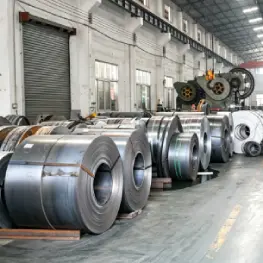
Yield and tensile strength analysis of prime certified Q235B/Q355B structural steel coils.
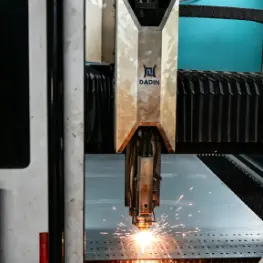
Laser-calibrated CNC cutting equipment ensures sub-millimeter tolerances on raw upright blanks.
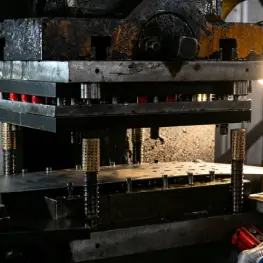
Continuous multi-die automated punch presses establish 100mm and 140mm pitch adjustment holes.
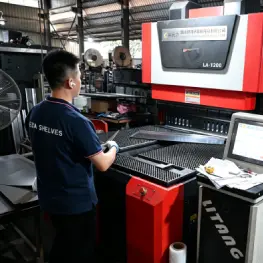
Multi-stage progressive cold bending stabilizes column web thickness and internal grain structure.
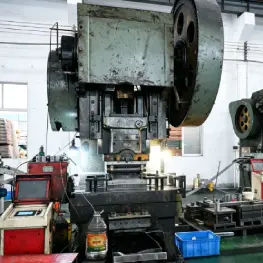
Heavy-duty roll mills forge heavy C-channel and boxed sections with high structural rigidity.
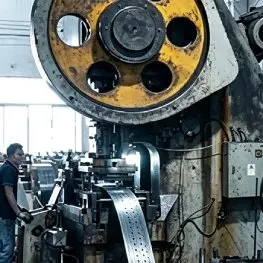
Automated deburring and edge-chamfering prevent micro-stress fractures and sharp edges.
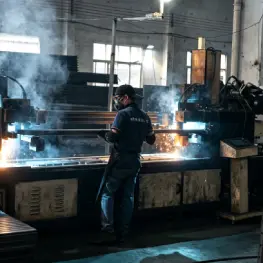
Multi-axis robotic arms weld heavy baseplates, column flanges, and cantilever connector brackets.
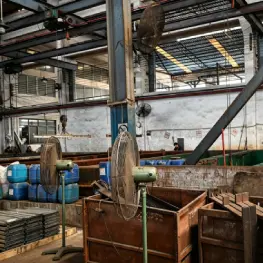
An intensive 7-stage chemical dip cleans mill scale, producing an iron-phosphate anti-corrosion barrier.
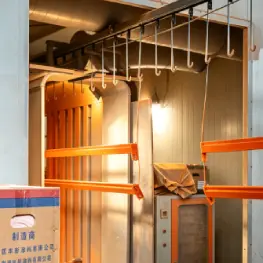
Automated spray booths apply thermosetting polyester-epoxy powder cured at 180°C–200°C.
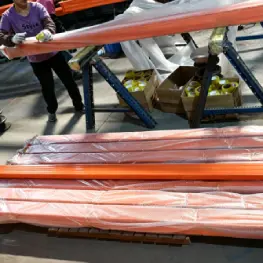
Coating adhesion tests, ultrasonic weld scanning, container strapping, and export manifest signoff.
Adjustable Cantilever Racking: Structural Mechanics & Load Architecture
Unlike conventional selective pallet racking that relies on vertical front and rear upright frames with intermediate horizontal load beams, cantilever racking is an unbraced open-front structural system designed specifically for non-standard, linear, and continuous goods such as structural steel, timber packs, PVC piping, gypsum panels, and aluminum profiles.
| Structural Parameter | Light / Medium Duty (Roll-Formed) | Heavy Duty (Structural I/H-Beam) | Extra Heavy Duty (Reinforced Boxed) |
|---|---|---|---|
| Column Section Profile | C-Channel Face-Welded (200 × 60 × 2.0–2.5mm) | Hot-Rolled WF / H-Beam (HEA/IPE 200–300) | Engineered Box Welded with Internal Ribs |
| Arm Capacity (UDL) | 200 kg – 600 kg per arm | 600 kg – 1,800 kg per arm | 1,800 kg – 4,500+ kg per arm |
| Column Height Range | 2,000 mm – 4,500 mm | 3,500 mm – 9,000 mm | Up to 12,000 mm (Crane / Stacker-Served) |
| Arm Connection Mode | Slotted Keyway with Safety Wedge Pins | High-Tensile Grade 8.8 / 10.9 Through-Bolts | Pivot Pin Joint (Impact Dissipating) |
| Vertical Adjustment Pitch | 50 mm / 75 mm / 100 mm pitch | 100 mm / 140 mm standard pitch | 100 mm / 150 mm custom punch pattern |
| Corrosion Finish Options | Polyester Epoxy Powder Coating (60–80μm) | Powder Coated or Hot-Dip Galvanized (ISO 1461) | Hot-Dip Galvanized (Outdoor 85–110μm Zinc) |
Roll-Formed vs. Hot-Rolled Structural Steel
A primary design choice during cantilever procurement is selecting between cold roll-formed uprights and hot-rolled structural steel shapes (HEA, HEB, IPE). Roll-formed columns utilize high-yield cold-rolled steel coils (Q235B), progressively cold-worked to create rigid C-profiles with reinforced return flanges. They offer remarkable strength-to-weight ratios, delivering a cost-efficient storage solution for retail lumberyards, plumbing retail outlets, and automotive exhaust distributors handling loads up to 600 kg per arm.
For high-throughput industrial logistics, outdoor steel stockyards, and heavy tube mills, structural hot-rolled H-beams (Q355B) provide unmatched mechanical resilience. The solid cross-sectional mass of hot-rolled flanges delivers superior resistance against fork truck impact forces. In heavy-duty operations, minor operator collisions that would crimp a cold-formed column face will typically cause negligible deformation to an engineered structural H-beam profile.
Pin-Joint Energy Dissipation Technology
Conventional rigid cantilever arm connections utilize bolted endplates that rigidly fix the cantilever arm perpendicular to the column face. While structurally stiff, any accidental upward or horizontal collision from a lifting mast transfers massive torsional and shear stresses directly into the column throat, risking permanent column twisting or foundational anchor shearing.
Heda Shelves incorporates advanced pivot pin connection geometry on its heavy-duty cantilever lines. The arm is mounted inside a fabricated heavy-gauge collar sleeve pinned with a high-shear hardened alloy steel axle pin. If a forklift operator accidentally snags an arm while elevating a bundle of rebar, the pin-joint allows the arm to rotate upward and slightly laterally, dissipating dynamic impact kinetic energy rather than transmitting destructive shear forces directly into the column core.
Deflection Limits & Foundation Anchorage
Cantilever racks act as true vertical cantilevers fixed at the base. Under asymmetric loading (e.g., fully loaded single-sided racks or double-sided racks with one side stripped for dispatch), enormous bending moments occur at the baseplate connection point. Engineering compliance to standards such as AS 4084 and FEM 10.2.09 requires rigorous deflection control:
- Arm Deflection Limit: Strictly maintained within δ ≤ L/250 under full uniform design load.
- Vertical Column Drift: Limited to h/350 to ensure fork clearance at high elevations.
- Anchorage Shear Verification: Multi-point chemical resin or heavy mechanical wedge expansion anchors (M16–M24) sized based on slab compressive strength (≥25 MPa).
Future Procurement Trends in Heavy-Duty Cantilever Racking (2025–2030)
Warehouse management systems and global supply chain pressures are fundamentally transforming how industrial cantilever racking is specified, engineered, and procured worldwide.
1. Integration with Automated AS/RS & AGVs
Historically, cantilever storage has been entirely dependent on human-operated side-loaders, 4-way reach trucks, and multidirectional counterbalanced forklifts. By 2026, international procurement is shifting heavily toward Automated Storage and Retrieval Systems (AS/RS) designed around cantilever racks. These setups utilize automated cranes equipped with telescopic forks or specialized vacuum lifts for bar stock, aluminum extrusions, and heavy sheet steel cassettes. To accommodate automated sensors, manufacturing tolerances on cantilever columns and arm levelness have tightened by over 40%, transitioning from standard roll-forming to laser-guided CNC manufacturing.
2. Hot-Dip Galvanization Over Simple Paint
With industrial land costs soaring, operations across Australia, New Zealand, Europe, and the Middle East are expanding their long-goods storage outside the warehouse walls into open yards. Traditional exterior paint systems degrade rapidly under intense UV exposure and maritime humidity. International buyers now mandate full batch hot-dip galvanization conforming to EN ISO 1461 and ASTM A123, providing minimum coating thicknesses of 85μm–100μm. This delivers a 25-to-50-year rust-free maintenance lifecycle in coastal C3 to C5 atmospheric environments, optimizing lifecycle ROI.
3. Seismic Performance Verification
Procurement specifications in seismic zones—particularly across New Zealand (NZS 1170.5), the US West Coast (UBC/IBC), and the Mediterranean—no longer accept standardized ex-factory load charts. Buyers require project-specific structural engineer computations evaluating higher ductility classes, enlarged heavy-flange baseplates, ductile grade anchoring bolts, and heavy-duty structural cross-bracing towers. Guangzhou Heda Shelves provides custom FEA load-deformation documentation for every overseas project, streamlining regional engineering certification.
Engineering Trends Shaping Modern Cantilever Rack Fabrication
Structural storage technology is advancing beyond static steel frames. Modern systems now incorporate active safety accessories, reconfigurable arm geometry, and multi-tier mezzanine decking.
Telescopic Arm Systems
Hydraulically or manually extendable cantilever arms that allow warehouses to instantly adjust arm lengths when shifting between 1.2m pack widths and 2.4m sheet goods without disassembling the column frame.
Cantilever-Supported Mezzanines
Eliminating traditional structural columns by using heavy cantilever uprights as structural supports for multi-tier catwalks, integrating bulk pipe storage below with picking shelves above.
Continuous Steel/Wire Decking
Removable heavy galvanized bar grating or welded wire mesh decking placed across cantilever arms, converting open arms into flat shelf tiers for non-uniform crates and pallets.
Anti-Roll Safety Accessories
Spring-loaded end-stops, drop-in pipe retainers, and rubber cushioning strips welded or fastened onto arms to prevent expensive stainless pipes or finished furniture from rolling or scarring.
Adjustable Cantilever Racking: Global Procurement FAQ
Real engineering, logistics, and compliance answers addressed by our chief structural engineers for global procurement officers, contractors, and distribution managers.
A single-sided cantilever rack features arms extending from only one side of the vertical upright column and is engineered to be anchored directly against perimeter warehouse walls. Because of asymmetric loading, single-sided columns experience high forward overturning moments, requiring extended base supports and heavier foundation anchoring. Double-sided cantilever racks feature arms protruding from both the front and rear faces of a central column. When loaded evenly, the opposing bending moments cancel each other out, making double-sided racks structurally more balanced, efficient in steel consumption, and ideal for central open-aisle layouts.
Safe working capacity for cantilever arms is strictly calculated assuming a Uniformly Distributed Load (UDL). If an arm is rated for 1,000 kg, that 1,000 kg must be evenly spread along its entire operational length. If the load is concentrated at the extreme tip of the arm, the bending moment exerted on the column connection collar doubles, reducing effective safe load capacity by roughly 50%. Our engineering team provides detailed load charts indicating rated capacities based on load center of gravity distances (e.g., 500mm, 600mm, or 750mm from the column face).
Yes. We regularly supply Australian logistics providers, lumber merchants, and steel stockists in Sydney, Melbourne, Brisbane, and Perth. Our design engineers calculate upright sections, baseplates, and arm connections referencing the structural mechanics mandated by AS 4084 (Steel Storage Racking). We supply complete structural calculation packs, section properties, and material test certificates (MTC) so your local Australian structural engineer can sign off on local council compliance and certification.
Because cantilever racking uprights transmit significant bending moments directly into the floor slab, foundation requirements are higher than those for standard pallet racks. For light-to-medium cantilever systems, a reinforced concrete slab of 150mm–200mm thickness with minimum compressive strength of 20–25 MPa is generally adequate. For heavy-duty industrial structural towers (heights >6m or arm loads >1,500 kg), an engineering slab assessment is mandatory; requirements often mandate concrete depths of 250mm–350mm (C25/30 or C30/37) with continuous rebar mesh to prevent anchor pullout.
Export shipments destined for Australia (DAFF), New Zealand (MPI), the Americas, and Europe undergo strict export staging. Upright columns and arms are bundled on heavy-duty, all-steel logistics stillages or ISPM-15 compliant heat-treated and debarked timber bearers. Components are wrapped with anti-abrasive vapor-barrier polyethylene film to prevent saltwater and condensation contact. We provide Phytosanitary declarations, clear container packing lists, and Certificates of Origin to ensure seamless border clearance.
Standard manufacturing lead time at our Guangzhou production facility is typically 15 to 25 business days, depending on the coating finish (powder coating takes ~15–20 days; batch hot-dip galvanizing requires ~20–28 days). Maritime shipping from South China ports (Nansha, Huangpu, Shenzhen) to major ports in Australia/New Zealand takes approximately 14 to 22 days; European ports take roughly 28 to 35 days; and US West Coast ports take approximately 16 to 22 days.
To deliver an optimized layout and quotation, our engineering department needs: (1) Dimensions and clear height of your warehouse or yard; (2) Type of goods stored (timber bundles, pipes, aluminum profiles, sheet panels); (3) Dimensions of inventory (length, depth, height); (4) Maximum bundle weight; (5) Desired storage levels per column; and (6) Specification of your material handling equipment (counterbalance forklift, multidirectional truck, or side-loader minimum aisle requirements).
Yes. We act as the dedicated manufacturing facility for numerous racking brands, equipment distributors, and system integrators across Europe, Oceania, and the Americas. We provide custom punch-hole configurations, proprietary color-matched RAL powder coating, private-label brand plate stamping, and neutral or custom-branded export packaging to support distributor brand equity.
Request an Engineered Cantilever Layout & Direct Factory Quote
Connect directly with the structural engineering department at Guangzhou Heda Shelves Co., Ltd. We provide free 3D CAD modeling, custom load capacity calculations, and factory-direct pricing for your warehouse expansion.
Get Catalog