Industrial Storage Engineering & Heavy-Duty Racking Benchmark
An engineering-driven technical evaluation for supply chain directors, industrial architects, logistics project contractors, and procurement executives evaluating Chinese racking manufacturing infrastructure, structural metallurgy, and regulatory design compliance.
In modern industrial logistics, automated intralogistics, and high-cube distribution centers, heavy-duty warehouse pallet racking represents far more than rudimentary steel framing. It serves as the physical backbone supporting billions of dollars in critical inventory, intricate automated material handling systems (AMHS), and round-the-clock throughput operations. Selecting an industrial storage partner in China demands a rigorous technical audit spanning mechanical steel yield thresholds (Q235B vs. Q355B), finite element analysis (FEA) deflection simulations, roll-forming profile consistency, electrostatic powder coating longevity, and international structural code compliance including AS 4084:2023 (Australia/Oceania), EN 15512 / FEM 10.2.02 (Europe), and ANSI/RMI MH16.1 (North America).
As industrial floor real estate premiums surge worldwide, storage facility operators are transitioning rapidly from basic selective layouts toward ultra-dense dynamic systems—including smart motorized mobile racking, multi-deep radio shuttle systems, and cantilever structural mezzanines. Chinese manufacturing facilities that lead the global export market combine vertical integration (from coil slitting and automated cold-roll profiling to robotic continuous welding and dual-chamber phosphating) with bespoke design engineering, allowing multinational importers to maximize pallet cubic density while strictly mitigating collapse and seismic risks.
Featured Industrial Pallet Racking & Heavy-Duty Systems
Explore our certified export series engineered for commercial logistics hubs, cold chain terminals, high-density distribution centers, and hazardous production environments.
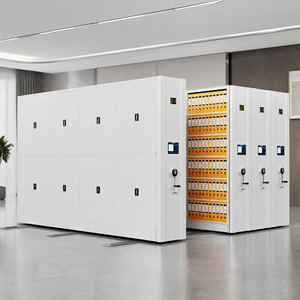
Customized High Density Mobile Shelving Smart Control Motorized Pallet Steel Rack
- PLC Automated Guided Tracks
- Floor Space Recovery: Up to 85%
- Photoelectric Safety Curtains
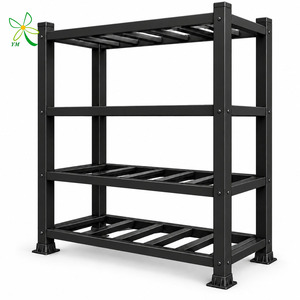
Corrosion Protection Stackable Heavy Duty 1200mm FRP Storage Rack
- Non-Conductive FRP Composite
- Acid, Alkali & Saline Resistant
- Modular Stackable Nesting
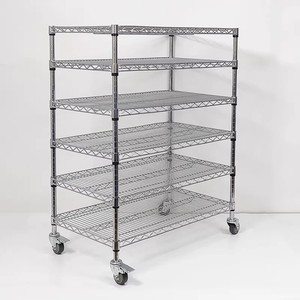
Chrome Plated Wire Mesh Anti-Static ESD Multi-Layer Industrial Shelves
- Surface Resistance: <10^9 Ω
- Triple-Nickel Chrome Finish
- Open Wire Ventilation Grid
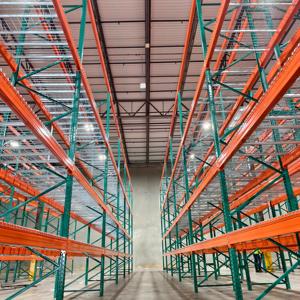
Heavy Duty Teardrop Pallet Racking System for Distribution Centers
- Universal Teardrop Hole Pitch
- Dual Auto-Lock Safety Pins
- RMI MH16.1 Certified Rating
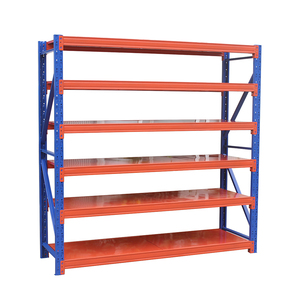
Adjustable Heavy Duty Selective Steel Pallet Storage Widespan Racking
- Direct Accessibility: 100%
- Box Beam Section: Up to 5000kg
- 50mm / 75mm Pitch Adjustable
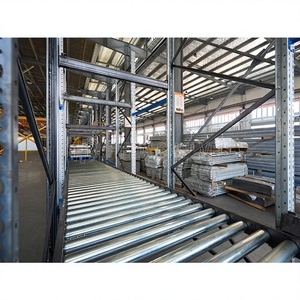
Customized Heavy Duty Gravity Roller Flow & Carton Flow Racks
- FIFO Automatic Rotation
- Centrifugal Speed Dampers
- High Throughput Pick Lanes
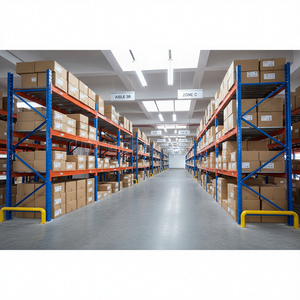
Heavy Duty Nested Cart Push Back Pallet Racking Storage System
- 2 to 6 Pallets Deep Storage
- Zero Forklift Entry Required
- Precision Nested Steel Carts
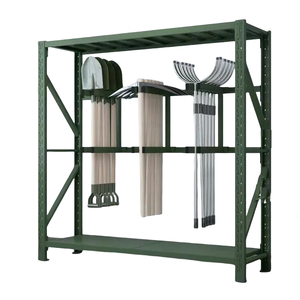
Adjustable Steel Industrial Shelving Units & Warehouse Longspan Racks
- Step Beam Mesh Decking
- Boltless Quick Assembly
- Manual Picking Optimization
Industrial Storage Typology: Kinematic & Spatial Comparison
Comprehensive architectural comparison matrix balancing volumetric storage utilization, SKU selectivity, forklift cycle times, and structural investment ratios across standard and advanced racking typologies.
| System Architecture | Floor Footprint Utilization | Selectivity Profile | Stock Rotation Strategy | Forklift Impact Vulnerability | Relative CAPEX Index |
|---|---|---|---|---|---|
| Selective Pallet Racking | 40% – 45% (Aisle Intensive) | 100% Direct Access | FIFO or LIFO | Moderate (Column Guards Mandatory) | Baseline (1.0x) |
| Drive-In / Drive-Through | 65% – 75% (Aisle-Less) | Low (Batch SKU Storage) | LIFO (Drive-In) / FIFO | High (Aisle Ingress) | 1.3x – 1.5x |
| Push-Back Carts (2-6 Deep) | 60% – 70% (Compact Lanes) | Medium (1 SKU per Lane) | LIFO (Gravity Assisted) | Low (Operates Outside Rack) | 1.8x – 2.2x |
| Gravity Pallet Flow | 70% – 80% (Dynamic Slopes) | High (Per Lane Access) | Strict FIFO Automatic | Low (Dedicated Ingress/Egress) | 2.5x – 3.2x |
| Radio Shuttle System | 80% – 88% (Deep Channel) | Medium-High (Autonomous) | Flexible FIFO / LIFO | Minimal (Zero In-Rack Forklift) | 2.8x – 3.8x |
| Smart Motorized Mobile Racking | 85% – 92% (Single Moving Aisle) | 100% Selective on Demand | FIFO / LIFO Dynamic | Very Low (PLC Sensor Locked) | 3.5x – 4.5x |
Strategic Procurement Vectors Reshaping Industrial Storage
Global logistics networks are re-engineering supply chain resilience. Procurement executives must evaluate these key macroeconomic shifts when contracting factory manufacturing in China.
1. AS/RS and Shuttle-First Modularity
Standard manual racking is being superseded by automation-ready structures. Global buyers now specify upright punching tolerances within ±0.25mm and ultra-stiff boxed guide channels capable of accommodating autonomous shuttles, vertical reciprocating conveyors (VRC), and automated stacker cranes without structural retrofitting.
2. Decarbonized "Green Steel" Procurement
Multinational ESG mandates in the EU (CBAM), Australasia, and North America require traceable carbon footprint declarations. Leading Chinese exporters now offer environmental product declarations (EPD), utilizing scrap-recycled electric arc furnace (EAF) steel and zero-VOC heavy-metal-free electrostatic powder coatings cured under low-energy infrared ovens.
3. Direct-from-Factory Turnkey Kits
Intermediate regional re-sellers add 30–45% markups with zero manufacturing oversight. The procurement trend favors direct factory partnerships offering end-to-end parametric 3D CAD modeling, factory pre-stamping of load plaques, localized anchor bolt selection, and container-cubed pallet staging to dramatically cut total landed costs.
Technological Innovations in High-Yield Structural Racking
From micro-alloyed structural sheet steels to automated dynamic continuous roll-forming lines: How modern manufacturing engineering enhances safety and dynamic capacity.
Cold-Rolled Section Optimization: High-Tensile Q355B vs. Standard Q235B
In high-bay racking systems exceeding 10 to 18 meters in clear height, structural dead weight becomes a critical factor dictating slab foundation thickness and seismic anchor shear stress. Our engineering facilities utilize high-tensile Q355B micro-alloyed structural strip steel (nominal yield strength $f_y \ge 355\text{ MPa}$, tensile strength $470–630\text{ MPa}$), delivering a 35% higher load-to-weight ratio compared to conventional Q235B carbon steel. By employing continuous cold-roll forming with up to 24 progressive rolling passes, cold-work hardening is precisely controlled without generating localized micro-fractures along column return bends.
Finite Element Analysis (FEA) and Seismic Dynamic Simulation
Every non-standard industrial storage bay engineered at HEDA Shelves undergoes rigorous computer-aided modal analysis and non-linear pushover simulations. Under high seismic performance regimes—such as the active fault parameters dictated by NZS 1170.5 in New Zealand, AS 4084:2023 Section 8 in Australia, and IBC/RMI MH16.1 in seismic zones 3 and 4 across the Americas—our engineers calculate second-order ($P-\Delta$) effects, ductility reduction coefficients, and beam-end weld shear endurance to eliminate catastrophic progressive collapse risks.
Dual-Coating & Anti-Corrosive Nanotechnology
For aggressive environmental exposures—such as sub-zero maritime cold chain warehouses (-30°C), agricultural fertilizer bulk sheds, and coastal high-humidity logistics hubs—surface treatment is paramount. Components pass through an automated 12-stage pre-treatment line featuring zinc-iron phosphating and silane nanocoating, followed by a double electrostatically applied polyester epoxy powder film ($60–90\mu\text{m}$ thickness). For high-saline offshore regions, continuous hot-dip galvanizing (HDG compliant with ISO 1461, minimum coating thickness $65–85\mu\text{m}$) provides decades of maintenance-free cathodic barrier protection.
Guangzhou Heda Shelves Co., Ltd.: Manufacturing Capabilities
Established in 2001, Guangzhou Heda Shelves Co., Ltd. has grown into one of Asia's most advanced heavy-duty warehouse equipment engineering centers, trusted by multinational logistics contractors worldwide.
30,000 m² Modern Smart Hub
Operates state-of-the-art automatic CNC laser slitting, 24-station continuous roll-forming lines, automated robotic arm welding clusters, and multi-color electrostatic powder-coating conveyor systems.
30,000 Metric Tons Monthly Capacity
Massive monthly cold-formed steel throughput guarantees shortened production lead times (10–18 working days) for multi-thousand pallet position projects, easily supporting high-volume global rollouts.
Accredited International Quality Certifications
Fully certified under CE Certification No. 2435-CPR-8605159, ISO 9001:2015 No. 18624Q00169R0M, and RoHS compliant. Load test calculations provided for local municipal certifiers.
Free In-House 3D & Parametric CAD Layouts
Our 300+ engineering and technical team converts your building floor plans, dock locations, forklift parameters, and sprinkler clearances into fully calculated 3D layout renderings and installation prints within 24 hours.
Biosecurity & Zero-Damage Export Packaging
All ocean container shipments are staged on specialized heavy-duty steel stillages or heat-treated timber compliant with ISPM-15, ensuring seamless clearance with Australian DAFF, New Zealand MPI, and US CBP.
Comprehensive OEM / ODM Distributor Programs
We provide full white-label manufacturing for overseas racking brands, including custom hole-pitch roll-forming, customer-branded laser cutting, bespoke color-matched powder coatings, and site-specific load plaques.
Frequently Asked Technical Questions (FAQ)
Key architectural, compliance, metallurgical, and logistics inquiries addressed by our Chief Structural Engineers.
1. How does your factory ensure compliance with AS 4084, FEM 10.2.02, and ANSI/RMI MH16.1 standards?
Our engineering division designs each pallet racking system around the specific legal standard mandated by your destination jurisdiction. For Australian and Oceanic projects, structural members reference AS 4084:2023 (Steel Storage Racking), incorporating prescribed upright perforation reduction factors, permissible beam deflection limits ($L/200$), and required upright shear connectors. For European projects, calculations strictly satisfy EN 15512:2020 principles. For North American distribution centers, framing adheres to ANSI/RMI MH16.1. Full calculation books, sectional moment of inertia reports ($I_x, I_y$), and mechanical mill test certificates are issued with every order for submission to local structural certifiers.
2. What concrete floor slab specifications and anchor bolt calculations are required?
Heavy-duty selective and high-bay racking systems generate high point loads at baseplate contact points, often ranging from 30 kN to over 150 kN per column. A minimum concrete slab strength of 25–30 MPa (C25/30) with a reinforced slab thickness of 150mm to 250mm is typically specified. Our engineering team provides detailed upright baseplate footprint drawings, calculating concrete cone breakout resistance, edge distance allowances, and embedment depth for mechanical expansion anchors or chemical epoxy capsules (e.g., M12 to M16 grade 8.8 bolts) based on site seismic zone requirements.
3. How does HEDA handle international biosecurity and timber packaging regulations?
Strict biosecurity authorities—such as Australia’s Department of Agriculture, Fisheries and Forestry (DAFF) and New Zealand’s Ministry for Primary Industries (MPI)—enforce zero tolerance for bark, timber pests, or soil contamination. HEDA eliminates this friction by defaulting to custom welded heavy-duty steel shipping cradles and stillages that require zero fumigation. When timber blocking is requested, we utilize exclusively ISPM-15 certified, heat-treated (HT), debarked, and globally stamped hardwood accompanied by official phytosanitary treatment certificates.
4. What surface finishes prevent corrosion in sub-zero cold stores and tropical climates?
For standard temperature-controlled warehouses, our automated dual-gun electrostatic powder coating delivers an abrasion-resistant polymer skin ($60–90\mu\text{m}$) that endures typical indoor industrial operations. For sub-zero chiller/freezer environments (-30°C) with active condensation, we formulate low-temperature cross-linked resin powders that prevent micro-cracking during thermal cycling. For extreme exterior, open-shed, or high-humidity tropical sites (such as coastal Queensland, the Pacific Islands, or Southeast Asia), we supply continuous hot-dip galvanized (HDG) steel conforming to ISO 1461, ensuring self-healing sacrificial zinc protection against salt spray and moisture.
5. How do beam-to-column connector locks prevent accidental dislodgement from forklifts?
Beam dislodgement caused by upward forklift tines is a primary factor in warehouse collapses. HEDA’s connector brackets feature heavy-duty multi-claw hooks (3-claw, 4-claw, or 5-claw cold-stamped from 4.0mm high-strength steel plate). Every beam end incorporates a spring-loaded zinc-plated safety locking pin engineered to resist upward impact forces exceeding 10 kN (surpassing FEM 10.2.02 and AS 4084 minimums). In high-throughput sites, bolted safety pins are provided to prevent unauthorized manual removal during beam re-profiling.
6. What is your typical ocean freight staging and container utilization strategy?
Because structural upright frames and horizontal beams exhibit different volumetric packing densities, improper loading leads to wasted ocean freight space. Our logistics engineers utilize proprietary 3D container cubing software. Long upright frames (nested to prevent transit chafing) are positioned along container floor tracks, with bundled box beams, pallets of baseplates, row spacers, and wire decks staged on top to maximize container weight capacity (achieving 24 to 26 metric tons per 40ft High Cube container). Every shipping bundle is clearly tagged with color-coded part numbers corresponding directly to your warehouse erection drawings.
Accelerate Your Storage ROI with Free 3D CAD Engineering
Provide your warehouse dimensions, clear eaves height, pallet specifications, and forklift turn radius. Our engineering team will deliver a comprehensive structural design layout, load calculation profile, and firm factory export quotation within 24 hours.