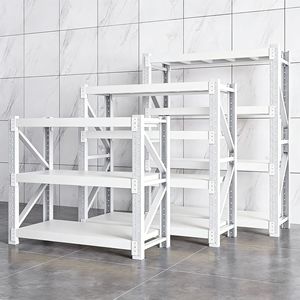
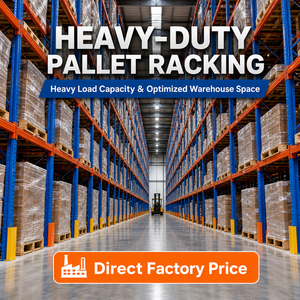
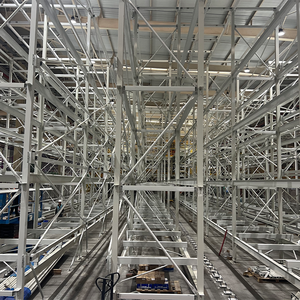
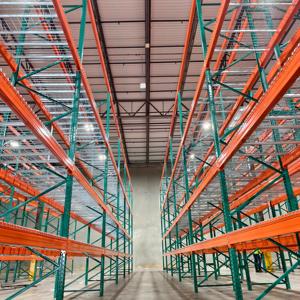
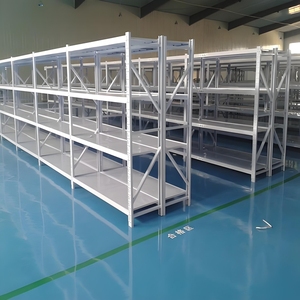
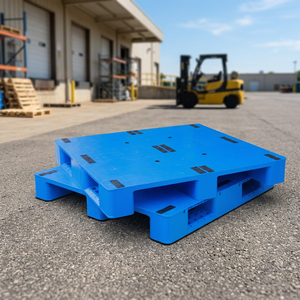
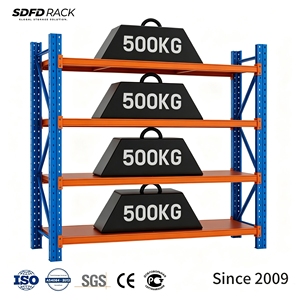
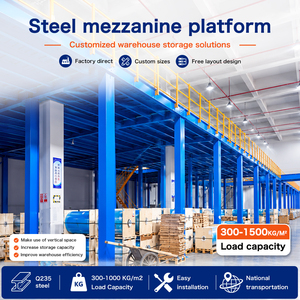
Customized Industrial Mezzanine Floor Rack Heavy Duty Steel Warehouse Storage Platform Multi Level Shelving
- Load Capacity: 300 – 1,200 kg/m²
- Integrated structural frame upright design
- Perforated steel & anti-slip floor panels
Precision-punched cold-rolled upright frames, heavy-duty load beams, and integrated structural platforms manufactured with high-tensile Q235B/Q355B structural steel for maximum volumetric efficiency.
A granular technical exploration of cold-formed steel behavior, perforated upright section stability, torsional-flexural resistance, and global safety code verification.
Pallet rack upright frames represent the primary vertical load-bearing mechanism in warehouse logistics infrastructure. Unlike conventional hot-rolled structural H-beams, rack frames rely on cold-formed thin-walled steel profiles produced through progressive multi-station roll-forming lines. The engineering challenge lies in balancing material economy with resistance to local buckling, distortional buckling, and global Euler flexural-torsional buckling.
At Guangzhou Heda Shelves Co., Ltd., upright columns are rolled from structural grade Q235B and high-strength Q355B hot-rolled pickled and oiled (HRPO) steel coils, possessing nominal yield strengths of 235 MPa and 355 MPa respectively. Through cold-work hardening during continuous roll-forming (22 to 26 sequential roller passes), the yield strength in the column corner radii increases by up to 15-20%, significantly enhancing the section modulus and moment of inertia ($I_x, I_y$).
Perforation design is equally critical. Whether utilizing American Teardrop configurations, European 50mm pitch Omega profiles, or Australian 76.2mm pitch diamond slots, punching introduces stress concentrations and reduces effective cross-sectional area. Advanced finite element simulation (ANSYS and RFEM) is employed to compute the Effective Width in compliance with EN 1993-1-3 (Eurocode 3) and AISI S100 specifications, ensuring that perforations maximize beam connector engagement without compromising axial load paths.
The stability of an upright frame in the cross-aisle direction is entirely governed by its bracing truss configuration. Industrial rack frames typically feature either K-bracing, D-bracing (diagonal-horizontal alternating), or continuous X-bracing. The cross-sectional profile of the bracing channels—commonly C-shaped or hat-shaped cold-formed sections with rolled-in stiffening lips—must withstand both tensile yield and compressive buckling under unevenly distributed pallet weights.
In global export markets, the structural engineering consensus heavily favors bolted frame assemblies over shop-welded frames. While welded frames eliminate field assembly, their volumetric footprint during ocean transport increases logistics costs by up to 300%, with significant risks of transit deformation. Bolted frames, utilizing high-tensile Grade 8.8 structural hardware with serrated flange lock-nuts, deliver identical shear rigidity when torqued to specified engineer limits, while allowing modular field replacement of damaged lower horizontal struts without requiring complete bay teardowns.
| Profile Specification | Base Steel Grade | Tensile Yield ($f_y$) | Standard Pitch | Compliance Standards | Typical Industrial Application |
|---|---|---|---|---|---|
| Omega Closed/Open Profile | Q355B Cold-Rolled | ≥ 355 MPa | 50mm / 75mm | EN 15512:2020 / CE | Automated AS/RS, High-Bay Cold Stores (>12m) |
| Teardrop Upright Frame | ASTM A1011 / Q235B | ≥ 235 - 310 MPa | 2.0 inch (50.8mm) | RMI ANSI MH16.1 | North & South American Logistics Hubs |
| Diamond Slot Upright | Q235B / Q355B | ≥ 235 - 355 MPa | 76.2mm (3.0 inch) | AS 4084-2023 | Australia, New Zealand, Pacific Distribution |
| Heavy-Duty Box Frame | Q355B Structural | ≥ 355 MPa | Custom / 100mm | FEM 10.2.02 / ISO | Heavy Coil, Die Storage, Drive-In Bases |
| Cantilever Column Frame | Hot-Rolled H-Section | ≥ 345 MPa | 100mm / 140mm | AISC 360 / AS 4100 | Timber, Structural Steel Pipes, Sheet Packs |
How progressive logistics operators, supply chain directors, and enterprise importers are recalibrating their racking frame specifications to survive evolving regulatory and automation pressures.
Procurement mandates are moving away from simplified static equivalent load calculations. Modern facilities in high-risk seismic regions (e.g., New Zealand under NZS 1170.5, the US West Coast under ASCE 7-22, and Latin America) now require nonlinear dynamic time-history simulations. Frame baseplates are evolving from simple stamped steel pads to heavy ductile cast or CNC-machined energy-dissipating anchor plates that absorb inter-story drift without brittle weld failures.
The explosive adoption of Autonomous Mobile Robots (AMRs), high-speed shuttles, and automated cranes requires frame deflection limits far beyond traditional manual forklift tolerances. Allowable column out-of-plumbness has tightened from 1/350 to under 1/750. Manufacturing lines now incorporate real-time laser profile scanners to verify roll-forming straightness and pitch alignment within ±0.5mm over a 12-meter continuous span.
Environmental regulations and aggressive cold-chain microclimates are reshaping surface finishing. Traditional iron and zinc phosphating pre-treatments are being superseded by zirconium-based nano-ceramic coatings that reduce sludge by 95% while enhancing powder paint adhesion. In sub-zero cold rooms (-30°C) and tropical Pacific coastal warehouses, pre-galvanized or hot-dip galvanized frame uprights (HDG) are mandated to eliminate micro-cracking and rust blistering caused by humidity condensation cycles.
Global sea freight fluctuations have converted packaging engineering into a core procurement priority. Tier-1 Chinese exporters engineer interlocking KD (knocked-down) frame bundles using precision-welded transport saddles. This packaging method achieves over 26 metric tons per 40ft High Cube container while completely preventing web buckling or paint chafing during 30-day ocean transits.
With stringent building code audits (such as AS 4084 verification in Australia and IBC special inspections in the USA), corporate buyers can no longer import unverified commercial-grade steel. Every production heat requires chemical composition verification (Carbon, Manganese, Silicon, Phosphorus, Sulfur) and Charpy V-notch impact toughness data matched to physical heat stamp numbers on frame columns.
Next-generation pallet rack frames are increasingly fitted with wireless tri-axial accelerometer sensors at critical forklift turning points. These IoT beacons automatically record high-velocity forklift mast impacts, logging structural yield thresholds into the warehouse management software (WMS) to prevent catastrophic rack frame collapses.
A quarter-century of structural manufacturing excellence, serving supply chains across Oceania, the Americas, Europe, and the Middle East with zero catastrophic structural failure records.
Factory Production Control certificate No. 2435-CPR-8605159, meeting rigorous European construction products regulation criteria for structural steel components.
Strict quality assurance protocols (Certificate No. 18624Q00169R0M) controlling every phase from raw coil slitting to automated electrostatic powder curing.
Dedicated design office providing customized warehouse layout drawings, frame section properties ($A, I_x, I_y, W_x, W_y$), and seismic compliance data within 24 hours.
Full ISPM-15 phytosanitary compliant packaging, bundled on heavy steel stillages to breeze through strict Australian DAFF and New Zealand MPI bio-security inspections.
Complete documentation packages including Form A, ChAFTA, and NZ-China FTA Certificates of Origin to unlock preferential import duty treatment for overseas partners.
Custom beam connector tooling, proprietary hole punching designs, and tailored brand stamping services for major international racking distributors and installers.
Critical technical, regulatory, and logistics queries answered by senior structural storage engineers to de-risk your international racking procurement.
While all three standards govern cold-formed steel racking design, their safety philosophy, load reduction coefficients, and testing protocols diverge significantly. AS 4084-2023 (Australia) requires strict limit state design focusing on pattern load eccentricities, explicit beam-to-column connector testing, and baseplate anchorage stiffness. RMI ANSI MH16.1 (USA) incorporates the AISI cold-formed steel specification, relying heavily on effective width methods and Allowable Stress Design (ASD) or LRFD methodologies. EN 15512:2020 (Europe) enforces limit state design combined with non-linear global frame analysis, requiring explicit consideration of semi-rigid joint behavior ($C_d$) under sway displacement. Heda Shelves calculates frames to suit the specific jurisdiction of your installation site.
A pallet rack upright frame does not carry a fixed load limit; its capacity is an inverse function of its unbraced length (the vertical distance between the floor and the first beam level, or between subsequent beam levels). In structural engineering terms, Euler buckling load is given by $P_{cr} = \frac{\pi^2 E I}{(K L)^2}$. As the unsupported height ($L$) of the lowest beam level increases from 1,500 mm to 2,200 mm, the frame's axial capacity can decrease by 25% to 40% due to flexural buckling around the weak axis ($y-y$). Consequently, our engineers require your exact first beam elevation to formulate safe upright column thickness (1.5mm, 1.8mm, 2.0mm, or 2.5mm) and bracing pitch.
For international projects, bolted upright frames are globally preferred for three distinct reasons: 1) Shipping Volumetric Efficiency: Knocked-down (KD) bolted frames nest tightly, allowing up to 3 to 4 times more frame components inside a single 40ft High Cube container compared to rigid welded frames, slashing ocean freight costs per pallet position. 2) Zero Transport Distortion: Rigid welded frames often suffer diagonal distortion during turbulent ocean voyages, making installation misaligned. 3) Easy Maintenance: If a forklift damages a lower frame member, a bolted structure allows quick replacement of individual struts or columns rather than replacing an entire welded bay.
For seismic active regions such as New Zealand (NZS 1170.5), Chile, Japan, or California (ASCE 7), standard static racking configurations are strictly prohibited. Heda Shelves applies seismic amplification factors ($C_d$, $R$, or $S_a$) calculated by certified structural engineers. We adjust the frame's cross-aisle and down-aisle stiffness by: 1) Increasing column baseplate footprint and thickness (≥10-16mm plate steel), 2) Utilizing heavy-duty M12/M16 chemical capsule anchors with high embedment depths, 3) Introducing full X-bracing spans in the rear bays, and 4) Incorporating welded heavy column floor shoes with dual anchoring pins.
Cold storage facilities (-20°C to -30°C) present extreme challenges including frost heave, moisture condensation during defrosting, and low-temperature steel embrittlement. Standard commercial steel can suffer brittle fractures under impact at sub-zero temperatures. Heda Shelves utilizes certified Q355B/Q355D steel coils featuring verified low-temperature Charpy V-notch impact toughness. For surface finishing, we apply either hot-dip galvanizing (HDG with ≥65 μm zinc thickness conforming to ISO 1461) or an advanced TGIC-free epoxy-polyester architectural powder coat cured at 200°C, preventing micro-fissuring and rust creep.
Australia's Department of Agriculture, Fisheries and Forestry (DAFF) and New Zealand's Ministry for Primary Industries (MPI) operate the world's strictest biosecurity inspection regimes. Untreated timber dunnage will result in immediate onshore fumigation orders or re-export at astronomical costs. Heda Shelves eliminates this risk entirely by packing racking components onto 100% all-steel transport frames or strictly using kiln-dried, heat-treated timber bearing the official ISPM-15 IPPC stamp. All containers undergo thorough high-pressure washing and residual moisture checks prior to seal application.