Mezzanine Platform
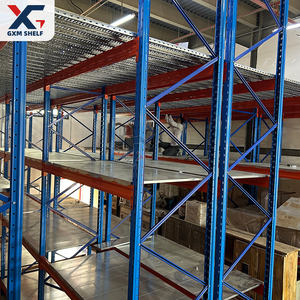
Certified cold-formed steel racking arrays and structural platforms manufactured under strict ISO 9001:2015, CE, and international safety compliance benchmarks.
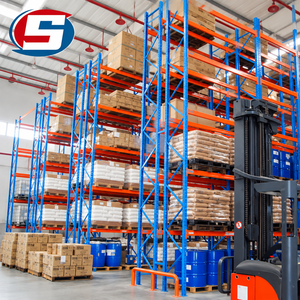
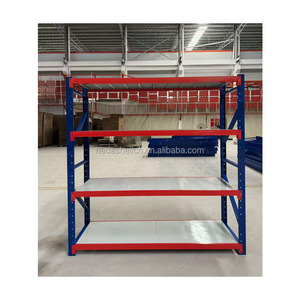
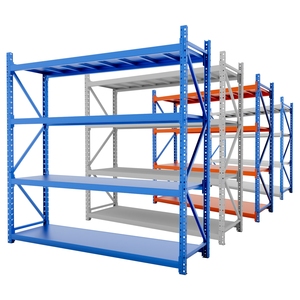
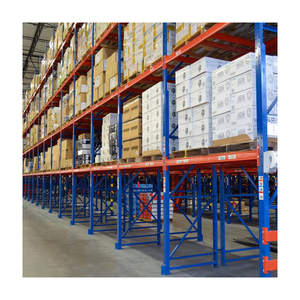
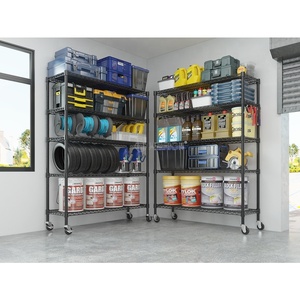
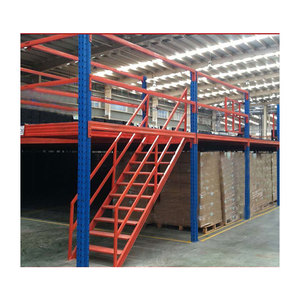
Established in 2001, Guangzhou Heda Shelves Co., Ltd. has evolved from a regional structural fabricator into an internationally accredited, technology-driven powerhouse serving supply chains across Australia, New Zealand, Europe, and North America.
In the sphere of global heavy-duty material handling, sourcing industrial racking and mezzanine platforms from top-tier Chinese manufacturers is no longer merely an arbitrage on raw material pricing; it is an integration into the world's most sophisticated steel fabrication clusters. Structural racking relies fundamentally on cold-formed thin-walled steel sections engineered to optimize load-to-weight ratios without sacrificing structural elasticity or buckling resistance.
At Guangzhou Heda Shelves Co., Ltd., raw coils are procured exclusively from state-level primary mills conforming to certified structural grades, predominantly Q235B (yield strength $f_y \ge 235\,\text{MPa}$) and high-tensile Q355B (yield strength $f_y \ge 355\,\text{MPa}$, comparable to European S355 and Australian Grade 350). Every production batch undergoes rigorous ultrasonic weld testing and tensile yield analysis, maintaining cross-sectional profile tolerances strictly within $\pm 0.5\,\text{mm}$ across automated continuous cold roll-forming lines.
To eliminate field assembly deviations in complex multi-tier mezzanine floor installations, upright columns and box-beam connectors are punched via high-precision CNC multi-station dies. The structural connectivity of our omega upright profiles and teardrop/box beams is designed in strict conformance with AS 4084:2023 (Steel Storage Racking), EN 15512:2020 (European Specification for Cold-Formed Steel Racking), and the American RMI (MH16.1:2021) design codes. This mechanical discipline guarantees predictable elastic-plastic behavior under dead, live, impact, and seismic spectrum loadings.
Automated uncoiling, slitting, and continuous 16-to-24-stand roll forming of omega-section uprights and interlocking step beams with uniform stress relief.
High-speed, multi-head numerical punching providing 50mm or 75mm beam adjustment pitches with index-locked pitch alignment tolerances under 0.2mm.
Six-axis industrial welding robots attach 3, 4, or 5-claw beam connectors with deep-penetration inert gas shielding, certified to AWS D1.1 and EN ISO 15614-1.
Comprehensive acid pickling, ultrasonic degreasing, clean water cascades, and zinc phosphating ensuring optimum molecular chemical bonding prior to powder coating.
Nordson automated powder spray booths depositing 60-80μm thermosetting epoxy-polyester coatings, cured at 180°C-200°C for exceptional impact and salt-fog endurance.
Export components strapped on dedicated steel stillages or ISPM-15 heat-treated timber dunnage to eliminate maritime transit deflection and facilitate rapid deconsolidation.
Compare footprint utilization, structural expenditure indices, throughput cycle capabilities, and automation readiness across primary heavy-duty systems.
| Storage System Type | Space Utilization | Pallet Selectivity | Standard Load / Level | CAPEX Index | Seismic & Code Suitability | Forklift Interaction |
|---|---|---|---|---|---|---|
| Selective Pallet Racking | 40% – 50% | 100% Direct Access | 1,000 kg – 4,000 kg | Baseline ($) | AS 4084, EN 15512, RMI | Standard Counterbalance / Reach |
| Drive-In / Drive-Through | 70% – 85% | LIFO / Strict Batch | 500 kg – 1,500 kg | Moderate ($$) | Requires Heavy Frame Bracing | Forklift Enters Rack Structure |
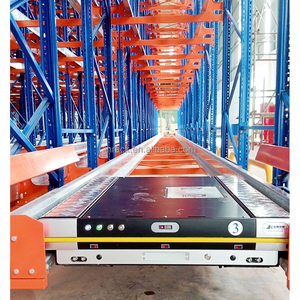
| Radio Shuttle System | 85% – 92% | LIFO or Automated FIFO | 500 kg – 1,500 kg | Advanced ($$$) | Excellent Dynamic Stability | Aisle-Only Forklift Drop-Off |
| Rack-Supported Mezzanine | 100% Vertical Gain | Hybrid (Pallet + Bin) | 300 – 1,000 kg/m² Floor | Moderate-High ($$$) | IBC / AS 1170.1 & AS 4084 | Stair, Lift & Pallet Gate Loading |
| Structural Steel Platform | Maximum Clear Span | Full Open Floor Plan | 500 – 2,000 kg/m² Floor | High ($$$$) | AISC 360, EN 1993, AS 4100 | Unobstructed Ground-Floor Traffic |
How progressive warehouse operators and international procurement directors are adapting specifications to meet technological and regulatory shifts through 2030.
Traditional static storage is rapidly losing ground to semi-automated and autonomous high-density configurations. Global buyers are increasingly retrofitting standard pallet racking into autonomous shuttle corridors. Multi-depth radio shuttle channels remove internal forklift operation entirely, eliminating mast impact risks—the root cause of over 85% of structural rack collapses worldwide.
Furthermore, leading Chinese factories are standardizing guide rail profiles to ensure plug-and-play interoperability with Autonomous Mobile Robots (AMRs), Automated Guided Vehicles (AGVs), and vertical reciprocating lifts (VRCs), creating flexible, modular automation networks at a fraction of traditional ASRS capital expenditure.
Procurement directors operating in high-risk seismic environments—such as New Zealand (NZS 1170.5), the Pacific Rim, the US West Coast (IBC/ASCE 7), and Southern Europe—are mandating sophisticated finite element analysis (FEA) from manufacturers. Racking systems are no longer treated as static furniture; they are structural buildings under continuous live mass excitation.
Current sourcing specifications require suppliers to provide certified nonlinear dynamic performance evaluations. Advanced engineering features include enlarged structural base plates, multidirectional chemical anchor embedding depths ($h_{ef} \ge 120\,\text{mm}$), reinforced diagonal cross-bracing channels, and ductile beam-to-column semi-rigid connection moment testing.
With the implementation of the European Union’s Carbon Border Adjustment Mechanism (CBAM) and stricter international ESG corporate governance, the embodied carbon of structural steel products is subject to rigorous procurement scrutiny. Leading Chinese manufacturers are transitioning their supply chain towards Electric Arc Furnace (EAF) recycled scrap steel and certified low-emission blast furnace coils.
Tier-1 factories now maintain verified Environmental Product Declarations (EPD) and supply chemical ladle analysis certificates proving compliance with RoHS, REACH, and VOC-free powder formulations, ensuring that overseas importers do not encounter punitive green tariffs or customs regulatory impoundments upon port arrival.
The explosive demand for rapid e-commerce parcel processing and localized inventory sorting has triggered a dramatic pivot toward rack-supported and multi-tier structural mezzanine designs. Instead of signing leases for costly horizontal square footage, facilities are expanding vertically to create two-, three-, or four-level mezzanine operations within existing footprints.
Modern mezzanine engineering incorporates pre-punched structural channel beams, modular fire-resistant perforated steel grating floors, integrated chute apertures, integrated LED raceway fixtures, and specialized cantilevered safety loading gates that interface smoothly with forklift drop zones.
Essential engineering checkpoints, third-party audit verifications, and freight optimization protocols required before issuing international purchase contracts.
When procuring structural equipment offshore, international engineering teams must inspect beyond basic price quotation sheets. A comprehensive factory evaluation encompasses three mandatory tiers of verification:
At Guangzhou Heda Shelves Co., Ltd., clients receive fully documented engineering data packs with every tender: structural calculation reports, section modulus calculations ($Z_x, Z_y$), radius of gyration values ($r_x, r_y$), and complete FEA stress contour simulations demonstrating elastic stability under full design loads.
Direct technical answers addressing engineering standards compliance, seismic certifications, shipping logistics, and customs documentation.
Yes. Fully accredited manufacturers like Guangzhou Heda Shelves Co., Ltd. design racking profiles specifically conforming to the structural principles of AS 4084:2023 (Steel storage racking) and EN 15512:2020. Our engineering office provides complete cross-sectional property data (second moment of area, torsional constants, and warping section modulus) along with detailed load calculation tables and seismic sign-off data packs. This enables independent structural engineers in Australia, New Zealand, or Europe to verify the installation against local building codes and certify safe working load (SWL) placards.
Structural racking components present unique container-stuffing challenges due to high weight density and irregular shapes. Upright frames are pre-assembled or shipped in knocked-down (KD) format nested with protective corrugated separator sheets. Step beams and box beams are banded in tight square bundles on custom-fabricated steel channel skids. All dunnage complies with international biosecurity mandates (ISPM-15 heat-treated stamped timber or 100% steel stillages), allowing frictionless clearance through Australian DAFF, New Zealand MPI, and US CBP agricultural inspections without treatment quarantine holds.
A rack-supported mezzanine uses heavy-duty pallet racking or longspan upright frames as its primary vertical load-bearing columns. This system is exceptionally cost-effective when the lower level requires dense storage (e.g., bin picking or pallet slots) and the upper level supports pedestrian picking or light sorting. In contrast, a structural steel mezzanine uses heavy hot-rolled H-beams (or universal columns) and C/Z purlins to achieve wide clear spans (typically 6m to 12m), keeping the ground floor completely unobstructed for forklift corridors, automated sorting machines, or bulk staging.
Standard indoor architectural powder coatings can become brittle and micro-crack at sub-zero operating temperatures (-25°C to -40°C), allowing condensation moisture to infiltrate and initiate subsurface corrosion. For cold storage and blast freezing applications, we specify low-temperature impact-resistant epoxy-polyester formulas or high-performance hot-dip galvanization (HDG according to ISO 1461, minimum 85μm coating thickness). Additionally, the base steel must exhibit high Charpy V-notch impact toughness at freezing temperatures (such as Q355D or Q355E) to prevent brittle fracture under sudden dynamic forklift impacts.
To produce an optimized CAD warehouse layout within 24 hours, our application engineering team requires: (1) An architectural warehouse floor plan showing clear internal eaves height, building column centers, roller doors, and fire sprinkler clearances; (2) Pallet specifications including overall dimensions (e.g., Australian standard 1165×1165mm, Euro 1200×800mm, or US 48×40 inches), cargo overhang, and maximum gross weight per pallet; and (3) Forklift fleet parameters, including mast lift height, minimum turning radius, and required aisle operating widths (typically 3.0m–3.5m for reach trucks, 1.8m–2.0m for articulated/VNA units).
Send our senior engineering team your warehouse architectural floor plan, pallet dimensions, and operational throughput targets. We deliver complete 3D structural layouts, load-distribution diagrams, and factory-direct FOB/CIF pricing within 24 hours.