[email protected] Supplying Australia, New Zealand & the Pacific Islands
Global Engineering & Export Authority

Top Trusted Commercial Industrial Shelving Systems Manufacturers & Exporters

High-precision cold-formed steel racking, structural mezzanine engineering, and turnkey intralogistics storage systems certified to international safety and load compliance standards.

Certified Fleet Architecture

Featured Industrial Warehouse Storage Systems

Engineered from premium Q235B and Q355B cold-rolled structural steel, our heavy-duty industrial shelving and automated pallet racking configurations are manufactured to withstand severe dynamic and seismic load requirements.

2001.
Founded Year / 25Y Track Record
30,000m²
Intelligent Production Facility
30,000t
Monthly Cold-Formed Steel Capacity
10,000+
Global Warehousing Projects Executed
Technical Whitepaper: Industry Focus

Structural Engineering Dynamics & International Standards in Heavy-Duty Storage

Commercial industrial shelving and selective pallet racking systems are not static ironmongery; they are mission-critical, life-safety structural frameworks. As modern supply chain hubs scale vertically to optimize cube utilization, the mechanical interface between cold-formed steel sections, dissipative baseplates, and dynamic floor slabs dictates operational longevity and seismic resilience.

When international EPC contractors, 3PL giants, and industrial asset managers source commercial shelving systems overseas, procurement decisions hinge on verified structural compliance. Our manufacturing facility in Guangzhou designs, models, and rolls heavy racking profiles based on limit-state design principles complying strictly with AS 4084:2023 (Steel Storage Racking), EN 15512:2020 (European Racking Code), RMI ANSI MH16.1, and NZS 1170.5 for extreme Australasian seismic zones.

"The ultimate limit state (ULS) of an industrial storage rack must account for second-order P-Delta effects, beam-to-column rotational stiffness, and upright perforational shear reduction factors. Specifying steel based solely on unperforated strip yield strength is the leading cause of premature progressive collapse in high-density facilities."

To eliminate micro-fracturing along punch patterns, upright profiles undergo continuous multi-station roll-forming with automated servo-controlled mechanical punching. The geometric configuration of the Omega and diamond-lock columns guarantees maximum moment of inertia while facilitating positive interlocking connector engagement, eliminating beam dislodgement risks even under severe pallet snag forces.

System Selection Architecture

Technical Comparison: Commercial Shelving & High-Density Pallet Racking

Selecting the ideal storage topology requires balancing volumetric storage density, SKU selectivity, picking cycle times, and floor-slab civil engineering limitations. The matrix below outlines operational tradeoffs across our primary manufactured system classes:

Racking Topology Floor Space Utilization Selectivity Rate Maximum Load / Unit Handling Fleet Interface Primary Industrial Sector
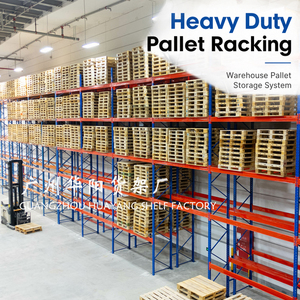
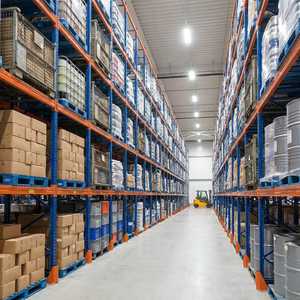
Selective Pallet Racking 40% - 45% 100% Direct 1,000 - 4,500 kg / level Counterbalance, Reach Truck 3PL, FMCG, Retail Distribution
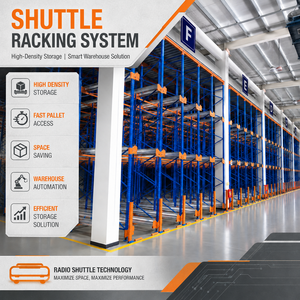
Radio Shuttle System 80% - 85% FIFO / LIFO Batched 1,500 kg / pallet Automated Shuttle Carrier Cold Storage (-30°C), Beverage, Dairy
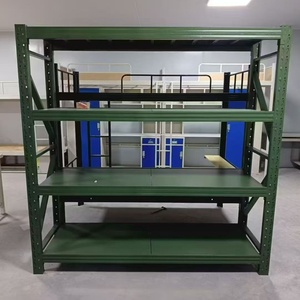
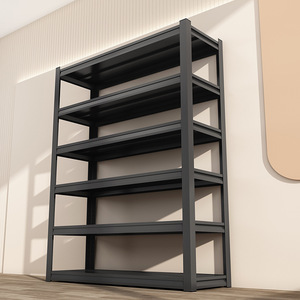
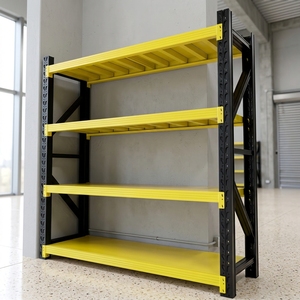
Long Span Boltless Shelving 55% - 65% 100% Manual 300 - 800 kg / shelf Manual Cart, Order Picker Automotive Parts, E-Commerce Totes
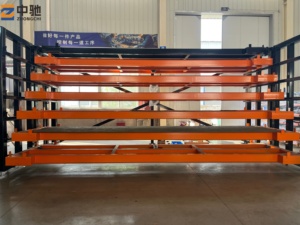
Heavy Cantilever Racking 50% - 60% 100% Linear 1,000 - 3,000 kg / arm Side Loader, Multi-Directional Timber, Extrusions, Steel Coils
Rack-Supported Mezzanine 150% - 250% (Volumetric) 100% Multi-Tier 300 - 1,000 kg / m² Vertical Lifts, Conveyor, Manual Apparel Fulfillment, Parts Warehousing
Strategic Procurement Horizons

Future Procurement & Engineering Trends in Industrial Storage

Supply chain executives and procurement directors face unprecedented volatility across labor availability, real estate leasing rates, and ESG compliance. Over the next five years, four fundamental shifts will redefine commercial racking procurement globally:

Automation-Ready Hybrids

Standard static racking is being superseded by hybrid structures capable of retrofitting autonomous mobile robots (AMRs), automated guided vehicles (AGVs), and high-speed vertical reciprocating conveyors (VRCs) without structural teardown.

Seismic Energy Dissipation

Stricter building codes in earthquake belts (such as New Zealand's Wellington fault zones or California's seismic regions) mandate non-linear response history analysis and yielding baseplate anchors to mitigate progressive row failure.

Low-Carbon Circular Steel

ESG covenants require tier-1 exporters to document carbon intensity. We integrate EAF (Electric Arc Furnace) scrap-recycled steel and zero-VOC thermoset electrostatic powder coatings to satisfy Scope 3 decarbonization mandates.

Digital Twin & CAD Integration

Procurement cycles now demand verified Building Information Modeling (BIM) files (Revit/IFC) alongside structural calculations before steel cutting, ensuring clash-free integration with ESFR sprinkler and MEP infrastructure.

Enterprise Manufacturing Capabilities

Why Global Supply Chains Partner with Guangzhou Heda Shelves Co., Ltd.

Established in 2001, Guangzhou Heda Shelves Co., Ltd. has grown from an industrial roll-forming workshop into a world-class manufacturing authority. Spanning 30,000 square meters of precision fabrication workshops and backed by over 300 experienced engineers and technical specialists, our monthly production capacity exceeds 30,000 metric tons of cold-formed structural steel storage equipment.

Free 3D CAD & FEA Layouts

Our engineering department supplies complete 3D photorealistic renderings, DWG floor plans, and Finite Element Analysis (FEA) load simulation calculations within 24 hours of receiving warehouse dimensions and pallet weight briefs.

Dual Global Accreditations

Backed by verifiable third-party certification: CE Certification No. 2435-CPR-8605159 and ISO 9001:2015 Quality Management System No. 18624Q00169R0M (valid through 2027), ensuring full audit traceability.

Biosecurity & Export Packaging

Shipments destined for Oceania, North America, and Europe are secured on heavy steel stillages or ISPM-15 certified heat-treated timber dunnage, guaranteeing immediate DAFF (Australia) and MPI (New Zealand) customs clearance without fumigation delays.

10-Stage Precision Manufacturing Workflow

Stage 01
Spectrometric Raw Steel QC
Stage 02
CNC High-Speed Slitting
Stage 03
Multi-Station Column Punch
Stage 04
Precision Cold Roll-Forming
Stage 05
Box Beam Roll Forming
Stage 06
Automated Laser Deburring
Stage 07
Robotic Pulse Welding
Stage 08
9-Stage Chemical Phosphating
Stage 09
Electrostatic Powder Curing
Stage 10
Pre-Assembly Inspection & Pack

CE Certified

Ref: 2435-CPR-8605159

ISO 9001:2015

Cert: 18624Q00169R0M

AS 4084 Compliant

Verified Australian Standards

NZS 1170.5 Ready

Seismic Dynamic Calculations

Expert Procurement Support

Frequently Asked Engineering & Export Questions

Clear, definitive answers to the most common structural, biosecurity, and logistical questions raised by warehouse developers and international racking importers.

How do your racking designs verify compliance with Australian Standard AS 4084:2023?
Our in-house structural engineers compute all racking bays with reference to limit-state principles mandated by AS 4084:2023. We supply certified engineering data packs detailing gross and net cross-sectional properties, section moduli, moment capacities, and Euler buckling analysis. This documentation enables your local independent certifier or chartered engineer to produce official sign-off certificates with zero discrepancy. Load plaques indicating safe working limits (SWL) for beams and frame capacities are supplied in accordance with Safe Work Australia standards.
Can structural shelving and mezzanines be engineered for New Zealand seismic zones?
Yes. For installations across New Zealand (including high-risk zones like Wellington and Canterbury), we design the racking system using site-specific spectral acceleration factors derived from NZS 1170.5 (Structural Design Actions - Earthquake actions). To accommodate significant horizontal ground motion, we incorporate heavy-duty box bracing, increased upright steel thicknesses, oversized baseplates with dual concrete chemical anchors, and reinforced inter-row tie spacers.
What steel grade is utilized and how is deflection controlled across wide beam spans?
We exclusively roll primary upright columns and load beams from certified Q235B (yield strength ≥ 235 MPa) and high-strength Q355B (yield strength ≥ 355 MPa) cold-rolled strip steel, confirmed via raw material heat certificates. Deflection limits under maximum Uniformly Distributed Load (UDL) are engineered to strictly adhere to L/200 (or L/300 upon specialized request), preventing permanent plastic deformation and assuring total forklift mast clearance during high-bay retrieval operations.
How do you ensure shipments comply with Australian DAFF and New Zealand MPI biosecurity?
To eliminate the risk of quarantine delays, customs impoundment, or onshore fumigation penalties, we pack all beams, uprights, and deck panels onto purpose-built heavy steel stillages or ISPM-15 certified heat-treated timber dunnage carrying visible international stamps. All containers are cleaned and inspected prior to stuffing, and packing declarations, commercial invoices, packing lists, and Certificates of Origin (under ChAFTA or NZ-China FTA) are provided with every Bill of Lading.
What surface pre-treatment and powder coating technology protects against industrial corrosion?
Our automated finishing line integrates a 9-stage pre-treatment process involving alkaline degreasing, ultrasonic water rinsing, pickling to strip scale, and high-density zinc phosphating. Components are subsequently electrostatically coated with lead-free, non-toxic epoxy-polyester thermoset powder and baked in curing tunnels at 180°C–200°C. For coastal, outdoor yard, or chemical environments, we offer hot-dip galvanizing to ISO 1461, ensuring over 500 hours of ASTM B117 salt spray resistance.
Can your radio shuttle racking operate reliably in deep-freeze cold storage facilities?
Yes. Our radio shuttle storage systems are specifically engineered for cold storage operating temperatures down to -30°C. Cold-chain variants utilize low-temperature synthetic lubricants, condensation-sealed IP65 electronic control boxes, and industrial lithium-iron-phosphate (LiFePO4) or gel batteries equipped with internal thermal management circuitry to ensure uninterrupted 8-10 hour operational shifts under harsh frozen conditions.

Accelerate Your Storage Capacity with a Free 3D CAD Engineering Proposal

Send our senior engineering group your warehouse CAD drawing, clear floor height, forklift clearance specifications, and pallet parameters. Receive complete system layouts, capacity calculations, and factory-direct pricing within 24 hours.