Explore our export-grade warehouse storage assemblies. Fully custom-engineered for maximum cube utilization, automated radio shuttle integration, dynamic gravity FIFO workflows, and extreme payload stability.
In modern industrial logistics, vertical cubic optimization has shifted from a peripheral spatial advantage to a fundamental operational imperative. Multi-tier pallet racking systems (often architecturally defined as rack-supported multi-level platforms or elevated picking catwalk systems) double or triple accessible operational square footage without expanding the building's physical slab footprint. However, elevating storage levels and manual picking floors to heights exceeding 10 meters introduces complex second-order structural deformations, dynamic seismic acceleration loads, and concentrated point loading that demand rigorous mechanical validation.
Unlike standard static selective racking where loads are primarily axial down the uprights into the warehouse floor slab, a multi-tier pallet racking structure functions as a hybrid space-frame structure. It simultaneously supports horizontal walkway decking loads (typically 300 kg/m² to 1,000 kg/m² uniform distributed live loads), pallet unit loads (up to 2,000 kg per beam tier), rolling dynamic loads from manual trolleys or electric pallet trucks, and localized impact factors defined under global codes such as AS 4084:2023 (Australia/New Zealand), EN 15512:2020 (European Standard for Steel Static Storage Systems), and ANSI MH16.1 (Rack Manufacturers Institute - RMI).
Selecting the optimal intralogistics racking infrastructure requires an analytical balance among storage density, throughput selectivity, material handling equipment (MHE) integration, and structural Capex. The matrix below contrasts the core architectural typologies exported by Guangzhou Heda Shelves Co., Ltd.
| Racking Architecture | Storage Density Index | SKU Selectivity (%) | Handling Equipment (MHE) | Max Payload per Level | Stock Rotation Paradigm |
|---|---|---|---|---|---|
| Rack-Supported Multi-Tier Mezzanine | High (Vertical 300%) | 100% at Catwalk Tiers | Conveyors, Vertical Lifts, Order Pickers | 300 - 1,000 kg/m² (Floor) | Mixed / Discrete Pick Waves |
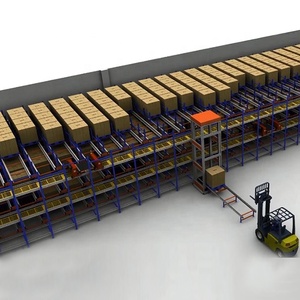
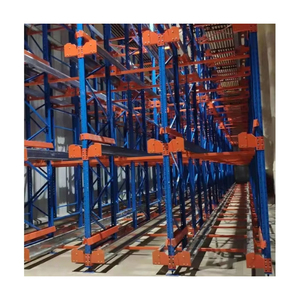
| Radio Shuttle Automation Racking | Ultra-High (85% Cube) | Lane-Dependent (Batch) | Semi-Automated Shuttles + Counterbalance | 1,500 kg / Pallet | LIFO or Strict FIFO Channels |
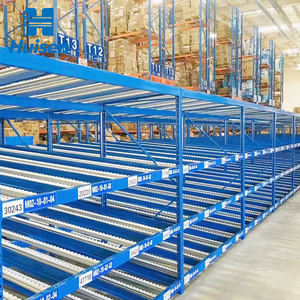
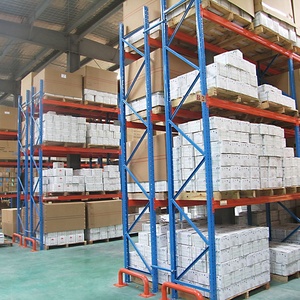
| Heavy-Duty Gravity Roller Flow Racking | Very High (75% Cube) | Face-Level Pallet Access | Standard Reach Trucks / Forklifts | 1,200 kg / Pallet | Deterministic FIFO (Gravity Assisted) |
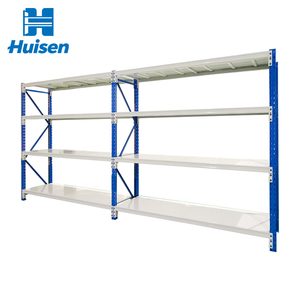
| Selective Pallet Racking (Double Deep) | Medium-High (60% Cube) | 50% Immediate Access | Pantograph Double-Reach Trucks | 1,500 - 4,000 kg / Beam Pair | LIFO per Double Pair |
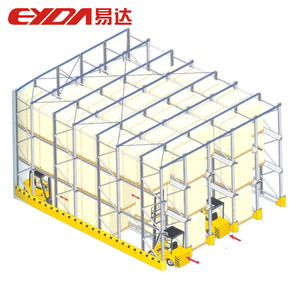
| Drive-In / Drive-Through Heavy Racks | High (70-80% Cube) | Low (Mass Bulk SKU) | Specialized Slim Mast Forklifts | 1,200 kg / Rail Tier | LIFO (Drive-In) / FIFO (Drive-Thru) |
Global supply chain volatility, land leasing costs, and carbon border adjustments (CBAM) are dramatically reshaping how procurement executives, warehouse directors, and industrial real estate developers evaluate multi-tier racking manufacturers.
Procurement teams are shifting away from monolithic static racks toward structures engineered for AMR (Autonomous Mobile Robot) catwalk traversal, top-tier goods-to-person induction, and radio shuttle retrofitting with plug-and-play rail tolerances.
With stringent building code enforcements in regions like New Zealand (NZS 1170.5) and the Americas, tier-1 procurement contracts mandate site-specific anchor embedment depth calcs, enlarged heavy ductile base plates, and dynamic frame bracing certified for high ductilities.
Institutional tier-1 importers now prioritize manufacturers utilizing closed-loop pickling and phosphating pre-treatments, zero-VOC electrostatic powder coatings, and certified recycled scrap ratios to satisfy ESG and corporate sustainability mandates.
The manufacturing of heavy-duty multi-tier racking has evolved beyond rudimentary sheet metal bending into high-precision structural steel fabrication. Cold-roll profiling lines now utilize continuous automated roll forming stations equipped with optical laser measurement systems that monitor upright hole pitch deviations within ±0.1mm tolerances across a 12-meter single upright column.
Furthermore, structural health monitoring (SHM) is entering commercial multi-tier installations. Upright base plates can now be equipped with low-profile load cells and vibration accelerometer nodes that transmit beam deflection and MHE impact alerts via wireless telemetry to warehouse management systems (WMS). This proactive engineering approach prevents catastrophic collapses caused by hidden forklift impacts on structural vertical columns.
Founded in 2001, Guangzhou Heda Shelves Co., Ltd. has established itself as an authoritative global manufacturer and exporter of heavy-duty pallet racking, multi-tier mezzanines, and industrial logistics systems. We combine end-to-end metallurgical engineering with export supply-chain expertise.
Every multi-tier and high-density system ships with comprehensive design packs: structural member properties, load-deflection charts, baseplate shear simulations, and engineer sign-off documentation referencing AS 4084, EN 15512, and seismic parameters.
We eliminate customs quarantine delays in Australia, New Zealand, and North America. Structural profiles are packed on custom heavy steel stillages or ISPM-15 heat-treated certified timber frames with waterproof wrapping and barcode tracking.
Our 300+ technical engineering team generates high-fidelity 3D structural CAD blueprints, beam pitch configurations, and flue-space layouts within 24 hours of receiving site dimensions, pallet footprints, and forklift turning radiuses.
To guarantee zero structural field variance across multi-tier upright frames, beams, and mezzanine connectors, HEDA Shelves enforces a strict 10-step metallurgical workflow controlled by automated machinery and in-house laboratory testing.
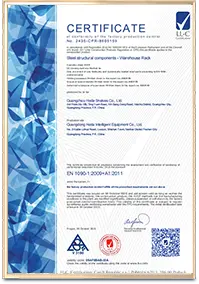
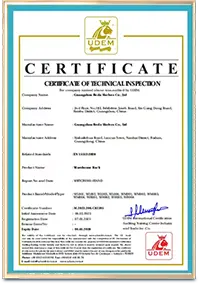
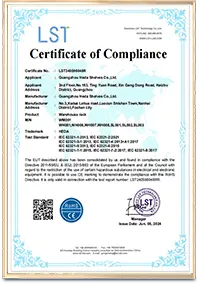
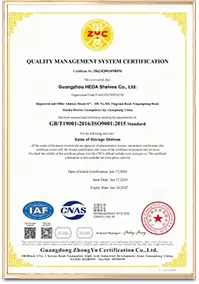
Transparency is foundational to reliable structural procurement. Guangzhou Heda Shelves Co., Ltd. openly publishes our accredited certificate identifiers for independent verification by third-party auditors and municipal certifiers.
In-depth structural, logistical, and compliance answers addressing the primary concerns of warehouse project directors, consulting structural engineers, and facility planners.