Featured Industrial Pallet Racking & High-Density Storage Solutions
Precision-formed beams, upright frames, and certified shelving configurations engineered for heavy pallet loads, automated warehouses, and specialized bulk logistics.
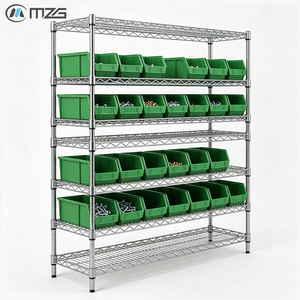
MZG Wholesale Electronics Storage Rack Wire Shelving with Plastic Bins
Height-adjustable multi-layer chrome and epoxy wire decking configured with pick bins for electronics, inventory picking, and small components logistics.
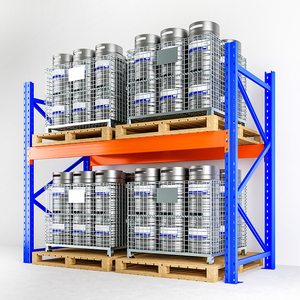
Industrial Steel Pallet Storage Shelves 5000KG Load-Bearing CE Certified
Reinforced roll-formed box beams paired with heavy cold-formed upright columns designed for heavy industrial palletization, cold rooms, and raw material yards.
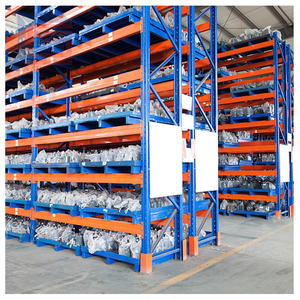
Industrial Pallet Storage Rack Steel Warehouse Adjustable Shelving
Adjustable multi-tier teardrop and European hook connector beams allowing rapid level reconfiguration for high-turnover FMCG and multi-SKU logistics centres.
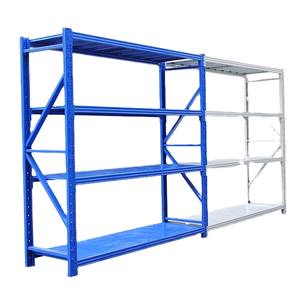
Garage & Warehouse Metal Storage Shelving Fast-Assembly Rack Units
Commercial-grade rivet and slotted angle steel shelving for manual picking, maintenance hubs, archive storage, and decentralized fulfillment points.
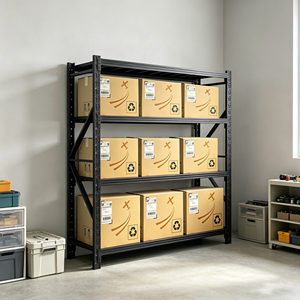
Multi-Level Powder Coated Corrosion Protected Card Slot Storage Rack
Pre-treated with automated pickling and phosphating before electrostatic polyester powder baking; built for humid workshops and chemical storehouses.
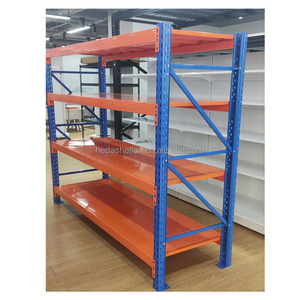
Long Span Industrial Metal Storage Shelves 4 Layer Racking Units
Optimized step-beam profiles accepting drop-in steel or timber decks. Perfect intermediate capacity system bridging pallet racking and hand-loaded shelving.
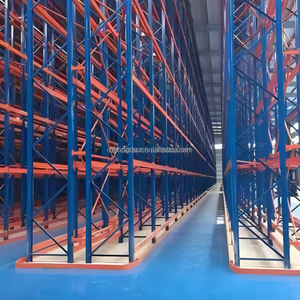
Very Narrow Aisle (VNA) High-Density Steel Pallet Racking System
Engineered for extreme heights up to 15+ meters with high-torsion box beams and tight deflection tolerances (L/300) required for turret trucks and wire-guided AGVs.
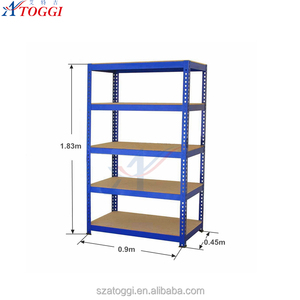
Steel 5-Layer Mobile Warehouse Stacking Rack Unit 900x450x1830mm
Flexible modular mobile storage frame designed for staging lanes, temporary seasonal consolidation, cross-dock transit, and lean manufacturing cell distribution.
1 Technical Classification & Mechanics of Pallet Rack Beam Types
In structural warehouse racking design, the horizontal load-bearing beam serves as the primary structural member resisting flexural bending, lateral torsional buckling, and localized web crippling. When selecting beam types for heavy industrial warehouses, supply chain engineers must examine not merely nominal capacity, but section modulus ($S_x$), moment of inertia ($I_x$), yield strength ($f_y$), and the end-connector rotational stiffness ($C_m$) under cyclic material handling loads.
Failure to match beam cross-sections to the pallet profile and decking interface can lead to premature vertical deflection exceeding safety thresholds, permanent beam deformation, or brittle fatigue failure at the connector welds. Below is an engineering evaluation of the primary beam geometries produced in modern roll-forming and structural fabrication facilities.
1. Roll-Formed Step Beams
Manufactured with a 1-5/8 inch (or customized 20mm to 50mm) recessed interior step along the upper flange. Specifically designed to nest flush-mount wire mesh decking, particle boards, or steel cross ties without increasing beam clearance height.
- Ideal for hand-pick cartons & varied pallets
- Continuous seam-welded step geometry
- Deflection calculated to L/180 or L/240
2. Roll-Formed Box Beams
Constructed by interlocking two cold-formed C-channel profiles with continuous longitudinal robotic seam welds. The closed tubular cross-section delivers superior torsional resistance ($J$) against twisting moments caused by off-center pallet loading.
- High lateral torsional buckling threshold
- Top choice for 1000kg to 4500kg pallet pairs
- Flush surface for drop-over accessories
3. Structural C-Channel Beams
Hot-rolled structural steel beams (typically ASTM A36 or GB Q235B/Q355B structural channels) bolted or pinned with heavy structural end-plates. Designed for environments prone to intense forklift impact, outdoor yards, and high-hazard storage.
- Thick web (5mm to 8mm+) absorbs fork strikes
- Superior performance in seismic zones
- Available hot-dip galvanized for exterior yards
4. Seamless Rectangular Tube Beams
Formed from single-piece precision high-frequency electric resistance welded (HFW) structural tubing. Tube beams eliminate external welding seams along the profile edges, creating an ultra-smooth, uniform surface that is simple to sanitize.
- Preferred for food processing & pharmaceutical grade cleanrooms
- Eliminates dust crevices and moisture pockets
- High strength-to-weight structural ratio
5. Specialized Drive-In, Shuttle & Cantilever Beams
Engineered support arms and continuous pallet guide rails tailored to high-density density applications. Drive-in cantilever support arms carry dynamic single-sided loads, while radio shuttle guide channels integrate sensor targets for automated buggies.
- Heavy-gauge tapered design to maximize vertical clearance
- High-yield cold-rolled steel (Q355B / ASTM A572)
- Integrated entry lead-in guides and optical stops
| Beam Cross-Section | Standard Steel Grades | Typical Section Heights | Max Allowable Load / Pair | Standard Deflection Limit | Primary Deck Compatibility |
|---|---|---|---|---|---|
| Roll-Formed Step Beam | Q235B, ASTM A1011 CS | 80mm – 160mm (3.15" – 6.3") | 1,000 kg – 3,500 kg | $L/180$ or $L/200$ | Wire mesh deck, flush drop-in timber, pallet bars |
| Interlocking Box Beam | Q235B, Q355B, S355JR | 80mm – 180mm (3.15" – 7.1") | 1,500 kg – 5,000 kg | $L/180$ or $L/240$ | Drop-over steel panels, wrap-around wire decks |
| Hot-Rolled Structural C-Beam | ASTM A36, Q355B (EN 10025) | C3" – C6" Structural Channel | 3,000 kg – 6,500 kg+ | $L/240$ to $L/300$ | Structural grating, heavy steel channels, direct pallet |
| Seamless Rectangular Tube | Q235B, ASTM A500 Gr B | 80mm – 140mm (3.15" – 5.5") | 1,200 kg – 4,000 kg | $L/200$ | Hygienic stainless or food-grade galvanized decking |
| Radio Shuttle Rail Beam | High-Tensile Cold Rolled Q355B | Custom Formed Dual-Flange | 1,500 kg / pallet dynamic | $L/300$ (automated limit) | Proprietary runner rail profile with embedded sensors |
2 Deflection Limits, Bending Moments, and End-Connector Engineering
Under global codes including AS 4084-2023 (Australia), RMI MH16.1 (United States), and EN 15512 / FEM 10.2.02 (Europe), pallet rack beams are designed according to Limit State Design (LSD) or Allowable Stress Design (ASD) methodologies. The maximum uniform distributed load ($UDL$) across a pair of beams is governed by either maximum flexural stress or deflection limits under serviceability loads:
$$\delta_{max} = \frac{5 \cdot w \cdot L^4}{384 \cdot E \cdot I_x} \le \frac{L}{180}$$
Where $w$ represents the uniformly distributed pallet load per unit length, $L$ is the unsupported beam span between upright columns, $E$ is Young's Modulus of elasticity ($2.05 \times 10^5 \text{ MPa}$ for structural steel), and $I_x$ is the second moment of area about the horizontal neutral axis. In automated storage and retrieval systems (ASRS) or narrow-aisle facilities handling mast-guided turret trucks, the deflection threshold is tightened to $L/240$ or $L/300$ to prevent mast binding and crane sensor errors.
Equally critical is the connector end-plate tab geometry. High-reliability factories employ 3-pin, 4-pin, or 5-pin cold-stamped connector hooks with integral high-shear safety locking pins. The connector transfer moment ($M_c$) stiffens the overall upright-beam portal frame, effectively reducing the effective buckling length of vertical upright columns ($kL_x$) and elevating overall seismic resistance without adding unnecessary steel deadweight.
3 Future Procurement Trends for Industrial Pallet Rack Beams (2025–2030)
Supply chain leaders, 3PL giants, and industrial EPC firms are undergoing a transition in how pallet racking components are specified, manufactured, and tendered. As mega-fulfillment hubs expand and automated material handling takes precedence, procurement teams are looking beyond basic spot steel price per kilogram.
Micro-Alloyed High-Yield Steels
Adoption of micro-alloyed hot-rolled strips (e.g., Q355B / S355MC) with niobium and titanium micro-additions. Yield strength increases by over 30% compared to legacy Q235B, enabling thinner gauge roll-forming that reduces dead load and maritime shipping costs while preserving 5000KG pair capacities.
ASRS & AMR Tight Tolerances
Traditional $\pm 2.0\text{mm}$ beam fabrication tolerances are insufficient for automated high-bay shuttle carriers. Global buyers require precision roll-forming lines with in-line laser measurement guaranteeing flange straightness within $\pm 0.8\text{mm}$ over spans of 3600mm.
Zero-VOC Eco Coatings & EPDs
Environmental Product Declarations (EPD) are rapidly becoming compulsory in international tenders. Factories utilize heavy metal-free zirconium pre-treatments followed by TGIC-free polyester powder systems cured with energy-efficient infrared convection ovens.
BIM Integration & QR Tracking
Individual beams and uprights now feature engraved 2D QR codes and RFID asset tracking. Structural engineers receive direct Autodesk Revit BIM family files containing parametric deflection curves and certified load tables ready for local regulatory approval.
4 Technological Evolution: Robotic Production & Advanced Seismic Testing
The manufacturing process for pallet rack beams has evolved from manual shearing and hand-welded brackets into fully automated CNC manufacturing cells. Modern OEM/ODM factories operate continuous cold-bending roll-forming lines fed from 20-ton uncoilers. High-precision hydraulic punch presses create slotted teardrop or card-slot patterns before profiles are roll-formed into closed interlocking box or step profiles.
Automated multi-axis robotic welding cells perform metal active gas (MAG) fillet welds joining the end connector clips to the beam profile. Unlike manual welding where human fatigue introduces porosity and micro-cracking at high-stress roots, automated laser-guided robotic welding ensures continuous penetration and repeatable weld throat thickness. Every batch undergoes ultrasonic non-destructive testing (NDT) alongside full-scale physical push-down tests on servo-hydraulic loading frames in accordance with AS 4084 and EN 15512 test protocols.
Coil Mill Chemical Inspection
Automated Slitting & Uncoiling
CNC Progressive Punching
Precision Multi-Roll Forming
Flying Hydraulic Cut-to-Length
Robotic Connector Welding
Acid Pickling & Phosphating
Electrostatic Powder Spray
High-Temp Curing Oven (200°C)
ISPM-15 Export Packaging
5 Verified Factory Credentials & Manufacturing Strengths
Founded in 2001, Guangzhou Heda Shelves Co., Ltd. has grown into an international engineering and manufacturing powerhouse with a 30,000 square meter standardized production hub and a dedicated workforce of over 300 experienced engineers, technicians, and logistics specialists. Supplying warehouse operators, logistics conglomerates, and OEM distributors across Australia, New Zealand, Europe, and the Pacific, Heda Shelves combines factory-direct economics with verifiable technical compliance.
Free 3D & CAD Layout Engineering
Our in-house design team generates complete 3D structural models and CAD layouts factoring in aisle clearances, truck turning radii, and exact pallet heights prior to production.
Independently Audited Certifications
Fully compliant with international quality standards, holding official CE Certificate No. 2435-CPR-8605159, ISO 9001:2015 No. 18624Q00169R0M, and RoHS safety verification.
AS 4084 & NZS 1170.5 Engineering
Standard design calculations are aligned with Australian Standard AS 4084 and New Zealand seismic guidelines (NZS 1170.5), delivering full calculation packs for local certified engineer sign-off.
Strict Biosecurity Export Packing
Shipments utilize custom steel stillages or ISPM-15 heat-treated, certified timber dunnage to ensure smooth passage through Australian DAFF and New Zealand MPI biosecurity border inspections.
ChAFTA & Duty-Free Documentation
We provide comprehensive export customs documentation, including Certificates of Origin (Form COO) enabling zero or reduced import tariffs under ChAFTA and NZ-China trade pacts.
OEM / ODM Distributor Programs
Complete private-label manufacturing programs for regional racking integrators and material handling equipment dealers, including custom color matching and structural branding.
6 Industrial Pallet Rack Beam Procurement: Engineering FAQ
Common technical, engineering, and logistics questions addressed by our senior structural engineering team during project design and quotation stages:
What is the engineering difference between Step Beams and Box Beams?
Step beams feature a secondary internal horizontal ledge (typically 1-5/8" or 50mm) specifically designed to house drop-in wire decking, galvanized steel panels, or shelf boards flush with the top beam edge. Box beams consist of two interlocking C-sections continuously welded into a closed tubular section, providing higher lateral torsional resistance ($J$) for concentrated heavy pallet loads resting directly across the top flanges.
How is beam vertical deflection calculated and tested under AS 4084 / RMI?
Deflection is calculated using standard elastic beam flexure formulas where maximum allowable sag under full rated uniform load cannot exceed $L/180$ (where $L$ is the clear span distance). For an Australian 2591mm (or 2743mm) standard beam span, maximum permissible sag at mid-span under full rated load is $14.39\text{mm}$. When the rated load is completely removed, the beam must show zero permanent residual plastic deformation.
Can your beam designs be engineered for New Zealand high-seismic zones?
Yes. In compliance with NZS 1170.5 and AS/NZS 4084 guidelines, we engineer our rack connections for elevated base-shear and inter-story drift demands. This involves utilizing 4-pin or 5-pin heavy-gauge beam connector plates, increasing upright column wall thicknesses up to 2.5mm or 3.0mm Q355B steel, enlarging baseplates, and adding heavy-duty structural row spacers with vertical portal x-bracing.
What beam profile is optimal for cold storage freezers (-25°C to -30°C)?
For sub-zero freezers, structural C-channel beams or sealed interlocking box beams fabricated from impact-tested Q355B or Q355D steel are recommended. Sub-zero temperatures can induce brittle notch fractures in low-grade carbon steels. Furthermore, all surfaces receive specialized low-temperature polyurethane powder coating or hot-dip galvanizing conforming to ISO 1461 to resist condensation corrosion.
Why are automatic beam safety locking pins mandatory?
Beam safety pins (spring-steel or drop-lock pins) prevent accidental upward dislodgement caused by forklift mast errors when picking or depositing pallets. RMI and AS 4084 require beam end connectors to resist an upward accidental force of at least 1,000 lbs (4.45 kN) or 5.0 kN without disconnecting. Every Heda Shelves beam incorporates pre-installed automatic high-visibility zinc-plated safety pins.
What is the typical production and ocean transit schedule to Oceania ports?
Factory production for typical projects (500 to 5,000 pallet positions) requires 15 to 25 business days from final 3D CAD approval. Direct ocean container shipping from our Guangzhou/Shenzhen terminals to major Oceania ports (Sydney, Melbourne, Brisbane, Fremantle, Auckland, Tauranga) typically takes 14 to 24 days depending on direct carrier routing and vessel clearance.
Engineer Your Warehouse Racking With Certified Factory Direct Precision
Connect directly with Guangzhou Heda Shelves engineering specialists. Provide your warehouse architectural layout, pallet dimensions, and operational load requirements to receive an AS 4084-referenced 3D CAD proposal and factory-direct quotation within 24 hours.