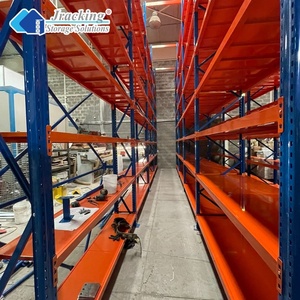
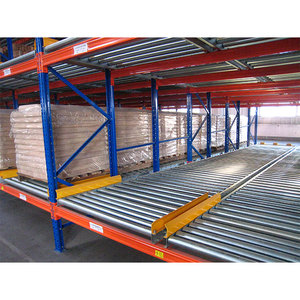
Q235 Steel 2000kg Capacity FIFO High Density Industrial Storage Gravity Pallet Flow Rack System
- Payload: Up to 2,000 kg/pallet
- Rotation: Strict FIFO Roller Flow
- Material: Cold-Rolled Q235B Steel
From certified dynamic flow channels to robotic shuttle-ready grids and structural building modules, explore our factory-direct industrial catalog manufactured from structural-grade steel.
For more than two decades, Guangzhou HEDA Shelves Co., Ltd. has bridged the gap between complex geotechnical-structural engineering and cost-efficient cold-formed steel manufacturing.
Our workshop houses multiple automated rolling profile production lines capable of producing Omega (Ω) upright profiles up to 120mm cross-section with yield strength exceeding 355 MPa (Q355B). Automated CNC punching ensures 50mm and 75mm connection hole pitch accuracy within ±0.1mm tolerances.
We execute strict traceability across every production lot. Governed by CE Certification No. 2435-CPR-8605159 and ISO 9001:2015 Quality Management (No. 18624Q00169R0M), raw coils undergo spectroscopic steel grading, yield-point testing, and weld-penetration analysis prior to roll-forming.
Durability starts beneath the surface. Our automated finishing cycle incorporates hot alkaline degreasing, multi-stage acid pickling, zinc phosphating, and deionized water rinsing followed by electrostatic powder coating baked at 200°C. Delivers superior salt-spray resistance (>500 hours) for high-humidity logistics sheds.
Strategic supply chain operations have transitioned beyond transactional steel buying. In today's volatile economic landscape, procurement directors prioritize structural resilience, total lifecycle yield, and seamless robotics interoperability.
Historically, commercial pallet racking was procured as a low-margin commodity, evaluated almost entirely on a per-kilogram price basis. However, rapid spikes in prime industrial rents across Australia (Sydney, Melbourne), New Zealand (Auckland), Europe, and North America have inverted this paradigm. Engineering teams now calculate Storage Density Volumetric Yield (SDVY) and total cost of ownership over a 15-year operational lifecycle.
A poorly engineered rack with undersized upright sections or inferior steel ductility incurs higher deflection rates, damages material handling equipment (MHE), and necessitates frequent beam replacements under impact loading. Progressive procurement teams now mandate non-linear FEA (Finite Element Analysis) verification, heavy-duty 4-hook beam connectors with integral locking pins, and certified column base anchorage designed to dissipate floor-slab shear moments without structural buckling.
With major regional distribution hubs situated in active tectonic belts—such as New Zealand's Wellington and Canterbury zones (governed by NZS 1170.5) or North America's West Coast (governed by RMI ANSI MH16.1)—seismic compliance has become a primary procurement barrier. The standard static load calculations are no longer adequate.
Modern international tenders specify ductility factor ($k_\mu$) calibrations, second-order $P-\Delta$ structural analysis, and dynamic response-spectrum modeling. Upright column designs now utilize higher-gauge Q355B micro-alloyed structural steels, reinforced box-profile baseplates with multiple anchoring patterns, and engineered spine/cross-bracing trusses capable of dampening horizontal harmonic oscillation during maximum credible earthquake (MCE) events.
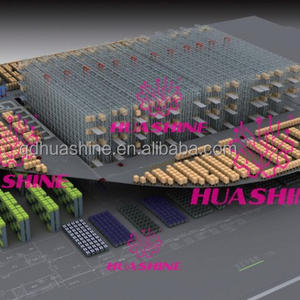
Supply chain labor shortages and soaring fulfillment expectations are accelerating the transition from manual forklift-operated selective racking to semi-automated and fully automated platforms. Radio Shuttle Racking systems, 4-Way Autonomous Pallet Shuttles, and automated storage and retrieval systems (AS/RS) demand manufacturing tolerances that traditional racking fabricators cannot achieve.
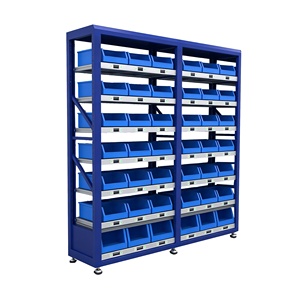
Guide rail running surfaces require positional straightness within $\pm 1.0\text{ mm}$ over a 12-meter span to prevent carrier derailment or sensor tripping. Additionally, weight-sensing smart shelves and line-side automated storage—such as our ZSW-W01 SMT cabinets—are bridging warehouse storage directly with MES and ERP ecosystems, achieving automated stock deduction, real-time tare recalculation, and zero-touch inventory counts.
Cross-border customs enforcement has tightened dramatically. Border authorities such as Australia's DAFF and New Zealand's MPI enforce strict biological quarantine protocols. Importers face immense demurrage costs if timber packaging harbors pests or fails ISPM-15 heat-treatment verification. Leading manufacturers now supply certified, returnable all-steel stillages and pallets that bypass biosecurity fumigation bottlenecks entirely, while lowering transport damage by over 92% compared to loose container stuffing.
| Racking Storage Type | Selectivity | Floor Space Utilization | Typical SKU Profile | MHE Fleet Requirement | Operational Flow |
|---|---|---|---|---|---|
| Standard Selective Rack | 100% Direct | 40% – 50% | High SKU count, varied turnover | Standard Counterbalance / Reach | FIFO |
| Drive-In / Drive-Thru | Low (Lane-dependent) | 65% – 75% | Low SKU count, bulk volume | Narrow Counterbalance / Reach | LIFO / FIFO |
| Gravity Pallet Flow | Moderate (Face-level) | 70% – 80% | Perishable food, FMCG, pharma | Standard Counterbalance / Reach | Strict FIFO (Gravity) |
| Semi-Automated Radio Shuttle | Batch / Lane Selective | 80% – 88% | Cold store, raw beverage, FMCG | Standard Forklift + Radio Carrier | FIFO or LIFO |
| Multi-Tier Mezzanine | 100% Pick Face Access | 150% – 250% (Vertical) | E-commerce, auto parts, carton pick | Manual Carts, Conveyors, Lifts | Flexible Batch Pick |
| Clad-Rack AS/RS Stacker Crane | 100% Computerized | 85% – 95% | High-throughput mega distribution | Automated Rail Stacker Crane | Dynamic WMS / FIFO |
From initial 3D layout conceptualization to container delivery and structural commissioning, we serve as an accountable, engineering-led manufacturing partner.
Our senior structural team produces complete 3D warehouse layouts, aisle-clearance profiles, and MHE turning radius simulations within 24 to 48 hours of initial floor-plan submission.
Every overseas shipment is backed by verified section properties ($I_x, I_y, Z_x$), steel mill chemical certificates, deflection calculation notes, and assembly schematics ready for sign-off.
As an authorized Chinese exporter, we issue official Certificates of Origin (Form COO), enabling importers to claim preferential zero-tariff or reduced-duty treatment under ChAFTA and ASEAN pacts.
Components are bundled into customized heavy-duty steel cradles with moisture-barrier film. No structural components contact container flooring, preventing transit bend and unloading bottlenecks.
Clear, engineering-backed answers addressing the most common technical, regulatory, and logistics inquiries raised by procurement teams, civil certifiers, and warehouse managers.
Our structural engineering department performs sectional calculations and finite element structural simulations adhering strictly to AS 4084:2023 (Steel Storage Racking) and EN 15512 limit-state design principles. We provide fully documented structural section properties (cross-sectional area, moments of inertia $I_x$ and $I_y$, section modulus $Z$), torsional rigidity coefficients, and beam load-deflection ratios under working limit states (typically restricted to $L/200$).
This technical dossier enables your locally registered Chartered Professional Engineer (CPEng / RPEQ) or European Certifier to easily conduct third-party verification and issue local building regulatory sign-off. Safe working load notices, beam locking safety pins, and aisle-end upright protectors are supplied standard to satisfy Workplace Health & Safety mandates.
Yes. For seismically sensitive territories such as New Zealand (governed by NZS 1170.5 and the New Zealand Building Code), our engineering team configures the entire rack structure around site-specific spectral acceleration factors ($C(T)$), soil class classifications (A through E), and performance ductility values.
Engineering modifications typically include upgrading upright steel gauges to high-yield Q355B structural steel, doubling frame bracing diagonals, utilizing enlarged heavy-duty baseplates (minimum 12mm–16mm thickness) with dual or quadruple high-embedment seismic chemical anchors (e.g., M12/M16 chemical studs), and integrating longitudinal tie-beams across back-to-back rack runs. Structural data files can be exported directly for review by local geotechnical and structural engineering consultants.
We source cold-rolled structural steel exclusively from tier-one steelmakers (such as Baosteel, Shougang, and Angang). Primary components utilize certified Q235B ($f_y \ge 235\text{ MPa}$, tensile $375\text{--}500\text{ MPa}$) and high-strength Q355B ($f_y \ge 355\text{ MPa}$, tensile $470\text{--}630\text{ MPa}$) depending on design load tables.
Every commercial consignment includes verified EN 10204 3.1 Mill Test Certificates (MTC) demonstrating batch-level chemical compositions (Carbon, Manganese, Silicon, Phosphorus, Sulfur) and mechanical testing results (yield, elongation, Charpy V-notch impact tests). Factory quality release records, dry-film coating thickness gauges (guaranteeing 60–80 microns), and cross-hatch paint adhesion test reports (ISO 2409 Class 0) are packaged with the commercial invoice and bill of lading.
Biosecurity non-compliance causes severe port delays, fumigation surcharges, or outright container re-export. To provide zero-risk clearance into Australia, New Zealand, and North America, HEDA Shelves utilizes dedicated all-steel stillages, steel strapping, and heavy-gauge corrugated edge-protectors for all structural components.
Whenever structural wooden pallets or dunnage must be utilized for auxiliary accessories, timber is strictly heat-treated ($56^\circ\text{C}$ core temperature for ≥ 30 minutes) and legibly stamped on both sides with the official IPPC ISPM-15 certification mark. Biosecurity treatment declarations, clean packing certificates, and detailed packing manifests itemizing container weight balances are submitted pre-vessel arrival to ensure fast customs clearance.
From our South China manufacturing facilities, port departure occurs via Guangzhou (Nansha) or Shenzhen (Yantian/Shekou). Average direct blue-water sea freight transit times are:
Our dedicated shipping desk manages FOB, CIF, CFR, or DDU/DDP arrangements. We optimize container volumetric stuffing utilizing 40HQ containers, achieving over 95% space utilization to significantly lower freight costs per pallet location.
To produce an optimized 3D layout, static calculation, and firm bill of quantities (BOQ), our engineering department requests the following six project parameters:
Connect directly with our senior intralogistics engineers for a complimentary structural review, 3D CAD layout calculation, and factory-direct project quotation within 24 hours.
Send an Inquiry