High Density
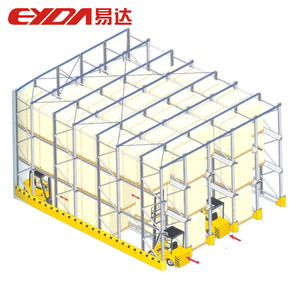
Heavy Duty 5 Layer Drive in Pallet Storage Racking System
Capacity: Up to 1,500 kg / pallet
Method: FIFO & LIFO configurable
Manufactured in our 30,000 m² ISO 9001:2015 facility using cold-rolled high-tensile structural steel (Q235B / Q355B). Designed for reach trucks, articulated forklifts, and automated shuttle systems.
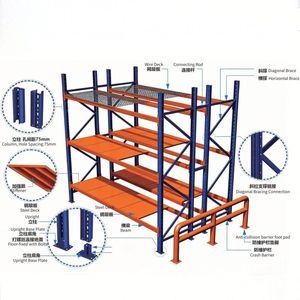
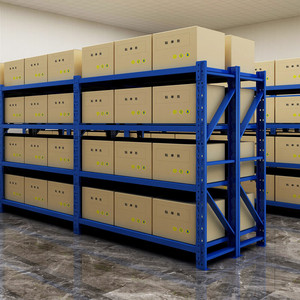
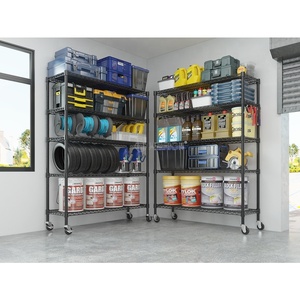
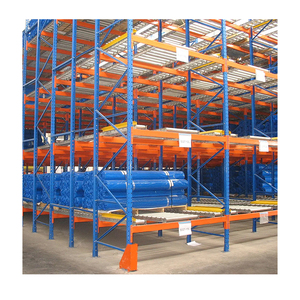
In modern high-throughput supply chain networks, supply chain directors and industrial engineers face a persistent spatial challenge: maximizing pallet storage volume within fixed facility footprints without escalating civil construction expenditures. Double deep warehouse racking represents a precise mathematical compromise between the pure 100% selectivity of single-selective racking and the extreme volumetric compression of drive-in or automated shuttle solutions. By placing two pallet positions back-to-back within a single-entry row structure (four pallet positions between access aisles in a back-to-back layout), double deep systems eliminate 40% to 50% of the operational aisles required by conventional selective configurations.
From an applied structural mechanics perspective, double deep racking introduces distinct flexural stresses and torsional loads on load-bearing members that diverge sharply from single-reach frameworks. When a reach truck or pantograph-equipped forklift extends a 1,200 kg unit load into the second depth coordinate, dynamic moment arms are amplified. The vertical and horizontal reaction forces transmitted into the front load beams, cross-aisle ties, and upright portal frames demand rigorous section property sizing. At our manufacturing facility, every double-deep upright profile is roll-formed with multiple continuous stiffening ribs along the web and flanges, yielding an elevated section modulus ($Z_x$ and $Z_y$) capable of resisting torsional-flexural buckling under non-uniform eccentric loading conditions.
Fabricated in continuous box-beam profiles with triple-claw or quadruple-claw high-ductility connector plates. Guaranteed vertical deflection under static safe working load does not exceed $L/200$ under international CE EN 15512 and $L/300$ for automated integration criteria.
Because double reach forks deposit pallets without direct forklift tire intrusion beneath the back position, bottom deckboards experience unsupported span stresses. We engineer optional heavy-duty pallet support bars and entry guide shoes to prevent drop-through hazards.
Point loads at the baseplate are magnified by the high density of double deep configurations. Baseplates are stamped from minimum 8 mm to 12 mm Q235B structural plate, secured via seismically rated mechanical wedge or chemical capsule anchors calculated against ACI 318 Appendix D / Eurocode 2.
Logistics directors must balance initial Capital Expenditure (CAPEX) with recurring Operational Expenditure (OPEX). Below is an empirical comparison across industrial pallet racking topologies derived from our factory project design archives:
| System Architecture | Floor Footprint Utilization | Pallet Selectivity | Aisle Width Required (AST) | MHE Fleet Requirement | CAPEX Factor per Pallet | Throughput Speed (Pallets/hr) |
|---|---|---|---|---|---|---|
| Double Deep Racking | 60% – 65% | 50% (Immediate) | 2.8 m – 3.2 m | Deep-Reach Pantograph Truck | Moderate ($$) | 30 – 38 |
| Standard Selective Racking | 35% – 45% | 100% | 3.0 m – 3.5 m | Standard Counterbalance / Reach | Baseline ($) | 45 – 55 |
| Drive-In / Drive-Through | 70% – 78% | < 15% (LIFO/FIFO block) | Tunnel Entry (Forklift enters) | Counterbalance / Narrow Mast | Moderate ($$) | 18 – 25 |
| Radio Shuttle Racking | 75% – 85% | Lane Dependent | 2.6 m – 3.0 m (Aisle only) | Standard Forklift + Shuttle Unit | High ($$$) | 40 – 50 |
| VNA (Very Narrow Aisle) | 50% – 58% | 100% | 1.6 m – 1.8 m | Turret Truck / Wire Guided MHE | High ($$$) | 35 – 42 |
Procuring structural warehouse equipment from an overseas manufacturer introduces regulatory compliance risks that can compromise site safety and void commercial property underwriting. At Guangzhou Heda Shelves Co., Ltd., our double deep and high-density pallet racking systems are manufactured under stringent CE Certification (Certificate No. 2435-CPR-8605159), strictly complying with the European Construction Products Regulation (CPR 305/2011/EU) and execution standard EN 1090-1 / EN 1090-2 (Execution of steel structures).
Furthermore, our structural calculation methodologies strictly follow the latest revisions of EN 15512:2020 (Steel static storage systems – Adjustable pallet racking systems – Principles for structural design), EN 15620 (Tolerances, deformations, and clearances), and the Australian Standard AS 4084-2023. We do not rely on generic, unverified load estimates. For every custom installation, our engineering department performs full Finite Element Analysis (FEA) modeling, evaluating stability against P-Delta second-order frame displacements, beam end connector rotational stiffness ($C_i$), and seismic response spectra under local building code demands.
Sourced exclusively from Tier-1 state mills with 3.1 Mill Test Certificates. Guaranteed yield strength $\ge 235$ MPa (Q235B) and $\ge 355$ MPa (Q355B).
Continuous progressive 24-station rolling lines prevent residual micro-cracking and work-hardening brittleness at column corner radii.
Beam connector plates are joined using multi-axis robotic MAG welding stations in compliance with EN ISO 3834 and AWS D1.1 specifications.
10-stage automated hot spray degreasing, zinc phosphating, and deionized water rinsing prior to electrostatic thermoset powder curing.
Logistics engineering is in the midst of a generational pivot toward autonomous handling, environmental resilience, and sensor-driven infrastructure. Procurement executives cannot purchase storage racking solely based on current stockkeeping profiles. Racking systems deployed today must feature modular expandability to integrate with automated equipment over a 15-to-25-year asset lifespan.
The global shortage of certified reach truck operators is accelerating the deployment of vision-guided, autonomous automated guided vehicles (AGVs). Double deep racking for AGV interaction demands heightened manufacturing tolerances (±1.5 mm beam level consistency across bays) and specialized optical laser targets mounted directly to upright faces. HEDA Shelves engineers structural column punches to support integrated sensor arrays and AGV reflector positioning.
Warehousing hubs located in seismic zones (such as New Zealand, the Pacific Rim, and Mediterranean Europe) are transitioning from heavy, rigid steel bracing toward ductility-controlled kinetic dissipation. Future procurement contracts increasingly specify yielding baseplate shoes, slotted diagonal bracing frames, and tuned mass dampers on tall rack uprights ($>12$ meters) to absorb ground motion energy without catastrophic frame collapse.
With chilled and deep-freeze logistics electricity costs soaring, cold storage facilities are systematically converting from standard selective racks to double deep and 4-way pallet shuttle systems. In sub-zero condensing environments (-30°C), standard powder coatings face micro-fracturing. Advanced procurement requires thermosetting modified polyester-epoxy powders or continuous hot-dip galvanizing complying with ISO 1461, preventing rust creeping around beam lock pins.
Racking operations under EN 15635 require mandatory annual structural safety inspections. Upcoming procurement benchmarks incorporate factory-applied QR/NFC identity tags on every upright frame and beam connector. Real-time strain gauge sensors on bottom beam levels can instantly detect localized forklift collision damage or hazardous over-capacity bay loading, pushing notifications directly to the warehouse enterprise maintenance platform.
Direct technical guidance compiled by our chief structural engineers to address the most critical questions posed by warehouse facility planners, EPC contractors, and global import distributors.
When operating a pantograph double-reach or telescopic fork truck, extending a pallet load into the second depth location dramatically shifts the center of gravity (CG) forward from the forklift drive axle (typically shifting from 600 mm to 1,200 mm or more). This lever-arm effect derates the forklift manufacturer's rated capacity by approximately 30% to 50% at elevated lift heights.
Engineering Recommendation: You must cross-reference your heaviest pallet unit loads with the forklift manufacturer's residual capacity chart at your target top beam height. Our engineering team routinely collaborates with major forklift brands to calculate exact aisle clearances and beam level spacings that preserve safe residual operating margins.
Under NFPA 13 (Standard for the Installation of Sprinkler Systems) and FM Global Data Sheet 8-9, double deep racking layouts require strict longitudinal and transverse flue space verification. Back-to-back double deep rows create four pallet depths between operating aisles, presenting a wider horizontal flame spread area.
Our standard layout design provides a continuous minimum 150 mm (6 inches) transverse flue space between adjacent pallet bays and a 200 mm to 300 mm longitudinal flue space between the back-to-back rack frames. Row spacer bars and heavy-duty mechanical pallet backstops are installed at factory-calculated coordinates to prevent pallet overhang from closing off essential vertical water penetration channels.
We provide full structural engineering calculation packs prepared to AS 4084-2023 (Steel storage racking) principles. For New Zealand projects, layouts are calculated against site-specific seismic coefficients ($C_d$) referencing NZS 1170.5 (Structural Design Actions - Earthquake actions).
These calculation packages include full frame section properties, torsional buckling checks, baseplate bearing stresses, and anchor pull-out verifications. This documentation allows locally registered Chartered Professional Engineers (CPEng) in Australia and New Zealand to verify and sign off on site producer statements (PS1 / PS3 / Form 15) smoothly.
Standard manufacturing lead time for full container load (FCL) orders (ranging from two to ten 40HQ high-cube containers) is typically 15 to 25 working days following final approval of engineering CAD shop drawings. For multi-thousand position mega-projects, phased container production schedules are implemented.
Ocean freight transit from South China ports (Guangzhou / Shenzhen) averages:
• Australian Base Ports (Sydney, Melbourne, Brisbane): 14 to 20 days.
• New Zealand (Auckland, Tauranga): 18 to 24 days.
• Western Europe / Mediterranean: 28 to 35 days.
• US West Coast: 16 to 22 days.
Structural steel rack components shipped via ocean freight are exposed to high relative humidity, temperature fluctuations, and aggressive saline marine atmospheres. HEDA Shelves employs an industrial export packaging protocol:
All beams and uprights are securely strapped onto custom heavy-gauge steel stillages or ISPM-15 heat-treated timber bunks with steel corner edge protectors. Critical contact surfaces are layered with moisture-repellent corrugated cardboard and wrapped in high-density multi-layer polyethylene stretch film. High-absorbency container desiccant bags are hung inside every container to prevent condensation and rust staining during equator-crossing ocean voyages.