Heavy-Duty Blue & Orange Industrial Pallet Racking Systems
Engineered with Q235B/Q355B high-tensile structural steel, precision roll-formed profile geometries, and scratch-resistant thermoset electrostatic polyester powder coatings for international fulfillment hubs, cold-storage distribution centres, and multi-tier logistics facilities.
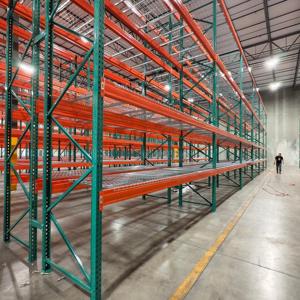
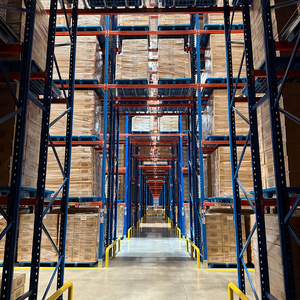
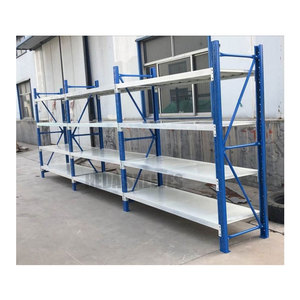
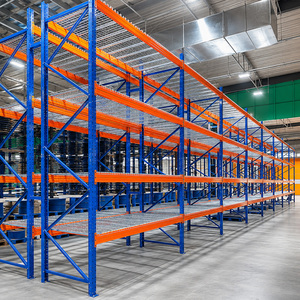
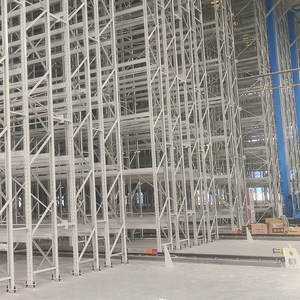
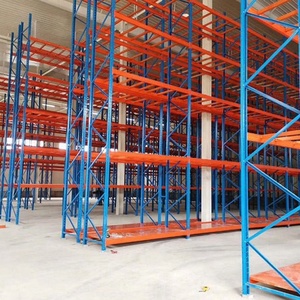
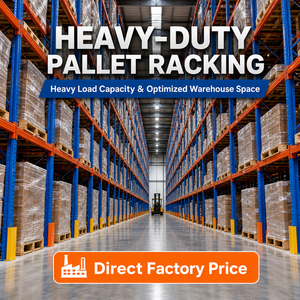
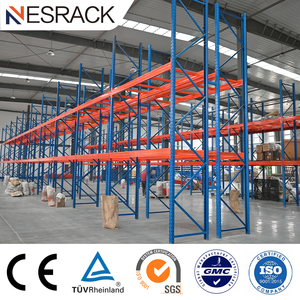
The Structural Engineering & Ergonomics of "Industrial Blue" Racking
In modern supply chain architecture, the widespread global adoption of Blue and Orange warehouse racking is not merely an aesthetic choice; it is a critical visual safety and human-factors engineering paradigm governed by international material handling protocols. In high-velocity logistics centers where counterbalance forklifts, narrow-aisle reach trucks, and Autonomous Mobile Robots (AMRs) operate continuously, visual clarity directly mitigates catastrophic rack strike incidents.
The standard industrial blue hue (predominantly RAL 5005 Signal Blue, RAL 5010 Gentian Blue, or RAL 5015 Sky Blue) is utilized for structural upright frames because blue occupies an optimal wavelength in the human photopic visual spectrum under high-bay LED and sodium warehouse lighting. It provides a non-fatiguing, contrast-rich vertical boundary that outlines the warehouse's physical grid. Concurrently, horizontal load beams are finished in safety high-visibility orange (RAL 2004 Pure Orange), establishing a pronounced luminance contrast ratio exceeding 4.5:1. This sharp visual demarcation allows forklift operators to instantly calculate elevation, entry clearance, and beam engagement planes during high-lift pallet placement exceeding 10 to 12 meters in height.
| Component Type | Material Grade | Yield Strength ($f_y$) | Tensile Strength ($f_u$) | Surface Treatment | Applicable Codes |
|---|---|---|---|---|---|
| Upright Columns (Omega Profile) | Q235B / Q355B Hot-Rolled Strip | 235 – 355 MPa | 370 – 510 MPa | Electrostatic Powder (60–90 μm) | AS 4084-2023, EN 15512 |
| Box Beams & Step Beams | Q235B Cold-Formed Steel | ≥ 235 MPa | 370 – 500 MPa | Safety Orange Thermoset Polyester | RMI MH16.1, FEM 10.2.02 |
| Bracing (Horizontal/Diagonal) | Q235B Cold-Rolled C-Channel | ≥ 235 MPa | 370 – 490 MPa | Galvanized / RAL 5015 Powder | EN 15620 Tolerance Spec |
| Baseplates & Anchor Shims | Q355B Heavy Structural Plate | ≥ 355 MPa | 470 – 630 MPa | Hot-Dip Galvanized (≥ 65 μm) | NZS 1170.5 Seismic Anchor |
Why Tier-1 Importers Partner with Our Manufacturing Facility
Operating a 30,000 square meter integrated manufacturing campus in South China since 2001, we bridge the gap between heavy structural steel roll-forming and rigid international compliance.
30,000 Tons Monthly Output Capacity
Equipped with 18 automated continuous cold-bending roll forming lines, robotic laser column punching, and dual automated electrostatic powder coating tunnels capable of executing multi-thousand pallet position projects without lead-time bottlenecks.
Certified Rigor (CE & ISO 9001:2015)
Full manufacturing compliance under CE Certification No. 2435-CPR-8605159 and ISO 9001:2015 Quality Management System No. 18624Q00169R0M. In-house mechanical test beds execute destructive shear, deflection, and load-to-failure batch verifications.
Free 3D Layout & Full Engineering Packages
Our 300+ engineering and technical staff convert warehouse architectural CAD drawings into high-density storage blueprints within 24 hours. We deliver complete engineering calculation dossiers, moment-connection analyses, and slab load point tables.
AS 4084 & NZS 1170.5 Seismic Integration
Custom structural calculations tailored for Australia and New Zealand seismic zones. Upright frame cross-sections, footplate anchor arrays, and back-to-back row spacers are engineered to withstand site-specific peak ground acceleration (PGA) forces.
Biosecurity-Compliant Export Packing
Certified ISPM-15 treated heat-stamped timber packaging, customized steel stillages, anti-chafing corner guards, and moisture-barrier film wrapping guarantee zero DAFF (Australia) and MPI (New Zealand) border quarantine hold-ups.
Full OEM/ODM Private Label Production
Custom profile perforation hole punches (teardrop, 50mm diamond, 75mm euro pitch, 76.2mm australian hook), personalized color pigmentation, engraved batch traceability numbers, and factory-direct brand labeling for international distributors.
Future Procurement Trends in Industrial Warehouse Racking
Global logistics modernization is driving profound transformations in structural racking requirements. B2B procurement leaders must account for the following macro trajectories to future-proof their supply chain assets.
1. Automation-Ready Tolerances
Transition from standard Class 400 (man-operated) tolerances to stringent Class 100/200 ASRS tolerances. Column plumbness tolerances have tightened from 1/500 to 1/1000, accommodating high-speed automated mini-loads and shuttle carriers.
2. Sub-Zero Metallurgy for Cold Chain
Surging frozen food and biopharmaceutical distribution requires cold-tough structural steels. Standard steels suffer brittle transition at -25°C; future procurement mandates impact-tested steels (Charpy V-Notch ≥27J at -30°C) with low silicon-killed chemistry.
3. Circular Steel & EPD Verifications
ESG reporting mandates are accelerating the demand for racking produced via Electric Arc Furnace (EAF) scrap steel rather than Basic Oxygen Furnace (BOF) coal routes. Independent Environmental Product Declarations (EPDs) are becoming mandatory tender requisites.
4. IoT Structural Health Monitoring
The integration of digital strain gauges, tri-axial accelerometer vibration sensors, and impact-detecting smart baseplates directly into blue upright frames. Real-time telemetry notifies safety directors of undetected forklift collisions before progressive collapse can occur.
Technological & Industrial Development Trajectories
The manufacturing landscape for warehouse storage equipment in China has transitioned from basic steel fabrication to an integrated science of high-precision cold-formed structural engineering. Today's leading manufacturers operate end-to-end digitally controlled value chains that dramatically compress production lead times while elevating structural reliability:
Continuous Roll-Forming Precision
Modern production incorporates 24-station continuous roll-forming lines with inline optical laser sensors that check flange angle tolerances within ±0.25° and column length tolerances within ±1.0 mm across 14-meter continuous upright runs.
Nano-Ceramic Surface Pre-Treatment
Eliminating conventional toxic chromate and phosphate baths, state-of-the-art facilities implement zirconium-based nano-ceramic conversion coatings. This creates a dense, microscopic inorganic lattice that doubles powder adhesion strength while cutting carbon output.
Finite Element Analysis (FEA) Modeling
Every non-standard racking configuration undergoes non-linear ANSYS FEA simulation to evaluate second-order ($P-\Delta$ and $P-\delta$) sway effects, local web crippling under concentrated pallet wheel loads, and torsional flexural buckling limits under seismic spectra.
These engineering advancements mean export shipments arrive on site with zero field-modification requirements. Every bolt hole, safety pin connector, and structural tie aligns perfectly according to design drawings, dramatically reducing local mechanical installation costs in high-wage markets across Australia, North America, and Europe.
Frequently Asked Questions by Global Racking Buyers
Essential technical, regulatory, and logistics answers for warehouse supply chain managers, procurement officers, and engineering contractors importing Chinese racking.
How does Chinese Q235B and Q355B structural steel compare to Australian, American, and European steel standards?
Can your blue and orange selective pallet racking be certified to Australian AS 4084:2023 compliance?
What parameters must be configured for racking deployed in New Zealand high-seismic zones?
What is the standard production lead time and sea freight transit duration from South China?
• Australia East Coast (Sydney, Melbourne, Brisbane): 12 to 18 days.
• Australia West Coast (Fremantle): 14 to 20 days.
• New Zealand (Auckland, Tauranga, Lyttelton): 16 to 24 days.
• North America West Coast (Long Beach, Oakland): 14 to 18 days.
• Western Europe (Rotterdam, Hamburg, Felixstowe): 28 to 35 days.
How do you manage international biosecurity packing compliance (DAFF & MPI)?
What exact details are required to obtain an engineered layout and price quotation?
1. Architectural floor plan showing building internal dimensions, column grid spacing, dock doors, pedestrian pathways, and sprinkler drops.
2. Clear ceiling height to the lowest structural obstruction (e.g., joists, HVAC, lighting).
3. Pallet specifications: Dimensions (Length × Depth × Height, including goods overhang) and maximum gross pallet weight.
4. Forklift equipment model: Minimum aisle width turning radius (AST), mast staging height, and maximum lift elevation.
5. Ambient storage environment: Ambient dry, air-conditioned, cold room (0°C to +4°C), or deep freezer (-18°C to -30°C).