Featured Industrial Warehouse Storage Systems
Engineered for maximum cubic space utilization, rigorous seismic resilience, and extreme cold-storage reliability. Explore our precision-manufactured product portfolio designed for high-density modern distribution centers.
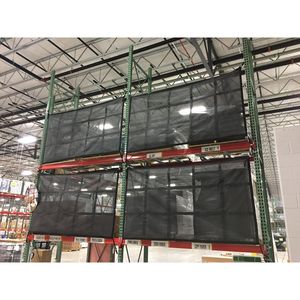
Wholesale Industrial Safety Cargo Heavy Duty Pallet Rack Net 500 Lbs Rated
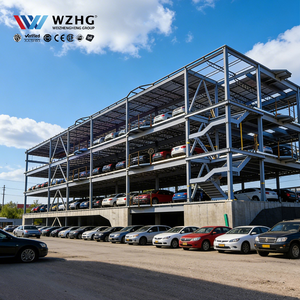
Steel Car Park Tower Heavy Duty Welding Steel Workshop Building System
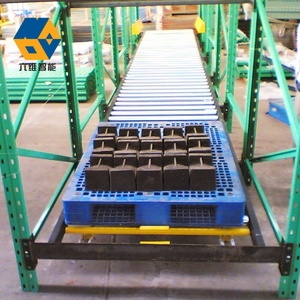
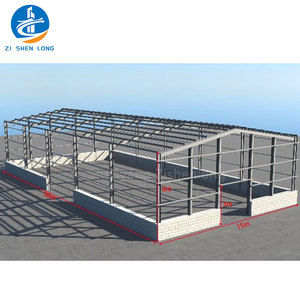
Metal Frame Structure Prefabricated Warehouse Workshop Steel Building
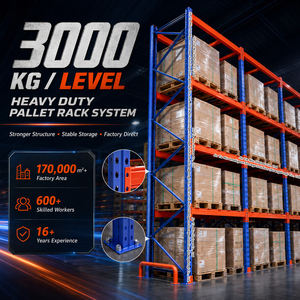
4 Storage Levels Durable Heavy Duty Pallet Rack For Warehouse Storage 3000KG
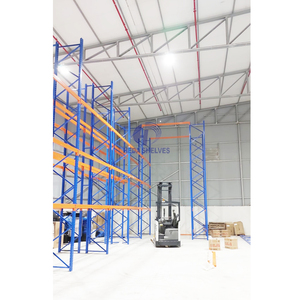
Heavy Duty Beam Pallet Racking System for Large Scale Logistics Warehouses
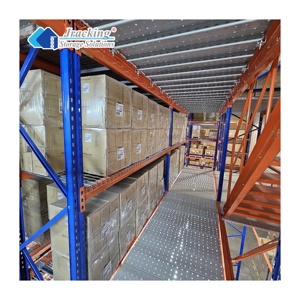
Premium Stacking Shelves Heavy Duty Steel EU Pallet Racking System
Engineering Anatomy of Drive In Racking Systems
Drive-In racking operates on the continuous lane principle, eliminating conventional operating aisles between racks to achieve an extraordinary storage density improvement of up to 75% to 80% compared with standard selective beam racking.
A high-performance drive-in rack configuration transforms warehouse cubic space into continuous storage blocks. Forklifts navigate directly into the longitudinal storage lanes to deposit and retrieve pallets supported on continuous side-mounted cantilever rails rather than horizontal crossbeams. This eliminates wasteful aisles and concentrates structural stability into a high-rigidity interconnected network of heavy-duty cold-rolled steel components.
Continuous Cantilever Pallet Rails
Engineered from premium Q235B and Q355B structural steel, our one-piece cold-formed support rails feature rolled entry guide angles. This geometry eliminates sharp edges, preventing pallet catch hazards and safely dispersing high vertical point loads evenly into the upright columns.
Overhead Top-Tie & Spine Bracing
Because Drive-In systems omit conventional longitudinal load beams at pallet levels, structural rigidity is achieved through heavy horizontal top beams and rigid diagonal structural spine bracing. This architectural system absorbs transverse forklift forces and satisfies seismic shear thresholds.
Floor-Mounted Ground Guide Rails
Equipped with structural steel angle or continuous C-channel guide tracks anchored into the concrete floor slab, forklifts enter lanes safely with minimal operator strain. The integrated flanged entrance horns absorb lateral impact and prevent mast strikes against critical upright frames.
| Engineering Parameter | HEDA Shelves Heavy-Duty Standard | Conventional Industry Baseline | Operational Advantage |
|---|---|---|---|
| Steel Grade & Yield Strength | Certified Q355B (Fy ≥ 355 MPa) | Standard Commercial Q235A (Fy ~ 215 MPa) | 65% higher yield resistance against accidental mast impact |
| Upright Column Profile | Cold-rolled omega multi-bend profile (100–120mm) | Basic 80–90mm open C-section | Superior torsional stiffness and higher buckling safety margins |
| Pallet Support Arm Connection | 5-lug boltless wrap-around stamped bracket | 3-lug stamped plate or field welded | Self-locking load transfer, fully adjustable at 50mm / 75mm increments |
| Finishing & Pre-Treatment | 9-stage pickling, phosphating & 180°C thermo-set powder | 3-stage wash and air-dry dip painting | Corrosion immunity down to -30°C cold stores and humid coastal climates |
| Seismic Engineering Standards | AS 4084-2023, FEM 10.2.02, RMI MH16.1 compliant | Generic domestic load ratings | Fully engineered data packs suitable for municipal engineering sign-off |
Engineering Rule of Thumb for Warehouse Planners: Drive-In racking operates on a First-In, Last-Out (FILO/LIFO) inventory logic. When configured with open access lanes on both opposing sides, it becomes a Drive-Through system supporting First-In, First-Out (FIFO) pallet rotation. For optimum cycle efficiency, design lanes between 4 to 8 pallets deep and 3 to 5 levels high.
Where Drive-In Racking Outperforms Alternative Systems
Selecting the right pallet storage topology directly dictates cubic throughput velocity and long-term operating costs. Review how high-density drive-in storage maximizes capital return across high-value industrial sectors.
Drive-In pallet racking represents the premier engineering solution for warehousing operations characterized by high volume, low SKU variety, and large batch manufacturing. By transforming redundant access aisles into dense, continuous storage space, facility operators achieve the lowest capital expenditure per pallet position of any high-density storage methodology available today.
Refrigerated & Deep-Freeze Logistics
Refrigerated air is among the most costly operational overheads in cold logistics. Operating inside temperature ranges from -30°C to +4°C, drive-in systems condense thermal storage density, eliminating air gaps and drastically lowering refrigeration energy consumption per pallet metric cube.
Food & Beverage Homogeneous Batches
Breweries, dairy processors, and beverage packaging plants deal with massive production volumes spread across concentrated SKU codes. Drive-In lanes allow an entire production run or shipping container load to be assigned to dedicated lanes, streamlining full-truckload picking.
Seasonal & Buffer Raw Materials
Agricultural seed packing, seasonal canning, and industrial bulk raw materials experience cyclical warehousing crunches. Drive-in systems serve as the ultimate dense buffer storage, absorbing high-tonnage surplus pallets until distribution cycles open up.
Future Procurement Trends: Drive-In Racking Architecture
Warehouse automation, supply chain resilience, and global ESG directives are changing how industrial racking systems are specified, manufactured, and deployed worldwide.
1. The Modular Transition to Semi-Automated 2D Radio Shuttle Systems
Forward-thinking supply chain directors are no longer purchasing single-purpose drive-in racks. Modern specifications require forward-compatible channel geometries that allow standard drive-in lanes to be retrofitted with semi-automated 2D radio shuttles. This hybrid evolution eliminates the need for forklifts to enter the rack interior entirely, decreasing rack impact damage by more than 85%, accelerating pallet entry speeds, and opening up lane depths beyond 20 pallets deep.
2. Advanced Metallurgy: Down-Gauging with High-Yield Micro-Alloyed Steels
Rising international shipping rates have driven Chinese racking manufacturers to transition from standard hot-rolled commodity structural sections to high-yield, cold-formed micro-alloyed steel grades (such as Q355B and automotive-grade high-strength strip steels). By applying complex roll-formed omega and sigma geometries with localized stiffening ribs, engineers can reduce raw component weight by 12% to 18% while simultaneously increasing overall frame load capacities. This reduces sea container shipping weights and saves thousands in ocean freight.
3. Full Digital Traceability and BIM-Integrated Warehouse Twins
Racking procurement is now tightly bound to global BIM (Building Information Modeling) requirements. Tier-one suppliers provide comprehensive Revit and IFC data libraries containing full stress calculation matrices, deflection limits ($L/200$), and floor-anchor shear calculations. This allows structural engineering teams to simulate seismic rack-structure-slab interactions in software before a single steel coil is cut on the factory floor.
4. Eco-Friendly Powder Coatings and Anti-Microbial Formulations
With global supply chains prioritizing ESG and zero-VOC production, advanced electrostatic thermosetting powder lines have replaced traditional solvent-based finishes. For pharmaceutical and grocery cold-chain applications, anti-microbial and food-safe powder topcoats certified to RoHS and REACH standards ensure zero chemical leaching and zero bacterial colonization in high-humidity chillers.
Why Global Importers & EPC Contractors Choose HEDA Shelves
Headquartered in Guangzhou since 2001, Guangzhou Heda Shelves Co., Ltd. operates a modernized 30,000 m² factory equipped with CNC roll-forming lines, robotic welding stations, and high-capacity powder coating plants.
In-House Design & Free 3D CAD
Our engineering team prepares comprehensive AutoCAD floor layouts, 3D structural simulations, and seismic load tables within 24 hours of receiving site dimensions.
AS 4084, FEM & RMI Compliance
Components are manufactured with reference to AS 4084-2023, FEM 10.2.02, and RMI MH16.1 design codes, delivering verified engineering data packs ready for municipal sign-off.
30,000 Tons Monthly Capacity
With automated high-precision roll-forming lines and robotic welding, we guarantee rapid turnaround times for multi-container enterprise distribution contracts.
Independent Quality Control
Certified under CE No. 2435-CPR-8605159 and ISO 9001:2015 No. 18624Q00169R0M. Every production batch undergoes raw steel tensile testing, weld ultrasonic checks, and powder thickness audits.
Biosecurity-Ready Export Stillage
Racking components are strapped in custom steel stillages or ISPM-15 heat-treated dunnage, eliminating customs inspection quarantine delays at Australian, European, and American ports.
Complete Trade Documentation
We supply full commercial packing documentation, Certificates of Origin under ChAFTA / RCEP, and detailed assembly drawings to ensure fast, safe on-site installation.
Drive-In Racking System Procurement: FAQs
Essential technical, structural, and logistic answers to guide supply chain managers, warehouse directors, and project engineers through direct factory procurement.
How does Drive-In racking achieve up to 80% density compared to standard selective pallet racks?
Selective pallet racking requires dedicated 3.0m to 3.5m forklift operating aisles between every back-to-back rack run, dedicating up to 60% of total facility floor space to vehicle circulation. Drive-In racking eliminates these intermediate aisles entirely. Pallets are staged continuously on side-mounted support cantilever rails inside open lanes. Forklifts enter the actual storage block along floor-mounted steel guide tracks, condensing storage into a solid block with space utilization reaching 75% to 80% of total warehouse floor volume.
Can HEDA Shelves engineer drive-in systems to comply with Australian AS 4084 and NZ seismic standards?
Yes. Our engineering department designs storage systems with reference to AS 4084 (Steel storage racking) principles, providing comprehensive section properties, beam and rail deflection calculations, and floor-anchor shear calculations. For New Zealand projects, we calculate dynamic seismic coefficients referencing NZS 1170.5 parameters, engineering reinforced base plates, heavy-duty floor anchoring, and enhanced cross-aisle portal bracing suitable for local certified engineer review and building consent sign-off.
What minimum clearances and forklift tolerances are required for drive-in lanes?
Proper drive-in engineering requires precise coordination between pallet dimensions and forklift physical geometry. Generally, a minimum total clearance of 75mm to 100mm is maintained between the outer edge of the pallet and the inside face of the upright column on each side. The overall width of the forklift truck chassis and mast must be narrower than the clear dimension between the cantilever pallet support rails (typically requiring 100mm to 150mm total vehicle operating clearance). Floor guide rails are installed to mechanically steer the truck along the center of the lane, preventing driver drift.
How does HEDA protect drive-in uprights from frequent forklift mast impact damage?
Because forklifts enter the interior of the rack structure, the front entry columns face elevated strike risks. HEDA employs a triple-protection safety design: First, the front uprights are fitted with reinforced steel wrap-around column guards or heavy cast-iron protectors bolted directly into the concrete slab. Second, heavy continuous steel angle guide rails line the floor throughout the entire lane, equipped with flanged flare horns at the lane entrances to funnel the forklift smoothly into the bay. Third, we offer reinforced double-upright columns at entry portals where two roll-formed omega profiles are welded back-to-back for double section modulus strength.
What concrete floor slab specifications and load-bearing capacities are required?
Due to the concentrated mass of high-density drive-in storage, concrete slab loading is substantially higher than in selective rack installations. Concrete floors must be engineered to a minimum compressive strength of 25 MPa to 30 MPa (3,600 to 4,350 psi) with an uncracked reinforced thickness typically between 150mm and 250mm, depending on rack height and pallet weights. Floor flatness should meet DIN 18202 Table 3 Line 3 or ASTM E1155 F-min 50 standards to avoid mast sway at upper storage levels. HEDA provides comprehensive column point-load calculations so your civil engineer can verify soil and slab suitability.
What is the typical production lead time and shipping process from the Guangzhou factory?
Standard manufacturing lead time ranges from 15 to 25 days following engineering drawing sign-off and deposit receipt. Shipping from our Guangzhou/Shenzhen port facilities provides direct sea-freight transit times of approximately 12 to 18 days to Australia/New Zealand, 20 to 28 days to Western Europe, and 18 to 25 days to the US West Coast. All components are packed on custom steel frames and strapped to prevent maritime transit vibration damage, complying fully with international container loading regulations.
Transform Your Warehouse Cubic Capacity Today
Send our senior engineering team your warehouse DWG floor plan, ceiling clear height, pallet dimensions, and forklift specifications. We will deliver a comprehensive 3D layout, engineering calculation pack, and factory-direct quotation within 24 hours.