Industrial-Grade Storage & Material Handling Systems
Engineered with verified high-yield structural steel (Q235B & Q355B), finite element load modeling, and robotic powder coating. Explore 8 standardized warehouse solutions available for OEM/ODM private labeling.
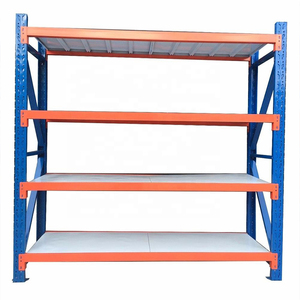 100% Selectivity
Adjustable Steel Selective Pallet Rack
Multi-level bolted upright assembly engineered for complete individual access to every pallet position across high-turnover multi-SKU distribution hubs.
- Payload: 1,000–4,500 kg/level
- Pitch: 50mm / 75mm Adjustable
- Finish: Epoxy Powder Coated
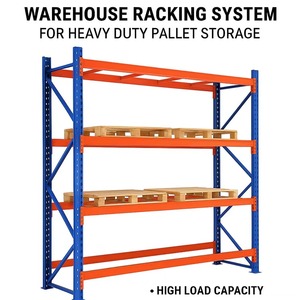 Heavy-Duty Logistics
Heavy Duty Pallet Storage System
Heavy-gauge cold-formed box beams and roll-formed omega columns designed for intensive heavy-load material handling and high-lift VNA reach-truck cycles.
- Profile: Upright 90/100/120mm
- Safety Factor: 1.5–1.8 (RMI / AS)
- Certified: ISO 9001 / CE
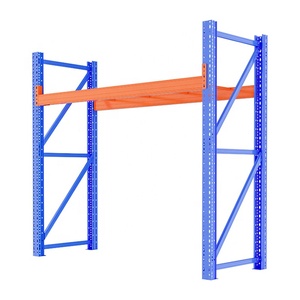 Medium Duty Shelf
500kg Medium Duty Storage Shelving
Boltless interlocking shelving units fitted with reinforced steel decking or timber board shelves, ideal for manual order consolidation and parts distribution.
- Uniform UDL: 300–500 kg/tier
- Decking: Cold-Rolled Steel
- Structure: Boltless Clip-in
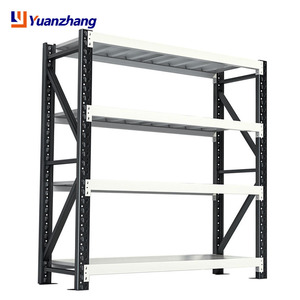 Workshop & Retail
Light Duty Adjustable Metal Shelves
Precision-punched slotted angle metal shelving with modular bolted corner gussets, offering rapid reconfigurability for hardware stores, maintenance bays, and e-com picks.
- Capacity: 100–250 kg/tier
- Assembly: Knock-down modular
- Corrosion: Degreased & Phosphated
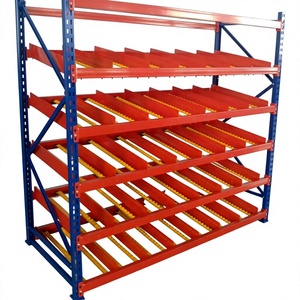 Strict FIFO Flow
Gravity Carton Flow Picking Rack
Inclined roller track bed providing autonomous dynamic gravity feeding from replenishment rear to front picking face, eliminating split-case picking delays.
- Bed: Aluminum / Plastic Rollers
- Tilt: 3°–5° Gravitational Bed
- Use: Fast Moving Consumer Goods
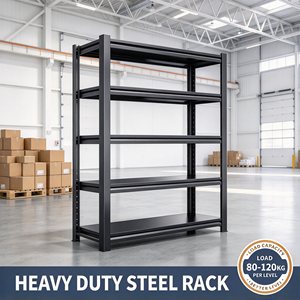 Commercial Display
Heavy Duty Steel Supermarket Gondola
High-tensile integrated upright base and multi-shelf adjustable display racking designed to handle extreme commercial retail payloads with scratch-resistant coating.
- Tiers: 4 to 6 Shelves Adjustable
- Structure: Single / Double Sided
- Backing: Pegboard / Solid Plain
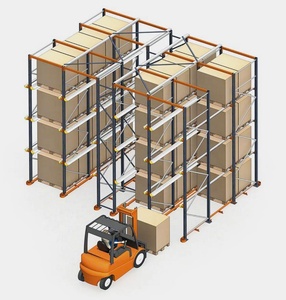 High-Density LIFO
Q235 High Density Drive-In Racking
Continuous aisle-less lane storage system engineered for cold-storage rooms and bulk beverage distribution, delivering up to 80% higher volumetric density than selective racks.
- Steel: Grade Q235B Cold Rolled
- Guide: Floor-mounted Truck Rails
- Config: Single / Double Entry
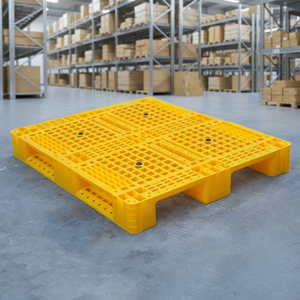 Reinforced Pallet
Steel-Reinforced HDPE Racking Pallet
Heavy-duty food-grade virgin HDPE polymer pallets internal-reinforced with corrosion-resistant galvanized steel tubes, rated for edge-racking without structural deflection.
- Racking Load: 1,200–1,500 kg
- Reinforcement: 4–8 Steel Tubes
- Design: 3 Runners, 4-Way Entry
Navigating Global Warehouse Racking Procurement: A Comprehensive OEM/ODM Industrial Framework
In modern supply chain architecture, racking is no longer a static steel commodity—it is a mission-critical structural sub-system governing volumetric storage throughput, floor area utilization, mechanical safety, and automated material handling integration.
As global warehousing costs per square meter continue an upward trajectory across North America, Europe, Australia, and New Zealand, logistics directors and general contractors face an increasingly complex challenge: securing high-load certified racking that guarantees absolute structural compliance with international standards (such as Australian AS 4084:2023, European EN 15512:2020, and American ANSI MH16.1) while simultaneously managing capital expenditure (CapEx) through factory-direct procurement.
This whitepaper breaks down the metallurgical properties, mechanical engineering tolerances, robotic manufacturing workflows, and seismic compliance protocols established by top-tier Chinese manufacturers like Guangzhou Heda Shelves Co., Ltd. Discover how leading intralogistics planners execute risk-free cross-border racking procurement from floor plan concept to port clearance.
Pallet Racking System Selection Matrix
Selecting the optimal storage topology requires balancing aisle access selectivity, cubic density, material handling fleet kinematics, and cost per pallet position.
| Racking Typology | Pallet Selectivity | Floor Density | Stock Rotation | Forklift Compatibility | Cost Index / Pallet |
|---|---|---|---|---|---|
| Selective Pallet Racking | 100% Immediate Direct Access | Baseline (40%–45% Footprint) | FIFO / LIFO Flexible | Counterbalance, Reach, VNA | Low ($) |
| Double Deep Racking | 50% (Two Pallets Deep per Bay) | High (+30% vs Selective) | Strict LIFO Per Lane | Pantograph Deep-Reach Forklifts | Low-Medium ($$) |
| Drive-In / Drive-Through | Low (Lane-Restricted Batches) | Ultra-High (Up to 80% Utilization) | LIFO (Drive-In) / FIFO (Drive-Thru) | Standard Counterbalance / Reach | Medium ($$) |
| Radio Shuttle Automation | Medium-High (Lane Controlled) | Maximum Density (Deep Lanes) | Configurable FIFO & LIFO | Standard Forklift (Shuttle Assisted) | Medium-High ($$$) |
| Gravity Flow Racking | High (Dedicated Picking Face) | Very High (Continuous Roller Bed) | Strict FIFO (Gravity Driven) | Standard Counterbalance & Reach | High ($$$$) |
| Rack-Supported Mezzanine | 100% Split Multi-Tier Picking | Doubled / Tripled Cubic Capacity | Batch & Piece Level Picking | Hand Pallet Trucks, Conveyors | Medium-High ($$$) |
Why International Tier-1 Contractors Partner with HEDA Shelves
Founded in 2001 and headquartered in Guangzhou, China, Guangzhou Heda Shelves Co., Ltd. operates a premier manufacturing footprint encompassing over 30,000 square meters. With an active engineering and fabrication force exceeding 300 professionals, Heda functions not merely as a steel mill processor, but as an integrated intralogistics engineering consultancy.
- AS 4084:2023 & EN 15512 structural validation
- Finite Element Analysis (FEA) load verification
- 30,000 Ton Monthly cold-rolling output
- Free 3D CAD & BIM warehouse layout designs
- ISPM-15 Certified timber & steel container packing
- 10-Year Structural anti-deflection warranty
EN 1090 Structural Steel
Verified Quality Management
Eco-Safe Pretreatment
Duty-Free / Tariff Reduction
10-Stage Precision Fabrication Workflow
Every cold-formed upright frame, load beam, row spacer, and base plate undergoes an unbroken chain of custody and rigorous automated fabrication.
Raw Coil Spectral Testing
CNC Precision Slitting
Continuous CNC Column Punch
Multi-Pass Cold Roll Forming
Precision Interlocking Profiling
Automated Surface Polishing
Robotic Robotic-Arm Welding
Acid Pickling & Phosphating
Electrostatic Powder Bake
Load Deflection & Export Pack
Emerging Procurement Trends in Global Pallet Racking
Strategic purchasing managers are moving away from reactive spot-buying in favor of value-engineered, standardized global procurement ecosystems.
Total Cost of Ownership (TCO) vs. Raw Unit Price
Global procurement teams evaluate racking based on life-cycle resilience: durability of epoxy finishes against aggressive salt air or cool-room condensation, availability of plug-and-play spare beams, structural gauge thickness, and simplified anchor designs that slash installation man-hours by up to 25% on-site.
Containerization-Optimized Nestable Geometry
With ocean shipping volatility affecting international procurement budgets, advanced Chinese manufacturers engineer beam and column nesting geometries that achieve up to 98% maritime container cubing efficiency. This reduces freight cost per pallet position by 30% compared to bulky, un-nested structures.
Pre-Engineered Seismic Compliance Documentation
Procuring entities in seismic fault zones—including New Zealand (NZS 1170.5), Australia, the US West Coast, and the Ring of Fire—increasingly mandate that imported steel racking packages arrive complete with section moduli calculations, weld fatigue reports, and anchor shear load capacities certified by registered structural engineers.
Architectural Evolution in Modern Storage Engineering
The boundary between static shelving and dynamic robotics is dissolving as factories transition into intelligent, automated intralogistics complexes.
Hybrid AS/RS & Radio Shuttle Integration
Traditional manually operated drive-in racks are rapidly being superseded by semi-automated Radio Shuttle and fully automated 4-way shuttle systems. By operating shuttle rovers inside 40-meter-deep storage lanes, facilities eliminate forklift impacts inside the racking superstructure and double throughput speed.
Structural High-Bay Rack-Supported Buildings (SILOs)
Rather than erecting a concrete tilt-up shed and filling it with shelving, enterprise logistics planners are building Rack-Clad SILOs. In this construction methodology, the racking columns form the actual structural frame carrying the roof truss and exterior wall claddings, drastically lowering civil construction capital expenditure.
Cold-Chain Optimization & Anti-Corrosion Metallurgy
With refrigerated pharmaceutical and frozen meat logistics surging, the demand for specialized cryogenic powder formulations and hot-dip continuous galvanization (ISO 1461) has doubled. These coatings prevent micro-fissuring and flaking at -30°C while resisting rigorous chemical washdown regimens.
Frequently Asked Questions by Global Racking Buyers
Detailed technical answers addressing compliance, material traceability, biosecurity, freight logistics, and on-site engineering approvals.
How does HEDA Shelves ensure compliance with AS 4084:2023, EN 15512, and RMI standards?
Our structural engineering department performs finite element stress modeling (ANSYS) and actual component destructive testing in strict alignment with regional design criteria. For Australian buyers, sections are engineered to meet AS 4084:2023 (Steel Storage Racking) limit-state design principles, including torsional-flexural buckling checks, connector stiffness tests, and shear pin integrity validations.
For European and American orders, we produce calculation packages conforming to EN 15512:2020 and ANSI MH16.1. We supply comprehensive structural calculation documentation, yield stress certificates, and stamped drawings ready for local third-party chartered structural engineers to certify and sign off.
What steel grades and thicknesses are utilized, and how is tensile yield strength verified?
We source prime, certified structural hot-rolled and cold-rolled strip steel exclusively from world-class domestic mills (such as Baosteel and Shougang). Standard uprights and load-bearing beams are formed from certified Q235B (yield strength fy ≥ 235 MPa) and high-tensile Q355B (fy ≥ 355 MPa, equivalent to European S355JR and ASTM A572 Grade 50).
Every single batch of raw steel entering our factory is cross-verified via chemical spectrometry (verifying Carbon, Silicon, Manganese, Phosphorus, and Sulfur limits) and physical mechanical tensile pulls. Mill Test Certificates (MTC conforming to EN 10204 3.1) are archived and provided with commercial shipping documentation.
How is seismic resilience incorporated for active earthquake zones (e.g., New Zealand NZS 1170.5)?
Seismic design for pallet racking requires precise balancing between structural stiffness and frame ductility. For installations in seismic zones, we calculate the dynamic Spectral Acceleration (Sa) based on site subsoil class and structural ductility factor (kμ). The physical rack structure is reinforced by: expanding the footprint and thickness of the welded base plates, upgrading chemical concrete anchor embedment depths, incorporating heavy-gauge horizontal and diagonal cross-plane back bracing, and installing heavy-duty double row-spacers across back-to-back runs to dissipate kinetic sway energy.
What are the packing, shipping, and biosecurity protocols for Australia (DAFF) and New Zealand (MPI)?
Strict biosecurity oversight by Australia's Department of Agriculture, Fisheries and Forestry (DAFF) and New Zealand's Ministry for Primary Industries (MPI) requires zero soil contamination, bark, or wood-boring pests. We address this completely at the source:
All beams and upright frames are stacked on all-steel stillages or certified heat-treated timber dunage bearing clear ISPM-15 stamps. Racks are shrink-wrapped in micro-perforated UV-resistant poly film with edge board guards, desiccant pouches to prevent container moisture condensation, and tagged with durable steel barcode labels. Complete customs packs—including Bills of Lading, Packing Lists with container weight distribution, and ChAFTA/ASEAN/RCEP Certificates of Origin—are dispatched digitally and physically.
Can you manufacture customized racking colors and private-label OEM specifications?
Yes. Over 65% of our overseas production is dedicated to private-label OEM and ODM partnerships with regional racking distributors, installation contractors, and material handling dealers. Our automated powder-coating lines support any custom RAL color specification (standard finishes include Safety Orange RAL 2004, Ultramarine Blue RAL 5010, Traffic Yellow RAL 1023, and Anthracite Grey RAL 7016).
We can laser-cut or emboss dealer logos into beam connectors, pre-affix custom load warning plaques displaying local compliance wording, and deliver unbranded, retail-ready packaging.
What specific details are required to receive a free 3D CAD proposal and load calculation within 24 hours?
To initiate an immediate engineering design, our technical team requires six basic parameters:
1. Architectural floor plan (DWG CAD or clear PDF) indicating warehouse dimensions, structural column grid, overhead doors, and emergency exit routes.
2. Clear building height to the lowest obstruction (underside of roof trusses, fire sprinklers, or lighting grids).
3. Pallet physical dimensions including cargo overhang (Width × Depth × Total Height including the wooden base pallet).
4. Maximum gross weight per pallet position.
5. Forklift make, mast model, minimum turning aisle width, and maximum fork lift height.
6. Project site address for regional seismic and ambient environmental calculations.