[email protected] Supplying Australia, New Zealand & the Pacific Islands

China Best Shelving Longspan Factories & Suppliers

Precision-Engineered Heavy & Medium-Duty Long Span Racking Systems | AS 4084 & CE Certified Modular Warehouse Infrastructure

High-Efficiency Longspan & Heavy-Duty Storage Configurations

Custom structural cold-rolled steel configurations tailored for third-party logistics (3PL), omnichannel distribution, automotive parts hubs, and high-density industrial mezzanines.
2001.
Founding Year
30,000m²
Factory Footprint
30,000t
Monthly Output Capacity
10,000+
Global Installations Completed

Longspan Shelving Engineering Blueprint: Cold-Formed Steel Precision & Dynamic Load Capacities

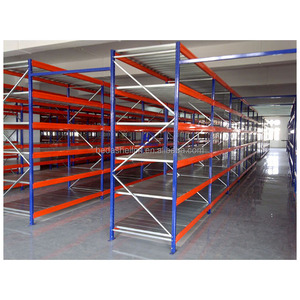
Industrial Longspan Shelving (also commonly classified as wide-span shelving or medium-to-heavy boltless racking) represents the definitive backbone for non-palletized inventory distribution. Operating between standard light rivet shelving and full-scale selective pallet racking, longspan fills a critical operational niche: high-density storage of hand-loaded, irregular, dense, or bulky stock items. When assessing Tier-1 Chinese manufacturers and suppliers, international buyers must transition from evaluating raw ton-price quotes to auditing the precision engineering parameters that dictate life-cycle load safety, beam deflection tolerance, and dynamic torsional resistance.

Information Gain Insight: The true structural integrity of longspan shelving relies on the yield strength ratio of cold-rolled Q235B vs. Q355B carbon steel, automated multi-stage rolling precision, and the post-punching profile consistency of upright frames under eccentric vertical loads.

Top-tier Chinese factories utilize automated continuous profile roll-forming mills equipped with in-line CNC punching. The punch-hole geometry—typically teardrop, butterfly, or multi-faceted diamond patterns—must maintain tolerances within ±0.1mm. High precision ensures the claw hooks of step-beams engage with an interference fit into the upright posts. This zero-slack engagement prevents the micro-rotations and upright twisting that lead to catastrophic progressive collapse under unladen dynamic shocks or minor warehouse lift-truck impacts.

Finishing protocols define the total lifecycle ROI of industrial shelving. Substandard factories often rely on manual dip degreasing and direct electrostatic coating. In contrast, certified manufacturing processes mandate a complete 10-stage automated pre-treatment system: hot chemical degreasing, twin-stage water rinse, acid pickling to eliminate mill scale, surface conditioning, micro-crystalline phosphating (creating an iron-phosphate anti-corrosion barrier), demineralized water rinse, and controlled curing. Subsequent electrostatic application of TGIC-free polyester powder coating (cured at 180°C–200°C for 20 minutes) yields a dry film thickness between 60 to 90 microns. This specification passes rigorous ASTM B117 salt spray tests for 500+ hours without rust bloom or edge delamination.

Future Sourcing Trends & Next-Generation Engineering in Longspan Systems

The global logistics landscape is undergoing an unprecedented structural transition driven by automated retail fulfillment, micro-warehousing, and regional supply chain reshoring. As global logistics engineers analyze their procurement matrices for the coming decade, Chinese manufacturers are executing strategic technological pivots across three vectors:

1. Hybrid AMR & AGV Integration

Modern longspan systems are no longer static racks. Upright footings, shelf clear spans, and bottom elevations are actively re-engineered to interface with Autonomous Mobile Robots (AMRs) and Automated Guided Forklifts, requiring reinforced floor anchors and wide-aperture lower pick tunnels.

2. High-Strength Ultra-Thin Gauge Steel

By transitioning from conventional commercial steels to high-strength micro-alloyed cold-rolled coils (e.g., Q355B and automotive-grade structural alloys), factories optimize material thickness by 15–20% while sustaining identical or superior yield loads, mitigating international sea container shipping surcharges.

3. Verified Dynamic & Seismic Compliance

Procurement departments require turnkey compliance packages. Advanced suppliers integrate localized engineering parameters into every design—such as AS 4084 (Steel Storage Racking) for Australasia and NZS 1170.5 seismic factors for active geotechnical zones—complete with formal finite element analysis (FEA) certifications.

Enterprise Manufacturing Capabilities & Global OEM/ODM Infrastructure

Sourcing directly from Guangzhou Heda Shelves Co., Ltd. eliminates intermediate trading house markups and delivers verifiable technical transparency. Established in 2001, HEDA Shelves operates as a full-scale industrial manufacturer specializing in engineered racking, heavy mezzanine systems, and high-tolerance longspan shelving configurations.

Turnkey CAD & 3D Modeling

Our in-house design team provides free 3D CAD layout optimizations within 24 hours. Floor layouts, load capacities, flue spaces, and forklift turning radiuses are engineered to match your facility footprint precisely.

Verified Certifications (CE & ISO)

Complete structural traceability. We provide official CE Certification (No. 2435-CPR-8605159), ISO 9001:2015 Quality Management documentation (No. 18624Q00169R0M), and independent SGS/RoHS material test reports.

Fumigation & Biosecurity Compliance

Every export shipment is packaged on custom heavy-duty steel stillages or strictly certified ISPM-15 treated timber, ensuring zero quarantine delays at rigorous ports of entry (including Australian DAFF and New Zealand MPI).

Frequently Asked Questions: Sourcing Longspan from China

Direct technical and logistical clarity for procurement directors, logistics engineers, and warehouse operations managers.

What is the definitive engineering difference between medium-duty longspan shelving and selective pallet racking?
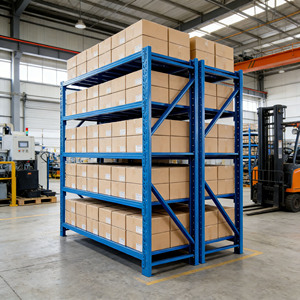
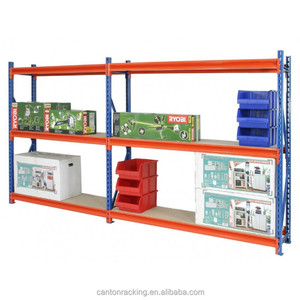
Medium-duty longspan shelving is optimized for hand-loaded, manual picking operations, typically handling uniform distributed loads (UDL) ranging from 200 kg to 800 kg per shelf level. The upright profiles, horizontal step-beams, and decking materials (steel panels, wire mesh, or particle board) are engineered with smaller cross-sectional dimensions to maximize clear vertical picking height and aisle space. Selective pallet racking utilizes substantially heavier cold-formed uprights (e.g., 80mm to 120mm profiles) and box/stepped beams designed for forklift loading of palletized unit loads ranging from 1,000 kg to 4,000 kg per pair of beams. Longspan provides greater SKU accessibility for small-to-medium boxes, whereas pallet racking prioritizes structural mass and forklift impact resilience.
How do top Chinese factories calculate deflection limits and structural safety factors?
Reputable manufacturers calculate beam deflection in strict accordance with international standards such as FEM 10.2.02 and EN 15512 (European codes), ANSI/RMI MH16.1 (USA), or AS 4084 (Australia). The standard allowable vertical deflection limit under full rated Uniformly Distributed Load (UDL) is typically L/200 (length of the beam divided by 200) for standard shelf levels, or L/300 where sensitive equipment or automated guided robotics require minimal floor-level slope. Uprights and frame connections are tested using dynamic finite element modeling (FEA) and destructive load presses to guarantee a minimum structural safety factor of 1.5 to 1.65 against mechanical yield failure.
Can longspan shelving upright frames be structurally utilized to support warehouse mezzanine floors?
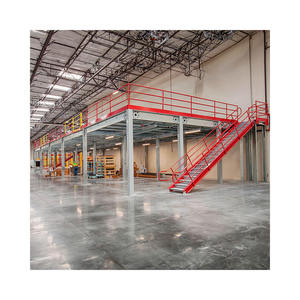
Yes. Rack-supported and shelving-supported mezzanine floor systems are one of the most cost-effective methods to double or triple usable floor area in high-clearance warehouses. When designing a shelving-supported mezzanine, the longspan upright profiles must be upgraded in both steel gauge (minimum 1.5mm to 2.0mm thickness) and cross-sectional depth to bear both the concentrated vertical loads of the shelf levels and the combined dead/live load of the mezzanine platform (typically calculated between 300 kg/m² to 1,000 kg/m²). Engineering packages must account for lateral wind/seismic forces, staircase egress points, and heavy-duty steel baseplate anchoring directly into the facility's reinforced concrete slab.
What documentation is required to clear customs smoothly and prove international quality compliance?
A comprehensive procurement package from a reputable Chinese exporter includes: 1) Verified Commercial Invoice and Detailed Packing List broken down by individual bundle, part number, and weight; 2) Ocean Bill of Lading (B/L); 3) Official Certificate of Origin (such as ChAFTA COO for Australia or Form E for ASEAN) to access preferential tariff exemptions; 4) Manufacturer Mill Test Certificates (MTC) proving steel chemical composition (Q235B/Q355B); 5) CE Declarations of Performance and ISO 9001:2015 registry; and 6) Official ISPM-15 heat-treatment stamps or fumigation certificates for all wood dunnage utilized, or proof of 100% all-steel container stillage bundling.
How does container packing configuration affect shipping cost efficiency and transit damage protection?
Because longspan uprights and beams are long, rigid metal profiles, improper hand-stuffing results in scratched powder coatings, bent connector lugs, and wasted container volumetric capacity (dead freight). Top factories utilize custom steel stillages and automated rolling skids to load 40ft High Cube (40HQ) containers. Uprights are bundled back-to-back with high-density protective foam separators; step-beams are stacked on specialized base channels and steel-strapped; decking panels are palletized and edge-protected with heavy corner boards. This guarantees container capacity utilization exceeding 92% while facilitating complete container unstuffing by forklift within 30 minutes at the destination port.

Request Your Free 3D CAD Warehouse Layout & Factory Quote

Connect directly with Guangzhou Heda Shelves engineering consultants. Submit your floor dimensions, target shelf capacities, or technical bidding specifications. We generate full layout proposals, load data sheets, and competitive FOB/CIF container price structures within 24 hours.