Heavy-Duty Pallet Racking Upright Frames & Storage Arrays
Continuous-profile uprights engineered from Q235B and Q355B structural steel, engineered to handle static and seismic loads from 1,000 kg to beyond 25,000 kg per bay.
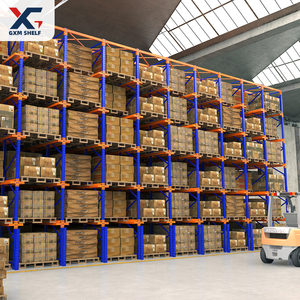 Boltless Interlock
GXM Industrial Heavy Duty Warehouse Rack Boltless Storage Pallet Racking System Shelving Drive-in Rack
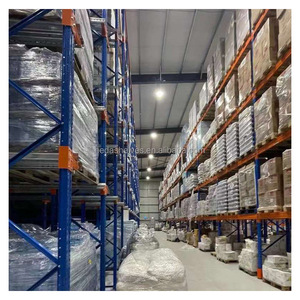 Standard Pallet
Warehouse Storage Rack Pallet Racking For Industrial Shelves Boltless Heavy Duty Pallet Rack System Warehouse Racking System
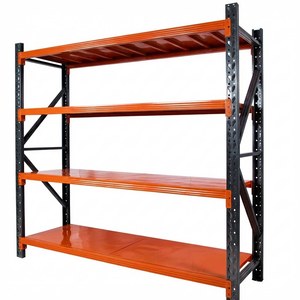 Multi-Layer Tier
Durable Cold Rolled Steel Heavy Duty Multi-Layer Pallet Rack Warehouse Storage Solution High Loading Capacity Epoxy Racking
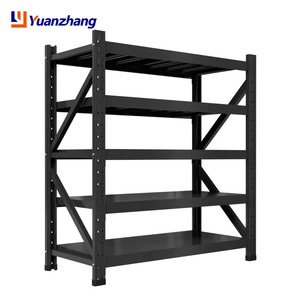 Medium-to-Heavy
Custom Steel Heavy Duty Shelving 300 Kg Layer Garage Black 4 Tier Warehouse Storage Metal Stacking Rack Unit for Warehouse
 Extreme Duty
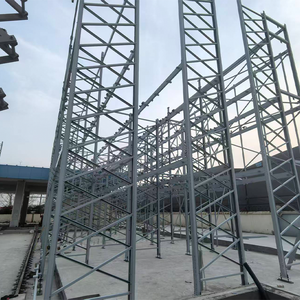
Mine Bulk Materials Anti-pressure Piling Heavy Duty 5 Layer Corrosion Protection Metal Warehouse Rack 1000-4000kg Load Capacity
 Fast Deployment
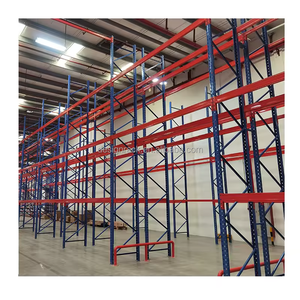
Heavy Duty Shelving Storage Easy Assemble Material Racking Unit Industrial Pallet Rack Solution Racking System Warehouse Storage
 High Density
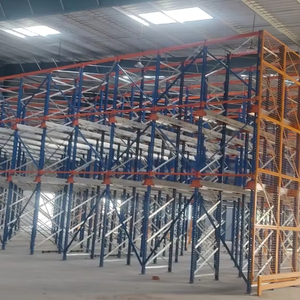
Steel High-Density LIFO Drive Pallet Rack 25000 kg Capacity Powder Coated Strong Guide Rails Forklift Drive-In Access Storage
 Drive-Through FIFO
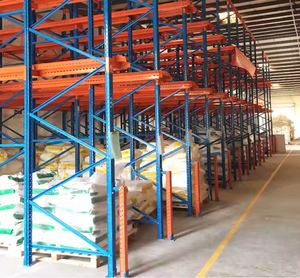
High Quality Adjustable Drive-Through Pallet Rack Industrial Warehouse Drive-In Racking System Folding Metal Storage Rack
Cold-Formed Upright Column Engineering: Minimizing Buckling & Maximizing Torsional Rigidity
A technical examination of cross-sectional geometries, residual rolling stresses, and perforation patterns that dictate vertical load capacity in modern high-bay distribution centers.
Multi-Ribbed Omega Profiles
Standard C-channels fail prematurely under eccentric vertical loading due to torsional-flexural buckling. HEDA uprights utilize continuous roll-formed 11-bend to 13-bend Omega (Ω) profiles with structural stiffening returns. This complex geometry dramatically enhances the polar moment of inertia ($J$) and radius of gyration ($r_x, r_y$), allowing the upright column to resist elastic distortional buckling even under unbraced heights exceeding 2,400 mm.
Progressive Hole Pitch Mechanics
The perforation pattern on an upright column is often the primary stress-concentration nexus. Our CNC progressive punching dies produce tapered teardrop, hex-locking, or Euro-standard diamond perforations along the neutral bending axis. By strictly avoiding punches along the critical outer flanges and cold-worked corners, HEDA uprights maintain over 92% of the original unpunched section modulus ($Z$), ensuring uncompromising stub-column test performance.
Metallurgical Yield Dynamics
Sourced directly from leading prime mills (Baosteel, Shougang), our base coils undergo rigorous chemical spectrometry and tensile testing. We utilize high-yield Q235B ($f_y \ge 235\text{ MPa}$) and micro-alloyed Q355B ($f_y \ge 355\text{ MPa}$) hot-rolled pickled and oiled (HRPO) or cold-rolled strip steel. Controlled carbon-equivalent values ($CEV \le 0.38$) guarantee exceptional cold-forming elongation without micro-fracturing along the 90-degree internal bend radiuses.
| Upright Profile (mm) | Standard Gauge (mm) | Steel Grade | Section Area ($A, \text{cm}^2$) | Moment of Inertia ($I_x / I_y, \text{cm}^4$) | Max Frame Capacity (kg) | Standard Punching Pitch |
|---|---|---|---|---|---|---|
| HU-80 (80 × 60) | 1.5 / 1.8 / 2.0 | Q235B (Yield ≥ 235 MPa) | 3.45 – 4.48 | 31.2 / 18.5 | 8,500 – 11,200 | 50 mm / 75 mm / 76.2 mm |
| HU-90 (90 × 70) | 1.8 / 2.0 / 2.3 | Q235B / Q355B | 4.82 – 6.02 | 52.4 / 32.1 | 12,000 – 16,800 | 50 mm / 75 mm (Standard Teardrop) |
| HU-100 (100 × 70) | 2.0 / 2.3 / 2.5 | Q355B (Yield ≥ 355 MPa) | 5.95 – 7.32 | 78.6 / 42.8 | 16,500 – 21,000 | 50 mm Euro / Universal Hex |
| HU-120 (120 × 95) | 2.3 / 2.5 / 3.0 | Q355B / SS400 | 8.44 – 10.82 | 164.2 / 102.5 | 22,000 – 28,500 | 75 mm Pitch (Heavy AS 4084 Spec) |
| HU-140 (140 × 95) | 2.5 / 3.0 / 3.2 | Q355B / S355JR | 11.20 – 14.15 | 288.5 / 145.2 | 28,000 – 36,000+ | Custom CNC Pattern (ASRS High Bay) |
Why Global Logistics Importers Trust Guangzhou Heda Shelves
Operating continuously since 2001, Guangzhou Heda Shelves Co., Ltd. combines heavy metallurgical manufacturing muscle with turnkey European & Australasian regulatory verification.
Legally Auditable Certifications
Transparency is foundational for risk mitigation. HEDA Shelves holds active, auditable compliance files including CE Certification No. 2435-CPR-8605159, Quality Management System ISO 9001:2015 No. 18624Q00169R0M, and full RoHS environmental compliance. Every production batch is backed by mill test certificates (MTC) to EN 10204 Type 3.1 detailing raw chemical melt analysis and mechanical elongation tests.
Biosecurity & Export Staging
Customs delays at arrival ports destroy logistics ROI. HEDA executes certified biosecurity packaging for Australia (DAFF) and New Zealand (MPI) standards. Uprights are banded onto heavy-gauge reusable steel stillages or ISPM-15 heat-treated, certified debarked timber dunnage. Bundle tagging incorporates barcode tracking and alphanumeric row identifiers, slashing on-site sorting and assembly time by up to 35%.
Turnkey 3D CAD & FEA Analysis
Before punching a single coil, our structural engineering department produces fully dimensioned AutoCAD layout schematics, 3D Revit models for BIM integration, and Finite Element Analysis (FEA) simulations. We model buckling bifurcation loads, baseplate anchor bolt pull-out tensions, and second-order P-Delta structural effects, providing full computational calculations for verification by your local registered structural engineer.
Future Trends in Warehouse Upright Columns & Storage Infrastructure
As global supply chains navigate automated intralogistics, extreme climate conditions, and aggressive sustainability mandates, the engineering parameters governing upright columns are shifting rapidly.
Integration with Automated Guided Vehicles (AGVs) & AMRs
Traditional selective uprights only accommodated standard counterbalanced forklifts. Modern distribution hubs require upright bases engineered with integrated laser-guided AGV and Autonomous Mobile Robot (AMR) docking targets. Upright columns now feature custom-welded tubular impact deflector skirts and recessed anchor brackets that prevent structural damage while preserving critical aisle clearances down to millimeter tolerances.
ASRS High-Bay Monoliths Exceeding 30 Meters
Industrial real estate land costs are forcing warehouses upward. Procurement is moving from spliced upright assemblies to continuous cold-rolled single-pass columns or modular structural flanged uprights capable of servicing 30-meter Automated Storage and Retrieval Systems (ASRS). These uprights demand ultra-tight manufacturing tolerances (camber/bow $\le L/1000$ and twist $\le 1^\circ$ per 3 meters) to ensure automated crane masts operate smoothly at high travel velocities.
Advanced Seismic Base-Isolation & Dissipative Baseplates
Following updated seismic codes across Australasia (NZS 1170.5) and North America (ASCE 7), standard static baseplates are being superseded by engineered energy-dissipative column shoes. These base assemblies utilize ductile anchor studs, yield-controlled shims, and elastomeric dampers beneath upright columns to absorb inter-story shear waves, significantly reducing the probability of rack collapse during maximum considered earthquake (MCE) events.
Zero-VOC Powder Coatings & Hot-Dip Galvanizing (HDG) for Extreme C4/C5 Sites
Cold chain facilities (-30°C) and coastal humidity accelerate corrosion. Buyers are pivoting away from basic air-dried coatings toward automated 9-stage pre-treatment (iron-phosphate or nano-ceramic zirconium) followed by architectural-grade electrostatic TGIC-free polyester powders. For fertilizer storage, coastal Oceania docks, and chemical warehouses, batch Hot-Dip Galvanizing (HDG) to ISO 1461 guarantees over 50 years of zero-maintenance corrosion protection.
Frequently Asked Questions: Upright Frame Specification & Direct Importing
Direct technical answers addressing structural certification, metallurgy, shipping logistics, and compliance verification for intralogistics procurement professionals.
How do HEDA upright frames comply with Australian Standard AS 4084:2023 and European EN 15512?
Compliance with modern racking standards requires an empirical and analytical dual-track protocol. Under AS 4084:2023 and EN 15512, cold-formed perforated uprights cannot be modeled purely on elastic beam theory because perforations degrade torsional and local buckling limits. HEDA conducts physical stub column testing, cyclic connection shear tests, and frame shear tests to quantify the genuine non-linear performance of our sections. We provide our global clients with comprehensive design data sheets—including cross-sectional area ($A$), effective moment of inertia ($I_{eff}$), and torsional constants—so that local consulting structural engineers can calculate site-specific load limit states and issue PS1/Certificates of Compliance without delay.
What is the structural performance difference between Q235B and Q355B steel in upright columns?
Q235B possesses a nominal yield strength of 235 MPa and an ultimate tensile strength of 370–500 MPa, delivering superb ductility (elongation ≥ 26%). It is the ideal, economical standard for light-to-medium pallet loads and ambient warehousing with beam spans up to 2,700 mm. In contrast, Q355B is a low-alloy, high-strength manganese steel with a minimum yield point of 355 MPa (approx. 51% stronger in yield than Q235B). Utilizing Q355B allows HEDA to roll uprights that handle extreme vertical loads (such as heavy drive-in and high-bay cantilever installations) while reducing the nominal steel gauge thickness by 15–20%, reducing total project deadweight, shipping tonnage, and foundation stress without compromising safety margins.
How are upright frame bracing patterns engineered to counteract seismic lateral loads?
Upright frames consist of two vertical columns interconnected by horizontal and diagonal bracing struts forming a vertical truss system. In non-seismic zones, standard K-brace or D-brace configurations with hollow C-section or tubular members are bolted at 600–1,200 mm intervals to resist transverse operational forces. For high seismic regions (such as New Zealand seismic zones 1–4 under NZS 1170.5 or California under RMI/IBC), the bottom bay geometry is tightened into a rigid X-bracing truss, and bracing gauges are thickened. Baseplates are enlarged with multiple high-strength expansion or chemical undercut anchors (M12–M16) to transfer overturning tension and shear loads directly into the concrete slab.
What ocean freight protection methods are deployed to prevent corrosion and shipping distortion?
Cross-ocean container shipping exposes raw and coated steel to severe thermal cycling and saline condensation. HEDA applies a three-layer export packaging standard: first, every upright column profile is nested to maximize container cubic efficiency; second, contact edges are padded with corrugated card and industrial polyethylene stretch wrap; third, nested bundles are strapped with high-tensile steel banding onto structural steel cradle channels (stillages) that prevent bending moments during forklift cross-dock handling. We pack desiccant packs inside 40ft HQ dry shipping containers to keep relative humidity below the dew-point condensation threshold during sea voyages.
Can HEDA manufacture replacement or expansion uprights compatible with legacy rack brands?
Yes. Our in-house tool and die tooling department can replicate proprietary perforation pitches and profiles, including Australian 76.2 mm pitch, European 50 mm / 75 mm diamond patterns, and American standard 2-inch teardrop profiles. If you are retrofitting or expanding an existing installation (e.g., Dexion, Colby, Schaefer, Stow, or Interlake styles), you can provide engineering drawings or sample cutaways. Our engineers will perform coordinate measuring machine (CMM) profiling to ensure 100% connector claw engagement, lock pin alignment, and load capacity parity with your existing infrastructure.
What is the production turnaround and transit time to major global commercial ports?
HEDA's 30,000 m² factory operates automated continuous roll-forming lines capable of yielding over 30,000 metric tons per month. Standard full container load (FCL) orders typically ship within 15 to 22 business days from drawing approval. Ocean freight transit from South China major ports (Guangzhou / Shenzhen) averages: 12–18 days to Australian East Coast (Sydney, Melbourne, Brisbane); 14–20 days to New Zealand (Auckland, Lyttelton); 18–24 days to West Coast North America (LA, Long Beach); and 24–32 days to European hubs (Rotterdam, Hamburg, Felixstowe). Direct port-to-port schedules minimize customs transshipment lead-times.
What structural documentation is provided to support client warehouse permitting?
Every commercial export project is accompanied by a complete Engineering Permitting Submittal Pack. This dossier includes: 1) Certified Mill Test Certificates (MTC) proving steel chemistry and tensile properties; 2) Independent ISO 9001:2015 and CE Factory Production Control (FPC) audit documentation; 3) Fully dimensioned CAD layout drawings detailing flue spaces, egress clearances, and clear heights; 4) Dynamic beam and frame load charts signed off by our structural engineering division; and 5) Official installation instructions along with standardized aluminum Load Notice Plaques compliant with AS 4084 and OSHA / ANSI requirements.
Ready to Engineer or Optimize Your Warehouse Racking Run?
Partner directly with one of China's premier racking upright manufacturers. Share your warehouse floor dimensions, clear stacking heights, pallet load parameters, and handling vehicle models. Our certified structural engineers will deliver a free 3D CAD proposal and comprehensive load quotation within 24 hours.