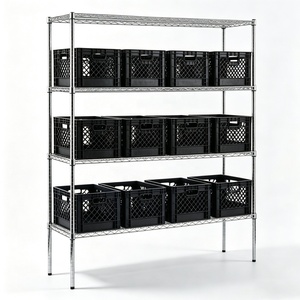
Engineered Industrial Racking & Warehouse Shelving Portfolio
Custom structural systems fabricated using high-tensile Q235B and Q355B cold-rolled steel, calibrated for heavy material handling, cold storage resilience, and rapid pallet throughput.
2001
Established Year
30,000+
Sq.m Production Facility
30,000t
Monthly Steel Output
10,000+
Global Projects Completed
Structural Anatomy of Heavy-Duty Drive-In Racking Architecture
A rigorous examination of continuous channel rail designs, upright profile elasticity, dynamic horizontal bracing, and seismic integrity.
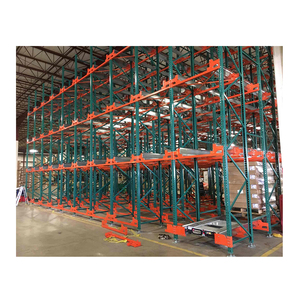
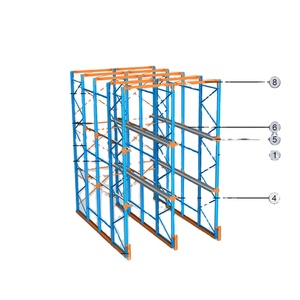
In high-density industrial logistics, conventional selective racking fails to provide financial viability when floor footprints encounter escalating real estate costs and soaring refrigeration energy expenses. As premier OEM/ODM drive in pallet racking system suppliers and exporters, our engineering framework eliminates operating aisles by creating continuous multi-level depth channels. Instead of beams spanning across upright columns, pallets rest upon cantilevered continuous support rails (corbels and pallet rails), permitting counterbalanced or reach forklift trucks to enter the storage matrix directly.
This structural arrangement unlocks floor surface utilization rates exceeding 75% to 85%, doubling the volumetric storage capacity of selective systems. The structural integrity of drive-in racking relies upon rigid structural portal frames, three-dimensional top portal ties, and heavy-duty back-wall bracing towers designed to absorb the lateral micro-deflections produced by equipment movement within deep bays.
"Drive-in storage efficiency is governed by the structural calculation of rail deflection under dead and live loads. Every millimeter of clearance must maintain geometric stability across thermal variations ranging from ambient logistics to -30°C flash freezer configurations."
Formed Omega Columns
Fabricated through precision continuous roll-forming lines, our multi-bend Omega upright profiles feature high inertial resistance (Iy and Iz), mitigating column buckling under extreme dynamic stacking forces.
Cold-Formed Pallet Rails
Tapered front guiding edges fabricated from structural steel channel sections allow smooth pallet entry, preventing edge snagging while providing reinforced structural corbel connection hooks.
Floor Anchoring & Guide Tracks
Integrated heavy structural floor-mounted guide rails (angle iron or chemical-anchored C-sections) shield upright posts against mast collisions, optimizing cycle times and operator confidence.
Comparative Performance Matrix: High-Density Warehouse Modalities
Evaluating trade-offs between initial capital investment, operational SKU velocity, and volume conversion efficiency.
| Evaluation Parameter | Drive-In Pallet Racking | Selective Racking | Push Back Racking | Radio Shuttle Racking |
|---|---|---|---|---|
| Space Utilization Ratio | Up to 80% - 85% | 40% - 45% | 65% - 70% | Up to 85% - 90% |
| SKU Selectivity | Low (Batch SKU / Homogeneous) | 100% Immediate Access | Moderate (Lane-specific) | Moderate to High per Level |
| Inventory Rotation | LIFO (FILO) / FIFO (Drive-Through) | Unrestricted FIFO / LIFO | Strict LIFO (Gravity Incline) | Flexible FIFO & LIFO |
| Initial Capital Outlay | Low to Moderate (Cost-Effective) | Lowest Baseline | High (Mechanical Carts) | High (Cart + Lithium Automated Units) |
| Cold Storage Efficiency | Extremely High Efficiency | Low (Heats Empty Aisles) | Moderate | Maximum Volumetric Density |
| Equipment Impact Risk | Moderate (Mitigated by Guide Rails) | Low | Low | Lowest (Tucks Outside Bays) |
Emerging Procurement Trends Shaping Industrial Storage (2025–2030)
Macro-economic pressure, micro-temperature logistics, and circular structural engineering demand evolving procurement methodologies.
1. Near-Zero Cold Chain Leakage
Refrigerated warehouse electricity costs represent up to 60% of total operating expense. Modern procurement teams specify drive-in matrices built for extreme high-cube clearance, compressing cooling cubic volume per pallet position.
2. Hybrid AGV/AMR Integration
Traditional manual drive-in systems are transitioning to autonomous forklift compliance. Channels require laser-verified tolerance bands (±1.5mm) and standardized optical target locators at lane entrances for driverless navigation.
3. Decarbonized Steel Traceability
Global procurement charters require Environmental Product Declarations (EPD). Steel coil supply lines are verified for reduced embodied carbon, accompanied by non-toxic powder coating processes certified under RoHS and REACH protocols.
Future Technology & Structural Development Vectors
Next-generation raw material developments and structural health monitoring frameworks redefine operational durability.
High-Strength Dual-Phase Steels
Transitioning from standard Q235B to high-yield micro-alloyed structural grades enables thinner wall cross-sections with increased load capacities, cutting raw dead-weight load on floor foundations by up to 14%.
Smart IoT Load Deflection Sensors
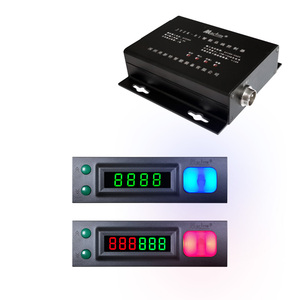
Integration of wireless strain-gauge sensors embedded directly on critical corbel cantilevers to transmit real-time deflection data directly to warehouse management dashboards, preemptively identifying overload conditions.
Hot-Dip Galvanized Marine Finishes
For aggressive environments across coastal Oceania, tropical Pacific operations, and harsh chemical zones, our hot-dip galvanization processes comply with ISO 1461, achieving zinc deposition depths beyond 65–85μm for multi-decade life spans.
Guangzhou HEDA Shelves: Engineering Competence & Factory Prowess
Founded in 2001, Guangzhou Heda Shelves Co., Ltd. operates an advanced 30,000 m² production base delivering end-to-end manufacturing control for world-class distributors and logistics operators.
With more than 300 experienced technical personnel and a monthly production volume reaching 30,000 metric tons, we bridge the gap between heavy structural manufacturing and strict international compliance. Whether engineering for Australian AS 4084, New Zealand NZS 1170.5 seismic regulations, or European CE EN 15512 frameworks, our structural engineering team delivers complete 3D layout simulations, static calculations, and certified manufacturing schedules.
Certified Quality Verification
Independent verified compliance with CE Certification (No. 2435-CPR-8605159) and ISO 9001:2015 Quality Management Systems (No. 18624Q00169R0M). Every batch is tracked back to raw steel mill certificates.
Complete In-House Production
From automated high-speed roll forming to robotic welding jigs, automatic acid pickling, phosphating baths, and dual-gun electrostatic powder coating lines, all processes are executed within our facility.
Custom OEM/ODM Logistics Packing
Engineered nesting bundles, steel stillages, and ISPM-15 compliant wood skids designed for rapid clearance through strict biosecurity checks (DAFF Australia and MPI New Zealand) without fumigation demurrage.
01
Structural Design
Finite element analysis and custom AutoCAD/SolidWorks layout planning.
02
Roll Forming
Cold-forming multi-stage rolls shaping high-yield steel coils.
03
Robotic Welding
CO2 gas shielded automated welding for brackets and frame assemblies.
04
Powder Coating
Phosphatized surface preparation with heat-cured polyester polymer coating.
05
Export Dispatch
Container load optimization, steel banding, and complete customs documentation.
Frequently Asked Questions for Overseas Procurement Directors
Comprehensive engineering clarity on design criteria, safety configurations, container packing, and local compliance certification.
How does HEDA guarantee compliance with AS 4084 and NZS 1170.5 seismic standards?
Our engineering team references AS 4084 (Steel Storage Racking) criteria during initial structural planning. We supply section properties, cross-sectional inertia calculations, dynamic shear load coefficients, and detailed layout documentation. For New Zealand projects, frame bracing thickness, chemical anchor bolt diameters, and enlarged baseplate footings are engineered to accommodate site-specific spectral acceleration data per NZS 1170.5 for immediate review by local certifiers.
What minimum dimensional tolerances are required between forklifts and drive-in lanes?
A standard drive-in bay requires 75mm to 100mm of operational clearance on either side of the widest point of the forklift chassis or pallet overhang. Overall clear bay width typically equals pallet depth/width plus 200mm minimum. Floor-mounted heavy structural steel guide channels are recommended for drive-in configurations exceeding 4 pallets in depth to prevent mast collisions with upright columns.
Can Drive-In Racking be converted into a Radio Shuttle or Push Back system in the future?
Yes. Because HEDA manufactures its upright columns on modular pitch increments (50mm or 75mm spacing), the primary upright frames can serve as the structural backbone for radio shuttle rails or push-back cart channels. When prospective clients plan future warehouse automation, we design upright column gauges to support subsequent dynamic load shifts without requiring total frame replacement.
What surface treatment is best for sub-zero food cold storage (-25°C to -30°C)?
For standard frozen food warehouses with consistent humidity control, our specialized epoxy-polyester electrostatic powder coating (60–80μm thickness) provides superior adhesion and avoids cold-brittleness. In environments characterized by regular wash-downs or condensation cycles, hot-dip galvanization conforming to ISO 1461 is recommended to stop sub-surface rust propagation.
What is the typical manufacturing lead time and sea freight schedule for Oceania/International ports?
Factory production for orders ranging between 2 to 10 full container loads (40ft HQ) averages 18 to 25 working days. Transit time via direct sea routes from South China ports (Guangzhou, Shenzhen, Nansha) to major destination hubs (Sydney, Melbourne, Brisbane, Auckland) typically spans 14 to 22 days. Full sets of export documentation, including preferential Certificates of Origin under ChAFTA, are dispatched digitally before vessel arrival.
Plan Your High-Density Warehouse Racking Project
Submit your warehouse CAD floor plan, clear ceiling heights, and pallet specifications. Our senior structural engineers deliver complete 3D layouts, load calculations, and competitive factory-direct quotations within 24 hours.
Inquire Now