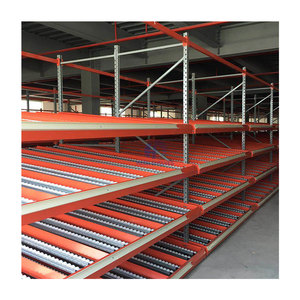
 Dynamic FIFO
Customized Gravity Pallet Carton Flow Racking System Vertical Roller Track
500-1500 kg/Pallet
Slope: 2.8° - 3.5°
Galvanized Rollers
Explore our heavy-duty FIFO pallet flow and carton flow configurations engineered for rapid stock rotation, cold-storage endurance (-30°C), and zero-energy gravitational fulfillment.
Dynamic FIFO
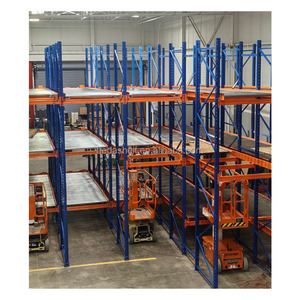 Heavy-Duty FIFO
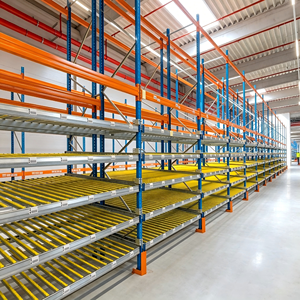 Carton Picking
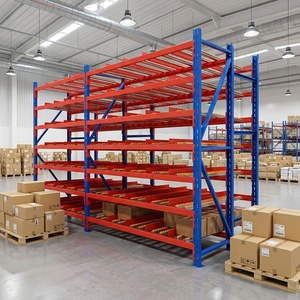 Custom Storage
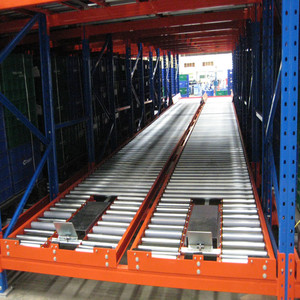 Sliding Track
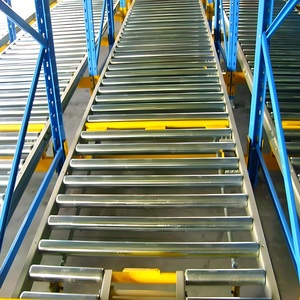 High Efficiency
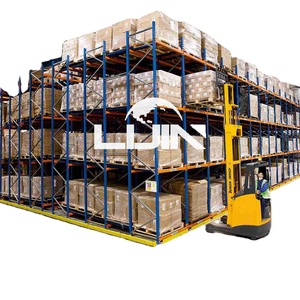 OEM / Live Storage
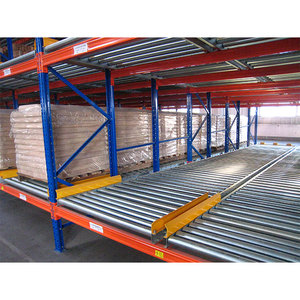 2000kg Rating
A rigorous engineering analysis of gravitational vector control, rolling friction damping, and kinetic load stabilization across high-density intralogistics lines.
Unlike static selective pallet racking, gravity flow systems (also referred to as live pallet storage) transform gravitational potential energy into managed kinetic roll. Achieving optimal flow dynamics requires absolute balance between the rack's pitch inclination, pallet bottom contact deflection, and the rolling friction coefficient ($\mu_r$) of cylindrical steel rollers.
When pallets move down deep lanes (ranging from 4 to over 25 pallets deep), uncontrolled acceleration causes dangerous end-stop collisions and packaging failure. We integrate heavy-duty mechanical centrifugal brake rollers and magnetic eddy-current retarders calibrated specifically to keep travel speed strictly between 0.25 m/s and 0.35 m/s, regardless of whether a load weighs 300 kg or 1,800 kg.
Additionally, our patented automatic load separation mechanisms relieve hydraulic backpressure at the discharge picking face, eliminating line pinch and ensuring smooth forklift extraction without rack deflection or load hang-ups.
Evaluating volumetric density, operational throughput, cycle efficiency, and total cost of ownership across major industrial racking systems.
| Storage Topology | Gravity Pallet Flow | Radio Shuttle Racking | Drive-In Racking | Push-Back Cart Racking |
|---|---|---|---|---|
| Stock Rotation Principle | Strict FIFO (First-In, First-Out) | Flexible FIFO or LIFO | Strict LIFO (Last-In, First-Out) | LIFO (Last-In, First-Out) |
| Warehouse Floor Utilization | Up to 75% - 85% | Up to 80% - 88% | 65% - 75% | 60% - 70% |
| Energy Consumption / OPEX | 0 kWh (Pure Gravity Driven) | Moderate (Lithium Batteries & Charging) | 0 kWh (Forklift Dependent) | 0 kWh (Forklift Push Driven) |
| Aisle Separation & Safety | Dedicated Loading / Discharge Aisles | Shared or Dual Aisles | Forklift Drives Inside Rack (High Collision Risk) | Single Front Access Aisle Only |
| Lane Depth Scalability | 2 to 30 Pallets Deep | 2 to 40+ Pallets Deep | 2 to 10 Pallets Deep | 2 to 6 Pallets Deep |
| Throughput Capacity (Pallets/Hr) | Ultra-High (Continuous Gravity Staging) | High (Constrained by Shuttle Speed) | Low to Moderate (Slow Forklift Maneuvers) | Moderate |
| Cold Storage Efficiency (-30°C) | Exceptional (No Electronics to Fail) | Requires Low-Temp Battery Packages | High Density, High Chilling Loss | Cart Wheels Require Low-Temp Grease |
How Tier-1 3PL operations, FMCG distributors, and cold-chain facilities are recalibrating procurement strategies to maximize CAPEX longevity and decarbonize operations.
With surging industrial electricity rates and carbon compliance mandates, automated storage that requires zero kilowatt-hours has become a premier corporate ESG initiative. Gravity flow systems deliver automated staging efficiency completely independent of grid power.
Pharmaceutical cold lines, frozen meats, and fresh dairy require dense storage footprints to minimize chilled airspace volume. Advanced anti-freeze roller bearings and hot-dip galvanized steel frames withstand severe sub-zero thermal cycling down to -30°C without metal embrittlement.
Modern flow racks are evolving beyond passive steel. Optical sensors, ultrasonic lane fullness detectors, and pick-to-light pick faces now feed real-time inventory telemetry directly into Enterprise WMS platforms, eliminating manual inventory audits and accelerating batch picks.
Global supply chain volatility has made rigid warehousing structures obsolete. Enterprise procurement teams now specify bolt-together, re-pitchable roller frames that can be repurposed from GMA standard pallets (48×40") to Euro or Australian pallets (1165×1165mm) in hours.
From high-tensile cold-rolled steel coils to CNC multi-station continuous roll-forming lines, examine our metallurgical and production disciplines.
All load-bearing upright columns and step beams are formed from certified structural high-yield steel coils, ensuring superior elastic modulus and post-yield ductility.
Our gravity lanes utilize heavy-wall seamless steel tubing fitted with deep-groove precision bearings, shielded against ambient dust, particulate debris, and humidity.
Every fabricated element passes through a fully automated 8-stage pickling, phosphating, and de-greasing bath prior to electrostatic thermoset powder curing.
In-depth technical clarifications addressing bottom board deflection, gradient calculations, speed control dynamics, and ocean freight logistics.
Pallet quality is the most decisive operational variable in live gravity storage. To ensure predictable rolling behavior without stalling or skewing, wooden pallets must feature uniform bottom runner boards oriented parallel to the roller track slope. Cracked, missing, or twisted boards will snag on the rollers.
Under maximum rated load (e.g., 1,000 kg), bottom board deflection must not exceed 5 mm. For plastic pallets or slip-sheet operations, specialized 3-track or full-width heavy steel roller configurations with high-friction coatings are engineered to avoid hydroplaning or slipping on the roller surfaces.
Our standard gravity flow bed slope is engineered between 2.8% and 3.5% (approximately $1.6^\circ$ to $2.0^\circ$ of angular pitch, yielding roughly 30–35 mm of drop per meter of track length). The exact angle is governed by physical pallet testing at our factory:
Lighter loads (under 400 kg) or slightly resilient plastic pallets demand a steeper incline (~3.5%) to overcome initial breakaway inertia. Conversely, dense, heavy pallets (1,200 kg to 1,800 kg) operate effectively at 2.8% to prevent excessive terminal kinetic energy. Our mounting brackets provide incremental slot pitch adjustments so site installers can fine-tune slopes after floor slab settlement.
In lanes deeper than 3 pallets, gravitational acceleration would cause unsafe terminal velocities without active braking. We integrate self-energizing centrifugal speed controllers located every 1.2 to 1.5 meters (one pallet length) along the lane center.
As the pallet passes over the brake roller, internal flyweights expand against an internal friction drum proportionally to pallet rotational speed. If the pallet travels under 0.25 m/s, zero resistance is applied. Once speed exceeds 0.30 m/s, progressive braking engagement stabilizes the pallet, ensuring a calm, uniform glide along the entire lane depth.
In a 10-pallet deep lane, the cumulative gravitational backpressure exerted by nine rear pallets resting against the front discharge pallet can exceed 5,000 kgf. Attempting to lift the front pallet against this pressure causes forklift mast strain, damaged pallet timber, and violent forward surges.
Our heavy-duty mechanical separation device physically isolates the first pallet from the trailing queue by automatically latching a safety stop behind the front load. Only when the forklift operator safely lifts and clears the front pallet does the separator pedal trigger, allowing the next pallet to roll forward gently to the picking face.
Yes. Over 40% of our gravity flow installations operate within chilled (+4°C) or blast frozen (-25°C to -30°C) logistics warehouses. For sub-zero installations, standard grease freezes and causes rollers to seize. We engineer our flow systems with:
1. Low-viscosity synthetic synthetic ester lubricants rated to -45°C inside all roller bearings; 2. Cold-tough structural steel (Q355D/E) with verified Charpy V-notch impact toughness to eliminate brittle fracture risk; 3. Hot-dip galvanized or electrostatic thermoset zinc-rich powder finishes that resist condensation corrosion during defrost cycles.
Every international export order is managed by our dedicated global trade documentation department. We supply complete commercial invoices, detailed packing lists with bundle piece-counts, verified Bill of Lading (B/L), and preferential Certificates of Origin (Form E, RCEP, ChAFTA, or EUR.1 where applicable) to minimize or eliminate import customs tariffs.
Components are bundled with steel strapping and plastic protective film on bespoke steel cradles or ISPM-15 stamped wooden skids, optimized for side and overhead unloading via forklift without container interior damage.