Featured Industrial Racking & Warehouse Systems
Factory-direct high-density storage solutions engineered to AS 4084, EN 15512, and RMI ANSI MH16.1 specifications, customized for distribution centers, manufacturing plants, and cold storage hubs worldwide.
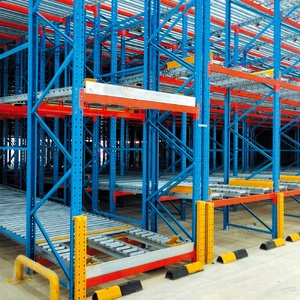
FIFO Steel Gravity Racking High Efficiency Adjustable Roller Racking Cold Storage High Density Multi-Layer Customizable Powder
Continuous dynamic flow bed equipped with speed-regulating centrifugal brake rollers, ensuring uncompromised first-in, first-out stock rotation for perishable and high-velocity goods.
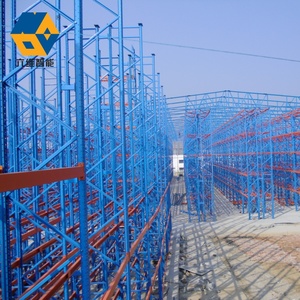
Clad-rack Warehouse Construction Rack Clad Building Commercial Warehouse Rack Numbering System
Monolithic architectural civil design where high-bay steel racking carries roof and wall cladding directly, slashing total warehouse construction timeline and civil capital expenditures.
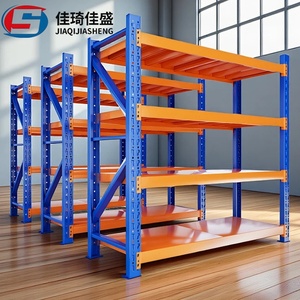
Adjustable Steel Warehouse Shelving Rack Multi Layer Storage Cabinet Pallet Stacking Shelf for Garage Workshop
Precision cold-bent light-to-medium industrial shelving engineered for spare parts distribution, retail back-of-house storage, and multi-tier picking mezzanine integrations.
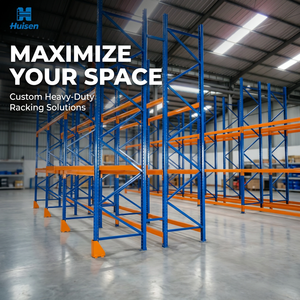
UMH-RMI Tested 5 Layer Steel Teardrop Style Industrial Beam Shelving Durable Anti-Rust Warehouse Rack
Universal North American standard teardrop connection framework. Rigorously tested to ANSI MH16.1 specifications with auto-engaging gravity locks and anti-scratch electrostatic finish.
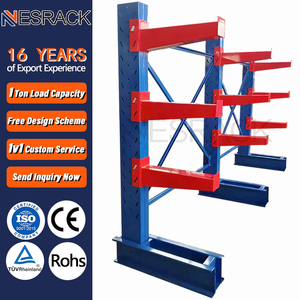
Heavy Duty Steel Metal Storage Shelf Single Size Adjustable Cantilever Rack for Warehouse & Factory OEM Supplier Pallet Packed
Engineered for unimpeded horizontal frontage without front uprights, accommodating long extrusions, structural timber, steel tubes, sheet metals, and oversize machinery parts.
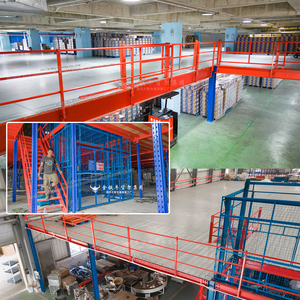
Custom I Beam Steel Structural Platform Mezzanine Floor Racking Loft for Warehouse Storage and Picking Area
Transform raw vertical warehouse air into high-yield usable square meters. Heavy-duty structural I-beam platforms designed for automated sorting lines and fulfillment mezzanine floors.
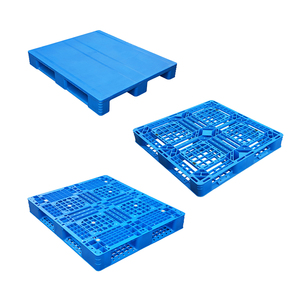
Preface 1200x1000 Light Duty HDPE 4-Way Entry Environmentally Friendly Euro Rack Open Bottom Deck Plastic Pallet
Dimensional precision pallet manufactured for automated narrow aisle guided systems, preventing conveyor jam-ups, moisture contamination, and timber splinter interference.
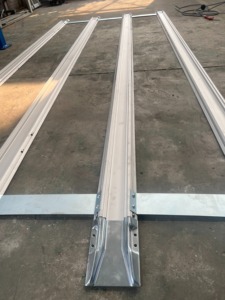
First in First Out Gravity Flow Lane Aluminum FIFO Rack Rail System for Warehouse Picking
High-strength extruded aluminum roller tracks for carton flow picking lanes. Implements lean manufacturing principles at assembly lines and eCommerce order fulfillment hubs.
Understanding Very Narrow Aisle (VNA) Mechanical & Structural Dynamics
How compressing aisle widths from 3,500mm down to 1,600mm unleashes up to 50% more volumetric warehouse density without forfeiting 100% pallet selectivity.
In contemporary industrial logistics and global supply chain operations, facility managers face an unyielding real estate dilemma: skyrocketing square-meter land acquisition costs matched with escalating consumer demand for rapid SKU fulfillment. Traditional wide-aisle selective pallet racking requires operating transfer aisles varying between 3,200mm and 3,800mm to accommodate standard counterbalanced forklifts. This layout squanders up to 60% of the cubic volume purely on vehicle transit corridors.
Narrow Aisle Pallet Racking (commonly classified as VNA / Very Narrow Aisle racking) fundamentally alters warehouse economics. By restricting operating aisle widths to an ultra-compact 1,500mm – 1,800mm and extending vertical reach up to 18 meters or more, VNA systems unlock between 40% to 50% additional pallet locations over the exact same building footprint. Unlike bulk block-stacking, push-back, or drive-in systems that sacrifice individual pallet accessibility, a calibrated Narrow Aisle design retains 100% immediate selectivity for every single SKU.
However, narrowing aisle tolerances while multiplying vertical height exponentially increases the mechanical and dynamic stresses exerted upon the cold-formed structural steel framework. When an articulated turret truck or man-up trilateral order picker operates at heights exceeding 14 meters, mast deflection, floor levelness, and beam torsion must be managed with razor-sharp manufacturing precision. Sourcing from a Tier-1 China narrow aisle pallet racking manufacturer is no longer merely an exercise in purchasing steel per metric ton—it is an engineering collaboration demanding certified material chemistry, finite element load analysis, and stringent international building compliance.
A crucial technical element governing high-bay VNA installation is floor flatness classification. Operating VNA turret trucks at high velocity within narrow clearances necessitates conformity to international superflat floor tolerances, including DIN 15185, VDMA 15251, and Concrete Society TR34 (Class DM1 / F-min 100). Any millimeter-scale undulation on the floor slab translates into magnified mast oscillations at 16 meters. To prevent rack strikes and ensure equipment safety, China's leading factories furnish heavy-duty bottom guide rails (typically 100×50×4.5mm cold-formed steel angles or structural C-channels) or engineer systems optimized for wire guidance via low-frequency floor-embedded induction loops (5.2 kHz to 10 kHz).
Structural Architecture: VNA vs Alternative Industrial Racking
A systematic comparative matrix evaluating volumetric space efficiency, capital expenditure per pallet position, handling equipment requisites, and operational throughput.
| Racking System Type | Typical Aisle Width (mm) | Cubic Space Efficiency | Pallet Selectivity | Handling Equipment Required | Floor Flatness Dependency | Civil Cost Suitability |
|---|---|---|---|---|---|---|
| Very Narrow Aisle (VNA) | 1,500 – 1,850 mm | 85% – 92% | 100% Direct | Articulated Turret Truck / Trilateral VNA Forklift | High (TR34 DM1 / DIN 15185) | Optimal for High Land Value |
| Standard Selective | 3,200 – 3,800 mm | 50% – 60% | 100% Direct | Counterbalanced / Standard Reach Truck | Standard Industrial Slab | Lower density, low Capex |
| Double-Deep Racking | 2,800 – 3,200 mm | 65% – 72% | 50% (Last-In First-Out per pair) | Pantograph Double-Deep Reach Truck | Moderate (TR34 DM2) | Multi-SKU batch buffering |
| Drive-In / Drive-Thru | Continuous Lanes | 80% – 88% | Low (Strict LIFO / FIFO batch) | Standard Counterbalanced Truck | Standard Industrial Slab | Bulk, low-SKU cold rooms |
| Radio Shuttle System | Transfer aisles only | 88% – 95% | Deep lane batch selectivity | Semi-automated robotic cart + Reach Truck | Moderate | High-throughput beverage & cold stores |
| Rack-Clad Building | Automated crane tracks | 95%+ | 100% Automated | Automated Stacker Cranes (ASRS) | Extreme (Engineered Foundation) | Eliminates civil building shed |
From an enterprise procurement perspective, selecting between VNA and dense storage configurations hinges on the relationship between throughput velocity and SKU proliferation. When a distribution center manages over 5,000 discrete active SKUs requiring high daily picking frequency (such as pharmaceutical distributions, automotive aftermarket parts, or e-commerce fulfillment), Drive-In systems fail due to honeycombing losses, and Double-Deep systems create excessive stock reshuffling. Narrow aisle racking emerges as the premier solution that harmonizes vertical cubic density with instant, uncompromised picking speeds.
Guangzhou Heda Shelves Co., Ltd.: 25 Years of Precision Engineering
Established in 2001, Guangzhou Heda Shelves Co., Ltd. is an industry-leading OEM/ODM manufacturer operating a dedicated 30,000 m² automated manufacturing facility with an output exceeding 30,000 metric tons per month.
30,000 m² Advanced Production Hub
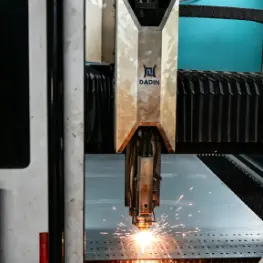
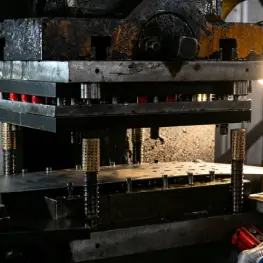
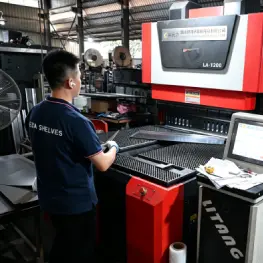
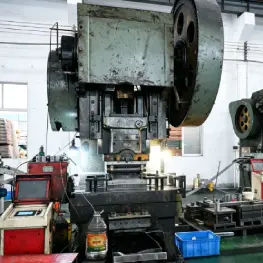
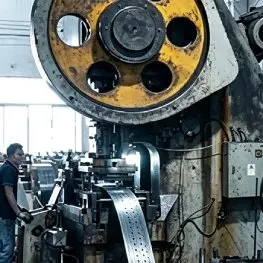
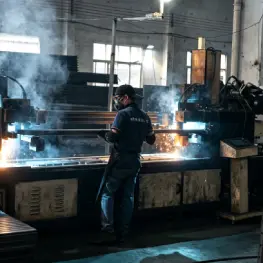
Equipped with high-precision continuous roll-forming lines, automated laser-guided punching presses, and robotic welding cells, our factory scales seamlessly to handle multi-thousand-ton sovereign infrastructure projects.
300+ Engineering & Production Crew
Our technical corps includes structural engineers, CAD/BIM designers, and certified metallurgical specialists who compute finite element models, dynamic deflection ratios, and seismic stability simulations.
30,000 Metric Tons Monthly Capacity
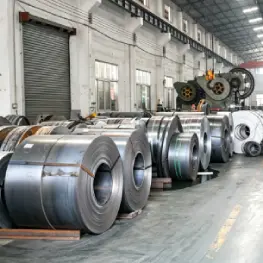
Continuous supply agreements with Baosteel and Shougang ensure premium prime-grade Q235B and Q355B structural steel coil inventory, guaranteeing strict lead times and resistance to global raw material volatility.
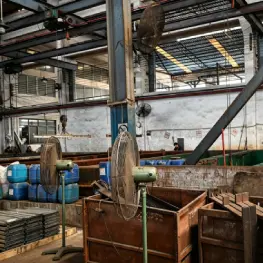
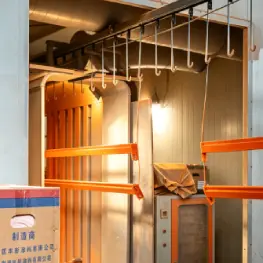
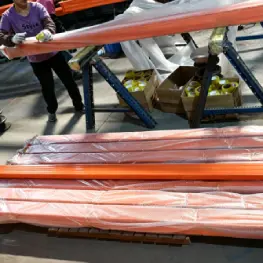
The 10-Stage Precision Manufacturing Workflow
Every upright, beam, baseplate, and diagonal brace undergoes strict inline quality inspection from mill coils to container lashing.
International Certifications & Structural Reliability
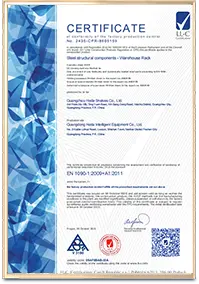
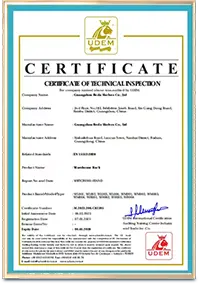
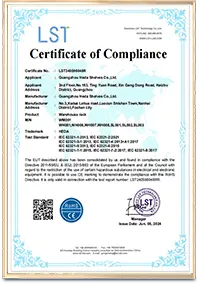
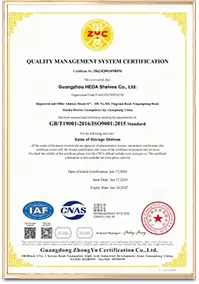
Procuring from Heda Shelves gives your project immediate compliance authority. We manufacture with full trace records and furnish verified certificates recognized by global certifying bodies and municipal building inspectors:
- ✔ CE Certification (EN 15512:2020) — Certificate No. 2435-CPR-8605159 confirming load safety and dynamic European conformity.
- ✔ ISO 9001:2015 Management System — Registration No. 18624Q00169R0M verifying repeatable manufacturing rigor and material traceability.
- ✔ AS 4084-2023 & NZS 1170.5 Seismic Alignment — Engineered bracing calculations and baseplate designs verified for Pacific and Australasian seismic zones.
- ✔ RoHS & Lead-Free Powder Coating — Thermoset polyester electrostatic finishes suitable for food distribution, cleanrooms, and pharmaceutical storage.
Future Procurement Trends & Technological Horizons (2026–2030)
How intelligent automation, AGV turret integration, seismic resilience, and ESG compliance are redefining narrow aisle pallet racking specifications.
The narrow aisle warehousing sector is experiencing a monumental transition toward lights-out automation and autonomous intralogistics. B2B procurement teams must evaluate racking assets not merely as static steel frames, but as the high-precision structural backbone for next-generation automated guided vehicles (VNA-AGVs), trilateral robotic order pickers, and automated pallet shuttles. The following structural trends dictate future project success:
1. AGV & AMR Autonomous Integration
Modern VNA corridors are shifting from manually operated turret trucks to driverless automated guided turret trucks. This requires tighter manufacturing tolerances (±1.0mm per bay), anti-reflective low-sheen powder coatings for optical LiDAR sensors, and zero ground-level guide rail deviations.
2. Performance-Based Seismic Modeling
In earthquake-prone territories (such as New Zealand, the US West Coast, and the Pacific Rim), high-bay VNA racks act as vertical pendulums. Procurement specifications now mandate dynamic response spectrum analyses, oversized ductile baseplates, and high-tensile anchor embeds compliant with NZS 1170.5 and AS 4084.
3. Low-Carbon Steel & EPD Certification
Global corporate ESG mandates require suppliers to substantiate lower Scope 3 embodied carbon. Chinese manufacturers are transitioning to electric arc furnace (EAF) recycled billet processing and supplying Environmental Product Declarations (EPDs) to assist warehouse operators in achieving LEED and BREEAM certifications.
Additionally, Rack-Clad Building Technology (where the storage racking constitutes the load-bearing framework for warehouse roofs and side walls) is gaining rapid procurement traction. By eliminating independent structural steel columns, perimeter foundations, and secondary roofing purlins, rack-clad installations reduce steel tonnage by up to 22% while truncating total construction schedules by 4 to 6 months. When coupled with automated narrow aisle cranes, this presents the pinnacle of modern spatial optimization.
Global Logistics, Biosecurity & Tariff Engineering
Cross-border procurement of industrial racking demands seasoned maritime logistical execution. Guangzhou Heda Shelves eliminates import friction through formalized trade compliance protocols:
All export bundles are strapped on custom welded steel stillages or fumigated timber compliant with Australian Department of Agriculture (DAFF) and NZ Ministry for Primary Industries (MPI) regulations, eliminating quarantine delays.
Accurate HS Code declaration under 7308.90.00 along with tailored Certificates of Origin (Form E, RCEP, ChAFTA) allow overseas buyers to legally access preferential tariff reductions and zero-duty import concessions where applicable.
Custom bundle-nesting engineering ensures 40HQ maritime containers hit their maximum weight thresholds (up to 26–27 metric tons) without void volume wastage, driving down ocean freight expense per pallet position to the absolute minimum.
Frequently Asked Questions: Narrow Aisle Racking Procurement
Clear, engineering-backed answers to the most critical technical, commercial, and structural questions raised by international procurement managers and warehouse engineers.
1. What floor flatness specifications are mandatory before installing a Narrow Aisle (VNA) system? +
Because Very Narrow Aisle turret trucks and order pickers operate with minimal lateral clearances (often 100mm to 150mm between the truck chassis/load and the rack face) at heights reaching 12 to 18 meters, floor levelness is non-negotiable. Installations typically require adherence to Concrete Society TR34 (Class DM1 or F-min 100) or DIN 15185 / VDMA 15251 standards for defined path movements. If an existing slab exhibits minor waviness, floor grinding along the turret truck wheel tracks or transitioning to a low-profile mechanical guide rail system (such as 100×50×4.5mm steel angle anchors) is required to ensure mast stability and prevent racking collision.
2. How do you choose between mechanical steel guide rails versus inductive wire guidance? +
Mechanical Guide Rails: High-rigidity steel angle profiles (100×50×4.5mm or structural C-channels) bolted to the slab along the entire aisle run. They provide foolproof physical containment, protect low-level pallet inventory from forklift chassis impacts, and do not rely on electronics. However, they restrict floor cleaning and require end-of-aisle lead-in horns.
Inductive Wire Guidance: A low-frequency signal cable embedded into a 15mm floor slot down the aisle center. The turret truck follows the electronic field automatically. Wire guidance leaves the warehouse floor completely flush, allowing rapid transit into intersecting aisles, cross-docking, and simpler housekeeping, but requires higher floor flatness and electronic calibration.
3. How does Guangzhou Heda Shelves guarantee compliance with AS 4084, EN 15512, and RMI standards? +
Every racking configuration designed by Heda Shelves undergoes rigorous structural load calculation based on cold-formed thin-walled steel mechanics. We evaluate section modulus, shear buckling, upright torsional-flexural buckling, and beam connector hook stiffness. For European destinations, our systems conform to EN 15512:2020 with CE certification (No. 2435-CPR-8605159). For Australia and New Zealand, we supply section property data packs, beam deflection limits ($L/200$), and site seismic parameters referenced to AS 4084-2023 and NZS 1170.5, allowing local chartered professional engineers (CPEng) to effortlessly issue sign-off certificates and design producer statements (PS1).
4. What is the typical lead time from 3D CAD sign-off to container arrival at international ports? +
A standard 500 to 5,000 pallet-position project typically requires 15 to 25 calendar days for factory manufacturing, including automated roll-forming, robotic welding, 8-stage surface pre-treatment, and electrostatic polyester powder curing. Sea transit from our primary port in Guangzhou or Shenzhen to major global hubs runs approximately: 14–22 days to Australian ports (Sydney, Melbourne, Brisbane); 18–26 days to New Zealand (Auckland, Tauranga); 25–35 days to Western Europe (Rotterdam, Hamburg); and 16–22 days to the US West Coast (Long Beach, Oakland). We provide real-time container tracking and complete customs document packages.
5. How does narrow aisle racking perform in seismic zones and cold storage environments? +
For seismic conditions, our engineering department increases column steel thickness, incorporates heavy-duty horizontal and vertical back-bracing towers, introduces double-row cross-tie spacers, and employs high-ductility anchor baseplates with enlarged embedment depths. In cold storage / freezer environments (down to -30°C), we utilize certified low-temperature impact-tested steel grades (preventing cold embrittlement) and apply anti-corrosive epoxy-polyester powder coats or full hot-dip galvanization to resist condensation rust and ensure multi-decade operational lifespans.
6. What exact project data is required to generate a complimentary 3D layout and structural proposal? +
To receive an actionable 3D CAD layout, load capacity calculation, and itemized quotation within 24 hours, provide our engineering department with:
- Building Architectural DWG / PDF: Length, width, clear ceiling height under beams/sprinklers, column grid spacing, dock door locations.
- Pallet Load Metrics: Pallet dimension (W × D × H including cargo overhang) and maximum gross weight per unit load.
- Forklift Model / Specifications: Model of VNA turret truck, maximum fork lift height, minimum transfer aisle requirement, and mast collapsed height.
- Project Site Location: Geographic location to compute local wind loads, seismic coefficient factors, and port routing.
Ready to Optimize Your Warehouse Storage Footprint?
Send our senior engineering team your warehouse DWG floor plan and pallet specifications. We deliver comprehensive 3D visual renderings, structural load capacity tables, and direct factory pricing within 24 hours.