Engineered Heavy-Duty Cantilever Racking Series
Custom-fabricated to eliminate front-column obstructions, our cantilever storage systems accommodate variable load lengths, non-standard dimensional profiles, and harsh ambient or exterior working conditions.
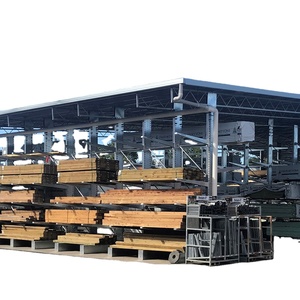 Hot-Dip Galvanized
Jracking Industrial Heavy Duty Cantilever Rack Hot Dip Galvanized Outdoors
- Corrosion Protection: ISO 1461 HDG
- Load Capacity: 1,000–4,500 kg/arm
- Profile: Heavy Hot-Rolled I-Beam
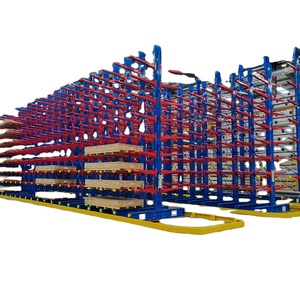 Warehouse Heavy-Duty
Jracking Cantilever Rack High Standard Warehouse Storage Racks
- Configuration: Single & Double Sided
- Height Range: Up to 12,000 mm
- Finish: Electrostatic Powder Coated
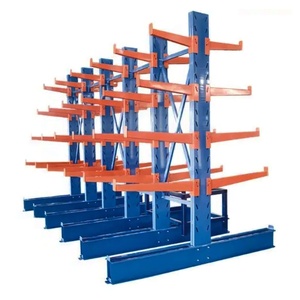 Q235/Q355 Steel
High Quality Cantilever Racks Q235 Steel Shelves for Pipe Storage
- Application: Steel Tubes, Barrels & Rods
- Arm Retention: Heavy Welded End-Stops
- Pitch Adjustment: 100mm / 140mm Bolted
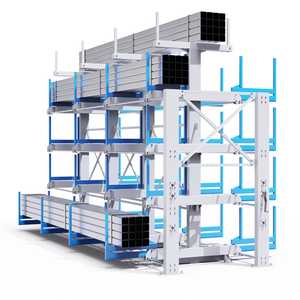 Telescopic Mechanics
Telescopic Cantilever Rack Custom Made for Heavy Metal Pipe Storage
- Extension: 100% Full-Stroke Crank/Slide
- Handling: 100% Overhead Crane Access
- Floor Footprint: Up to 60% Space Saving
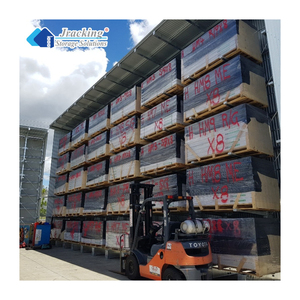 Exterior Rated
Heavy Duty Galvanised External Adjustable Metal Cantilever Racks
- Weatherproofing: Zinc Coating >85μm
- Accessories: Overhead Canopy Brackets
- Seismic Design: Engineered to Site Zone
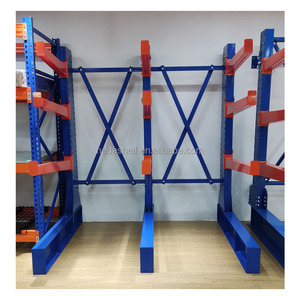 Timber & Lumber
Warehouse Cantilever Systems Timber Storage Racking
- Application: MDF, Plywood, Framing Timber
- Arm Type: Beveled Taper with Rubber Lining
- Forklift Entry: Wide Continuous Open Span
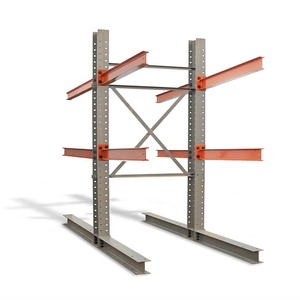 Motorized Smart Storage
Motorised Roll-Out Cantilever Rack System - Steel Pipe Storage
- Drive Mechanism: Electric Remote & Gearbox
- Efficiency: Single-Operator Crane Loading
- Safety: Automatic Torque Limit Cutoffs
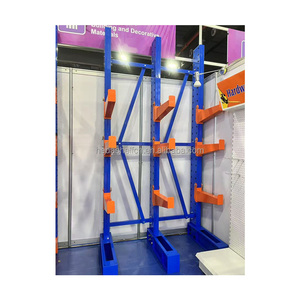 Double-Sided Core
Industrial Double Sided Heavy Duty Cantilever Racking System
- Structural Balance: Symmetrical Central Web
- Space Optimization: Dual-Aisle Access
- Base Anchoring: Heavy M20/M24 Hilti Studs
Engineering White Paper: Structural Mechanics & Design Criteria for Industrial Cantilevers
Cantilever racking represents the premier engineering solution for the uninterrupted horizontal storage of long, irregular, or heavy items, including structural steel sections, tubing, extrusions, timber packs, furniture, and sheet metal plates. Unlike conventional pallet racking, the absence of front-aisle vertical columns introduces critical asymmetric mechanical forces—primarily bending moments, shear stresses, and torsion—that demand rigorous structural engineering.
Fundamental Cantilever Engineering Law: In any cantilever rack system, the bending moment applied to the central upright column increases exponentially with arm length and load eccentricity: \( M = \sum (P_i \times L_{cog}) \), where \( P_i \) is the point load of level \( i \), and \( L_{cog} \) is the distance from the upright face to the center of gravity of the load. Structural calculations must account for unbraced column flanges, torsional deflection, and soil foundation bearing resistance.
1. Structural Hot-Rolled I-Beams vs. Cold-Formed Roll-Formed Profiles
When engineering high-capacity industrial cantilevers, material selection dictates the operational ceiling. Two principal structural methodologies govern the global manufacturing landscape: Hot-Rolled Structural Steel Sections (HEA, IPE, or W-beam profiles) and Cold-Formed Roll-Formed Profiles.
For applications exceeding 1,000 kg per arm, or in high-impact operations involving heavy machinery, hot-rolled structural steel (Grade Q235B or high-yield Q355B, conforming to AS/NZS 3678 and EN 10025) provides unparalleled yield performance. The thick flange thickness of hot-rolled I-beams resists direct forklift carriage impact and cyclical dynamic fatigue, whereas cold-formed profiles are suited for lighter-duty operations (under 500 kg per arm) where budgetary constraints outweigh ultimate durability.
| Engineering Parameter | Hot-Rolled Heavy Structural Steel (IPE / HEA) | Cold-Formed Roll-Formed Section |
|---|---|---|
| Base Material Grade | Certified Q355B / ASTM A572 Gr 50 / AS/NZS 3678 | Commercial Grade Q235B Cold Strip Steel |
| Load Capacity Per Arm | 800 kg to 5,000+ kg (Heavy Duty) | 150 kg to 600 kg (Light-to-Medium Duty) |
| Torsional Rigidity & Impact | Extreme; thick solid flanges absorb side impacts | Moderate; vulnerable to edge buckling under collision |
| Deflection Limits (under UDL) | Strict \( \le L/250 \) or \( \le L/200 \) deflection standards | Often exhibits \( \le L/150 \) with visible operational sag |
| Arm Connection Interface | Precision-drilled heavy gusset plates with Grade 8.8/10.9 structural bolts | Hook-in connector pins with lock pins |
| Outdoor & Coastal Suitability | Exceptional for Hot-Dip Galvanizing (85μm+ DFT) | Prone to internal micro-void corrosion in roll seams |
2. Tapered Arm Design & Deflection Compensation Camber
A signature hallmark of Tier-1 manufactured cantilever racking is the inclusion of an intentional engineered upward camber (typically 1.5° to 2.0° incline from the horizontal plane). Under full Uniformly Distributed Load (UDL), structural steel arms experience elastic deformation. By pre-cambering the arm through precision gusset machining, the loaded arm deflects down into a true horizontal orientation, mitigating any risk of inventory rolling outward into warehouse transit aisles.
Furthermore, arms manufactured with tapered profiles (deeper cross-section at the column connection collar, gradually reducing toward the tip) optimize the strength-to-weight ratio. This distributes the internal bending moment uniformly along the arm length, reducing excessive deadweight stress on the upright frame.
3. Global Standards Alignment: AS 4084, EN 15512, and RMI Compliance
Exporting industrial cantilever racks requires exact compliance with national structural codes. In Australia and New Zealand, installations must adhere to the fundamental structural verification guidelines of AS 4084 (Steel Storage Racking) and AS/NZS 1170 for seismic acceleration. In Europe, EN 15512 and FEM 10.2.02 govern design, while in North America, ANSI MH16.1 published by the Rack Manufacturers Institute (RMI) serves as the legal baseline.
Our manufacturing workflow validates every custom column-to-base moment connection via computerized Finite Element Analysis (FEA). Anchor bolting calculations consider seismic overturning moments (\( M_o \)), uplift forces on front anchors, and concrete edge-distance shear failure under post-tensioned conditions.
Future Industrial Cantilever Procurement Trends (2025–2030)
Global supply chain volatility, urban warehousing land costs, and decarbonization mandates are reshaping how logistics directors and procurement heads specify long-span storage infrastructure.
1. Transition to High-Density Motorized & Telescopic Systems
Traditional static cantilever racks require wide forklift operating aisles (often 4.5 to 6.0 meters for side-loaders or counterbalanced trucks). Modern facilities are rapidly adopting motorized roll-out and telescopic cantilever designs. With 100% arm extension, overhead crane hoists directly access bundles, reclaiming up to 70% of wasted aisle square footage and drastically reducing material transit cycle times.
2. Total Cost of Ownership (TCO) vs. Raw Tonnage Metrics
Enterprise buyers are moving away from evaluating cantilever bids purely on "cost-per-kilogram of steel." Holistic TCO models incorporate installation speed (bolted modularity vs. field-welding), floor slab reinforcement requirements, zinc coating thickness longevity in coastal zones (C3/C4 environments), and modular adjustability to reconfigure arms when client inventory dimensions change.
3. Carbon Footprint & Recycled Structural Steel Auditing
ESG compliance across multinational manufacturing is pushing procurement officers to audit the environmental product declarations (EPD) of rack mills. Sourcing from manufacturers utilizing scrap-fed Electric Arc Furnace (EAF) production with low embodied carbon, paired with volatile organic compound (VOC)-free thermoset polyester powder coatings, has become a prerequisite for Tier-1 corporate tenders.
Technological Innovations Revolutionizing Cantilever Manufacturing
Modern cantilever systems are no longer static arrays of welded steel; they are deeply integrated mechanical structures engineered with modern metallurgical processes and robotic automation.
Automated Multi-Axis CNC Beam Drilling & Punching
Historical methods of manual plasma cutting resulted in bolt-hole dimensional tolerances of ±1.5 mm, creating cumulative vertical alignment creep across tall 9-meter columns. Today, our factory utilizes high-precision 3D CNC structural drilling lines that guarantee hole center pitch tolerances within ±0.2 mm. This ensures that column-to-base flange connections and arm pivot pins fit with zero structural slop, eliminating vertical plumb errors during warehouse erection.
Duplex Coating Systems for Aggressive Chemical & Coastal Sites
For outdoor lumber storage yards, coastal marine distribution hubs, or chemical fertilizer plants, standard powder coating suffers micro-pinhole infiltration and rapid underfilm corrosion within 24 to 36 months. Our advanced duplex coating technology fuses Hot-Dip Galvanizing (HDG) per ASTM A123 / ISO 1461 (yielding a minimum of 85 microns of metallurgical zinc-iron alloy layer) with an electrostatically applied UV-stabilized exterior polyurethane topcoat. This duplex system yields a corrosion resistance lifespan exceeding 30 years in harsh C4/C5 atmospheric classifications.
Sensorized Arm Deflection & Digital Overload Warning Systems
As warehouse environments embrace Industry 4.0, next-generation heavy-duty cantilevers are increasingly deployed with integrated load-cell strain gauges embedded directly within arm pivot collars. Connected via Industrial IoT gateways to warehouse management software (WMS), these sensors trigger real-time acoustic alarms if dynamic forklift drops induce moment loads beyond the designed safety margin (\( >1.5 \times \) Working Load Limit).
Why Enterprise Global Importers Partner with Our Manufacturing Hub
Founded in 2001, Guangzhou Heda Shelves Co., Ltd. has grown to become an authoritative international manufacturer and turnkey exporter of structural storage systems. With an expansive 30,000 m² state-of-the-art production complex and over 300 experienced engineers, structural detailers, and metallurgical welders, we control every critical phase of manufacturing in-house.
Full CE Certification (No. 2435-CPR-8605159) and ISO 9001:2015 Quality Management (No. 18624Q00169R0M). Every batch is metallurgically tested for yield strength and weld penetration.
Our structural engineering department produces fully coordinated 3D CAD floorplans, arm loading charts, and deflection analysis calculations within 24 hours of brief receipt.
Tailored export packaging utilizing dedicated structural steel stillages or ISPM-15 heat-treated dunnage, guaranteeing rapid inspection release with DAFF (Australia) and MPI (New Zealand).
We provide full suites of preferential export documentation (COO, Form A, Form E) enabling our global distribution partners to benefit from 0% or reduced customs duties.
Whether you require single-sided columns to place flush against masonry boundary walls or double-sided central spines for wide-aisle forklift turning radiuses, our engineering group works from your building dimensions, clear roof heights, slab compression test scores, and equipment specs to maximize your operational cubic volume.
Frequently Asked Questions: Industrial Cantilever Specification
Critical engineering considerations, compliance standards, and installation verifications every procurement manager and warehouse engineer should review prior to placing a factory-direct purchase order.
How do you calculate the required cantilever column section and arm capacity?
What is the difference between single-sided and double-sided cantilever stability?
How do Hot-Dip Galvanized (HDG) cantilevers prevent corrosion compared to outdoor powder coating?
Can your cantilever systems be engineered for seismic zones in Australia and New Zealand?
What floor slab specifications and concrete anchoring depths are required?
What is the lead time, shipping methodology, and biosecurity preparation for export?
Request an Engineered Cantilever Layout & Production Estimate
Provide your warehouse dimensions, clear operating ceiling heights, material bundle weights, and forklift specifications. Our senior structural design engineers will deliver a comprehensive 3D CAD proposal, load-capacity matrix, and factory-direct quotation within 24 hours.