[email protected] Supplying Australia, New Zealand & the Pacific Islands
Industrial Whitepaper & Direct Factory Directory

Top Trusted Roller Pallet Racking Factories & Factory

High-Density Gravity Flow Engineering, Strict FIFO Inventory Dynamics, and Certified OEM/ODM Manufacturing for Global Logistical Distribution Centers

Direct Manufacturing Lineup

Engineered Heavy-Duty Roller & Pallet Storage Systems

Precision-machined structural uprights, centrifugal speed-dampened roller tracks, and gravity-fed flow channels manufactured to international safety standards.

Technical Architecture

Mechanical Dynamics of Industrial Roller Pallet Racking

Understanding incline kinematics, speed dissipation, load isolation latches, and structural column design to prevent dynamic failure in high-volume FIFO operations.

Kinematic Mechanics & Gradient Control in Live Pallet Flow

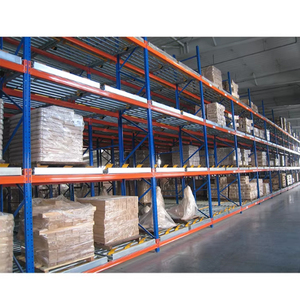
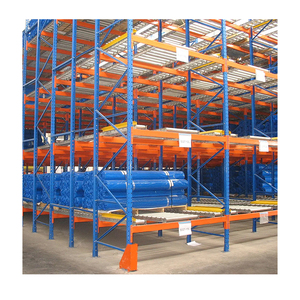
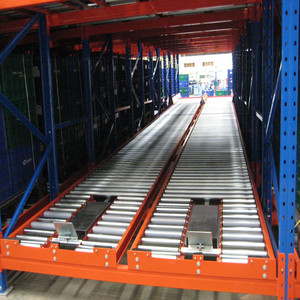
Roller pallet racking (commonly classified under gravity flow or dynamic live pallet racking) utilizes gravity to convey fully loaded unitized pallets from an intake loading aisle to a discharge picking face. Unlike static selective configurations, a roller bed involves kinetic momentum that must be precisely governed. If the track slope is insufficient, pallets stall within the channel (creating dead locks); conversely, excessive slope results in runaway pallets that strike the discharge stops with catastrophic force.

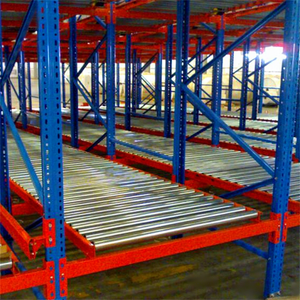
In our manufacturing practice, the optimum conveyor gradient is calibrated strictly between 2.0% and 3.5% (approximately 1.15° to 2.0°), depending on pallet base geometry (GMA wooden pallets, Euro pallets, or perimeter-base Australian standard 1165 × 1165 mm units). Variations in pallet bottom board smoothness, moisture content, and pallet deflection under load dictate the selection between full-width cylindrical steel rollers and multi-lane split skate-wheel roller tracks.

To maintain continuous flow without structural creep, upright frames and load beams are engineered to withstand not only the static payload of 1,000 kg to 1,500 kg per pallet position, but also longitudinal dynamic thrust forces generated as moving pallets settle against friction dampers.
Standard Gravity Bed Calibrations

  • Standard Incline Gradient: 2.0% to 3.5% based on bottom skid profile
  • Controlled Speed Window: 0.15 m/s to 0.30 m/s via centrifugal speed brakes
  • Braking Interval Pitch: 1 brake roller positioned every 1 pallet position (approx. 1.2m to 1.5m)
  • Steel Roller Wall: Heavy-gauge galvanized carbon steel (Ø50mm to Ø60mm)

Braking Mechanics & Pallet Separator Lock Latches

In deep-lane roller systems accommodating up to 20 pallets deep, the primary operational risk is cumulative line pressure. When multiple heavy pallets accumulate along an incline, the aggregate weight transfers to the lead pallet at the picking face. A 1,000 kg pallet backed by 9 trailing pallets exerts up to 10 metric tons of line force, pinning the front unit against the terminal stops and making extraction by standard counterbalanced forklifts hazardous or mechanically impossible.

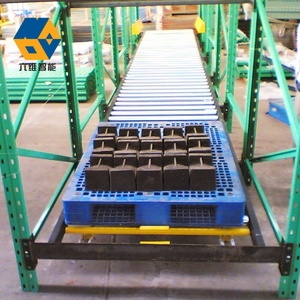
To eliminate this hazard, our factories incorporate mechanical or pneumatically triggered Time-Delay Separator Latches. When the leading pallet glides onto the discharge station, it activates a heavy-duty mechanical floor trigger that automatically locks the second pallet 150mm upstream. This physically isolates the first pallet, reducing extraction friction to zero. Once the forklift retrieves the lead pallet, the separator latch resets smoothly, releasing the subsequent unit into the picking zone.

Simultaneously, direct-contact centrifugal internal-brake rollers govern velocity. As internal planetary gears expand against brake shoes proportional to speed, the pallet maintains a steady 0.25 m/s transit regardless of ambient temperature or loading fluctuations.

Engineering Specification Matrix

Engineering Subsystem Structural Parameter Verification Standard
Upright Profile Roll 80×60mm to 120×95mm Omega Section EN 15512 / AS 4084
Roller Bearing Core Sealed Precision Ball Bearings (6204/6005) ISO 9001:2015
Centrifugal Brake Wear-Resistant Synthetic Friction Lining CE 2435-CPR-8605159
Surface Finish Pickled, Phosphated & Epoxy Powder Coat RoHS & ASTM B117 Salt
Industry Foresight

Future Procurement & Product Trends (2025–2030)

How warehousing logistics, warehouse management automation (WMS), and cold-chain environmental demands are transforming roller pallet racking architecture.

Enterprise Credentials

Direct Manufacturing Strengths & Compliance Verification

Operating a comprehensive 30,000 m² state-of-the-art production complex since 2001, providing robust heavy industrial racking to Tier-1 logistics providers across the globe.

2001
Established Pioneer
30,000m²
Production Complex
300+
Engineers & Technicians
30,000t
Monthly Steel Output

Independent Global Accreditations

Complete traceability and safety documentation. Products carry verifiable CE Certification (No. 2435-CPR-8605159), ISO 9001:2015 Quality Management System Certification (No. 18624Q00169R0M), and RoHS adherence, ensuring seamless structural permits with municipal building inspectors worldwide.

AS 4084 & NZS 1170.5 Engineering

Full alignment with regional regulatory mandates including Australia AS 4084 (Steel Storage Racking) and New Zealand NZS 1170.5 seismic displacement parameters. We furnish engineering data packs, certified frame section moduli, base-plate shear calculations, and localized load signage with every installation.

10-Stage Precision Manufacturing

Every profile goes through automated precision steel slitting, CNC upright multi-punching, continuous roll cold-forming, robotic beam welding, acid pickling, multi-stage phosphating, and uniform electrostatic powder coat curing to deliver superior wear-resistant finishes in ambient or refrigerated sheds.

Free 3D Layout & Static Load Modeling

Our in-house structural engineering department delivers custom 2D CAD architectural schematics, 3D clearance simulations, and warehouse throughput lane models within 24 hours of receiving site dimensions, column spans, ceiling truss heights, and forklift turn-radius profiles.

DAFF / MPI Biosecurity-Compliant Packaging

Export packing is designed to pass customs inspections effortlessly without costly port treatment holds. We utilize fully certified ISPM-15 heat-treated dunnage or non-wood steel transport stillages, bundled with waterproof shrink wrap, corner impact edge-guards, and complete bilingual packing manifests.

Full OEM / ODM & Private-Label Services

Serving racking distributors, equipment dealers, and logistics EPC contractors. We supply private-label upright column roll-forming (including teardrop, hex-hole, and diamond-slot formats), customized brand color-matching, custom load signage, and direct split-container drop shipping.

Procurement Clarity

Frequently Asked Questions by Industrial Buyers

Crucial engineering, commercial, and logistical criteria addressed to streamline global sourcing and ensure peak installation safety.

What are the key technical differences between roller pallet racking and push-back racking?
Roller pallet flow racking is a First-In, First-Out (FIFO) system where pallets enter from a rear loading aisle and travel down a sloped roller bed to a front picking aisle. This physically separates loading traffic from retrieval traffic, making it ideal for perishable goods, high-throughput food distribution, and expiration-sensitive pharmaceuticals. Push-back racking operates on a Last-In, First-Out (LIFO) model using nested wheeled carts on a single front aisle: forklifts push back previous pallets when depositing new stock. While push-back is well-suited for moderate density with fewer SKUs, roller flow racking handles deep-lane storage (up to 20 pallets deep) with zero cross-aisle forklift congestion.
How do centrifugal brake rollers prevent dynamic load acceleration and structural damage?
As a pallet glides over an inline centrifugal brake roller, the downward frictional force drives an internal planetary gear set. When rotational speed increases, internal brake shoes expand centrifugally against the roller's steel cylinder casing. This creates mechanical resistance directly proportional to the pallet's velocity. Consequently, a light 400 kg pallet and a heavy 1,500 kg pallet glide at an identical, safe transit velocity (typically 0.20 to 0.25 m/s), eliminating high-impact terminal collisions and preserving the structural integrity of the rack's steel stops.
Can roller pallet racking accommodate non-standard pallets (e.g., Australian 1165×1165mm vs Euro 1200×800mm)?
Yes. The bottom skid configuration is the critical factor. Euro pallets (1200×800mm) running with 3 bottom runners parallel to the track require 3-lane split-roller tracks or full-width steel cylinders. Australian standard pallets (1165×1165mm) feature a full perimeter-base bottom frame, which creates different contact surface mechanics. Our engineering team customizes the roller diameter (Ø50mm, Ø60mm, or heavy-duty Ø76mm), roller wall gauge, and transverse spacing across the bed to prevent bottom board sagging and guarantee smooth rolling.
What structural provisions are engineered for seismic zones such as New Zealand or coastal Pacific rims?
For seismic sites designed in accordance with NZS 1170.5 and AS 4084 standards, our engineering team increases column wall thicknesses, implements heavy-gauge diagonal channel cross-bracing, enlarges foot base-plates with dual M16/M20 chemical resin floor anchors, and integrates mechanical anti-jump retention clips on every roller track. This prevents loaded pallets from hopping off the roller channels during vertical and lateral seismic ground acceleration.
How does the factory manage quality control during upright roll-forming and welding?
Raw steel coils (certified prime Q235B / Q355B structural grade) undergo spectrographic metallurgical analysis and tensile testing before slitting. Cold-roll profiling utilizes 16 to 24 continuous forming stations to prevent micro-fissuring at structural bends. Beam end-connectors are welded via automated multi-axis Panasonic robotic stations with ultrasonic weld testing. Finished members pass through a 10-stage pre-treatment line (pickling, phosphating, electrostatic epoxy powder coating) cured at 200°C for superior impact and scratch resistance.
What documentation and biosecurity precautions accompany sea freight shipments?
Every export container is packed using steel stillages or ISPM-15 marked and debarked heat-treated timber to fully satisfy Australia DAFF, New Zealand MPI, and USDA biosecurity inspection mandates. We furnish a complete commercial invoice, certified packing list, bill of lading, Certificate of Origin (benefiting from regional Free Trade Agreements such as ChAFTA), mill test certificates, and comprehensive 3D installation blueprint manuals.

Accelerate Your Warehouse Capacity With Factory-Direct Engineering

Connect directly with our senior racking engineering group. Provide your architectural layout, building clear heights, and pallet profile details to receive an optimized 3D CAD proposal and structural load calculation package within 24 hours.

Free 2D CAD & 3D Modeling Layouts
CE & ISO 9001:2015 Verified Compliance
AS 4084 / Seismic Structural Calculation
Direct Container Ocean Freight Logistics

Consult an Engineer Today

Ready to evaluate roller slope angles, pallet weights, or custom lane capacities for your facility?

Inquire Now