Precision Racking Systems for High-Throughput Japanese Operations
From standard JIS T11 pallet flow lanes to automated high-density vertical systems, our OEM/ODM manufacturing facility supplies rigorously engineered storage infrastructures tailored to strict Japanese quality inspections.
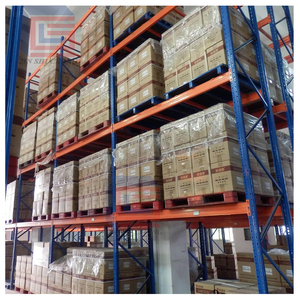
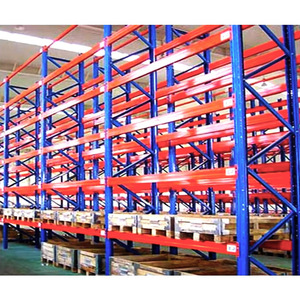
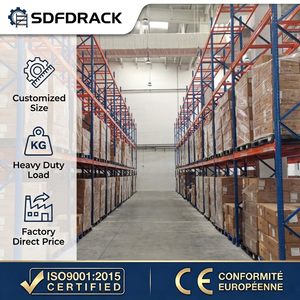
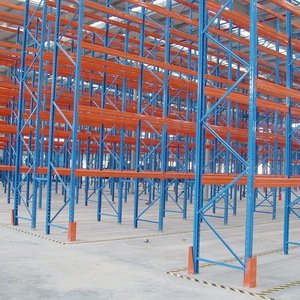
Navigating the "2024 Problem" in Japan: Why High-Density Flow Rails Are Essential
The Japanese logistics and material handling sector is undergoing a profound structural transformation driven by legislative reform, demographic shifts, and severe real estate density pressures. The enforcement of statutory overtime caps on commercial truck drivers—widely recognized across Japan as the "2024 Problem" (物流の2024年問題)—has severely constricted long-haul logistics lead times and intensified the pressure on distribution centers across Greater Tokyo (Kanto), Osaka-Kobe (Kansai), and Central Nagoya (Chubu). Warehouses can no longer afford lingering truck dwell times, protracted pallet buffering, or convoluted aisle maneuvers.
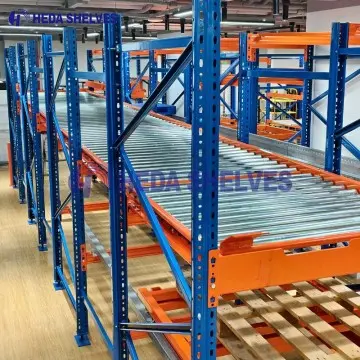
Concurrently, warehouse real estate prices in prime logistics zones like the Tokyo Bay waterfront, Yokohama, and Hanshin industrial corridor have escalated to historic highs. Facility operators face an imperative to maximize vertical storage cubic capacity while adhering to strict fire safety codes (消防法) and seismic mitigation statutes under the Japanese Building Standards Act (建築基準法). Flow rail racking systems (also engineered as pallet flow or dynamic gravity roller racking) resolve these dual pressures by eliminating access aisles, converting floor utilization rates from standard 40% selective layouts to over 75% volumetric utilization, and establishing deterministic FIFO pallet flow directly compatible with JIS T11 standardized pallets (1100 mm × 1100 mm).
Turnaround Velocity for 2024 Caps
Separating the replenishment intake aisle from the picking departure aisle eliminates forklift traffic interference. Gravity rollers feed pallets automatically to the pick face, slashing truck turnaround and driver waiting duration to under 20 minutes per container.
Cubic Footprint Conservation
By eliminating dead aisle space required by reach trucks and counterbalance equipment, our flow rail assemblies permit 4 to 12 deep pallet lanes. Warehouses in Kanagawa and Chiba achieve up to 85% higher pallet capacity within identical facility footprints.
Kaizen & TPS Harmony
Engineered for seamless integration with Toyota Production System (TPS) and visual 5S lean principles. Color-coded flow tracks, ergonomic roller stops, and fail-safe magnetic centrifugal speed brakes guarantee continuous, defect-free material flow.
Tailored Flow Rail Engineering for Japan’s Core Industrial Verticals
From refrigerated distribution complexes in Hokkaido to high-turn automotive assembly sub-lines in Aichi Prefecture, our racking is customized for the exact operating parameters of local Japanese facilities.
1. Refrigerated Cold Chain & Fresh Food Wholesale
Cold storage facilities in Japan incur substantial energy overheads per cubic meter. Drive-in systems often risk product expiration oversights due to LIFO buffering. Our low-temperature flow rail racking functions flawlessly down to -30°C in blast chillers and frozen distribution hubs.
- Specialized cryogenic roller bearings with food-grade, freeze-resistant lubrication prevent track freeze-up.
- Strict FIFO inventory sequencing ensures perishable dairy, seafood, and prepared bento ingredients never surpass best-before horizons.
- Corrosion-resistant electro-galvanized or epoxy powder finishes endure severe condensation during defrosting cycles.
2. Automotive JIT Manufacturing & Mega E-Commerce
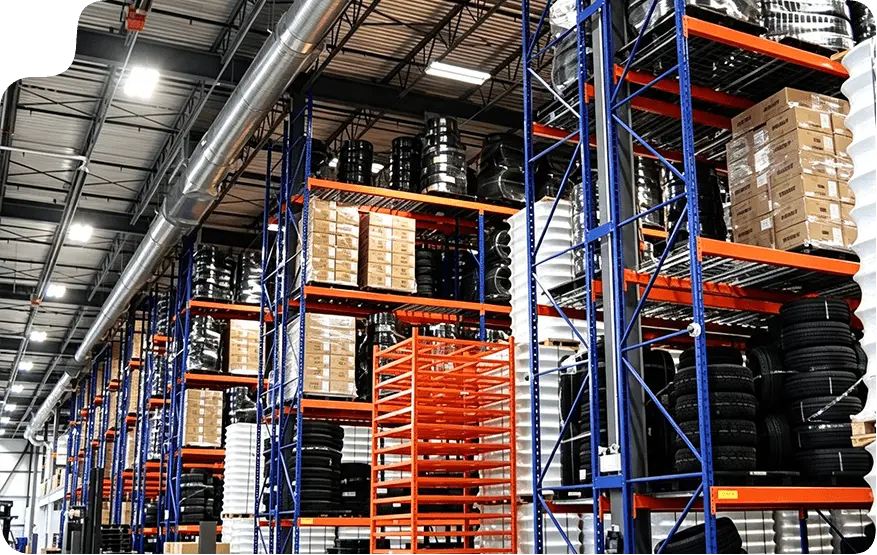
Japanese tier-1 automotive suppliers operating around Nagoya and Kanagawa operate on rigid Just-In-Time (JIT) cycles. Every batch of stamped components, wire harnesses, or sub-assemblies must present automatically to line-side tuggers without manual searching or crane delays.
- Custom pallet flow lanes equipped with pick-face separators that decouple the front pallet for zero-pressure, safe extraction.
- Integrated roller brake controllers maintain a steady 0.25 m/s rolling velocity irrespective of unit load weight (from 300 kg to 1,500 kg).
- Direct mechanical compatibility with AGV and AMR autonomous dispatch fleets increasingly deployed across modern Japanese warehouses.
Rigid Seismic Anti-Quake Standards for Japan
Japan represents the world’s most seismically demanding market. Racking systems cannot merely support vertical gravitational loads; they must withstand intense lateral ground acceleration during Great Kanto or Nankai Trough contingency scenarios.
HEDA Shelves fabricates racking systems using high-tensile Q235B and Q355B cold-rolled structural steel sourced exclusively from certified tier-1 steel mills. Our engineering team prepares complete structural computation packages referencing the Building Standards Act of Japan (建築基準法施行令第88条) and the Japan Storage Equipment Association (JAMDA) engineering guidelines. Baseplates, anchor embedments, and upright cold-formed profiles are designed with elevated ductility ratios, horizontal cross-bracing frameworks, and optional viscous damper ties.
| Engineering Parameter | HEDA Shelves Japan OEM Specification | Standard Market Generic Equivalent | Operational Value for Japanese Buyers |
|---|---|---|---|
| Primary Steel Grade | Certified Q355B / Q235B Cold-Rolled Carbon Steel | Commercial Grade Low-Tensile Scrap Steel | Superior yield strength preventing upright buckling during seismic tremor events. |
| Standard Pallet Fit | JIS T11 (1100×1100 mm), Euro (1200×800), US (1200×1000) | Generic Western-only dimensions | 100% native dimensional compatibility with standard Japanese wooden and plastic pallets. |
| Braking Architecture | Speed-governed centrifugal internal friction rollers | Unregulated gravity drift or manual wedges | Eliminates terminal impact shock, protects fragile consumer products and expensive robotics. |
| Seismic Anchor Engineering | Heavy-duty dual M16/M20 chemical concrete anchors + seismic footplates | Single standard mechanical expansion sleeve | Meets high horizontal design shear force coefficients (k=0.2 to 0.4) for seismic certification. |
| Surface Finish & Quality | Automated electrostatic epoxy powder (70-90μm) + Pre-phosphating | Manual spray coating lacking pickling pre-wash | Resists peel, chipping, and corrosive wear under stringent Japanese cleanroom/warehouse 5S audits. |
Our 10-Step High-Precision Fabrication Process
Operating from our 30,000 m² advanced facility founded in 2001, Guangzhou Heda Shelves Co., Ltd. enforces strict end-to-end quality assurance across all components shipped to Japanese ports.
Raw Steel Spectrometry
Mill test certificates and chemical spectrometer analysis for carbon, manganese, and silicon content verification.
CNC Continuous Punching
High-speed automated CNC punch lines create teardrop, diamond, or metric butterfly slot patterns with ±0.1mm tolerance.
Precision Roll Forming
Multi-stand continuous roll forming mills shape high-load upright columns and interlocking step beams with seamless rigidity.
Robotic Argon Welding
Automated robotic welding cells weld connector claws and seismic baseplates with uniform bead penetration and zero spatter.
Multi-Stage Pretreatment
Immersion degreasing, acid pickling, and microcrystalline phosphating guarantee robust bonding for subsequent coating.
Electrostatic Powder Line
Swiss Gema automated powder application booth baked at 200°C for durable, scratch-resistant, impact-absorbing surface film.
Flow Rail Sub-Assembly
Pre-assembly and kinetic calibration of roller tracks, centrifugal speed regulators, and entry guides prior to packing.
ISPM-15 Export Staging
Custom steel strapping, protective corner angle-boards, and fumigated steel stillages designed for ocean container shipping to Japan.
Strategic Value for Japanese Trading Houses, General Contractors & Integrators
For more than two decades, Guangzhou Heda Shelves Co., Ltd. has established itself as an engineering-driven manufacturing partner for major logistics integrators, commercial trading houses (商社), and warehouse builders worldwide. We understand the exacting standard of documentation, punctuality, and defect-free execution demanded by Japanese engineering firms.
CAD & 3D Modeling Within 24H
Submit your warehouse AutoCAD floor plan (.dwg), column spans, sprinkler heights, and pallet specifications. Our senior engineering team produces comprehensive 3D layouts, lane capacity analyses, and structural simulation packs within 24 hours.
Full OEM Private Label Support
We routinely supply systems under private-label arrangements for Japanese material handling distributors. Components can be finished in customized corporate RAL colors, stamped with your brand insignia, and packaged with Japanese-language assembly instructions.
Direct Coastal Shipping Routes
Located near South China deep-water ports (Guangzhou / Shenzhen), we maintain contracted container liner allocations to all principal Japanese commercial ports: Tokyo, Yokohama, Nagoya, Osaka, Kobe, and Hakata. Typical ocean transit is merely 4 to 7 days.
Frequently Asked Questions for Japanese Warehouse Projects
Key technical, compliance, and customs considerations addressed by our engineering and export team.
Request Your Custom 3D Flow Rail Layout & Quotation
Consult with our senior warehouse design engineers today. Provide your facility floor dimensions, clear ceiling heights, pallet load weights, and turnover velocity targets to receive a custom 3D CAD proposal and factory-direct pricing for the Japan market.