Selective Rack
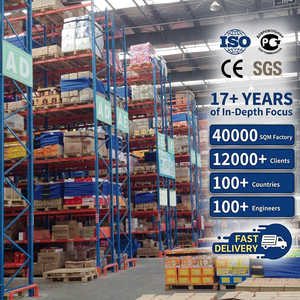
Directly manufactured using high-tensile Q235B and Q355B cold-rolled steel coils. Fully customized upright profiles, bolt-free step beams, and dynamic gravity rollers built for multi-tier fulfillment hubs.
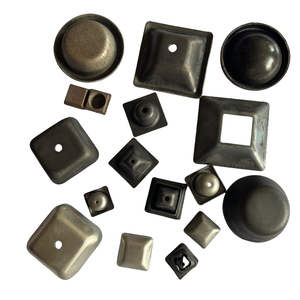
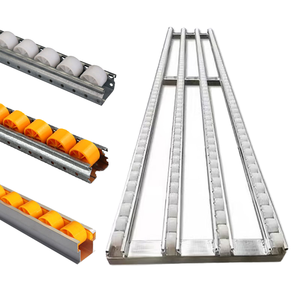
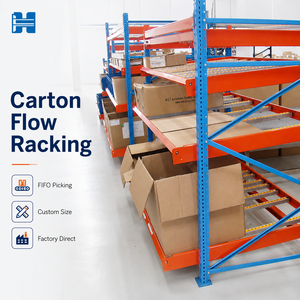
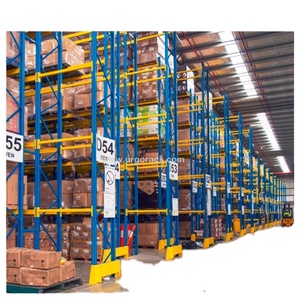
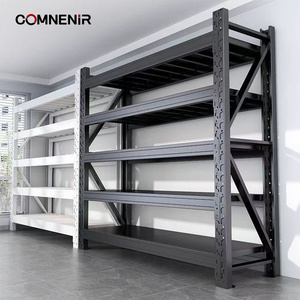
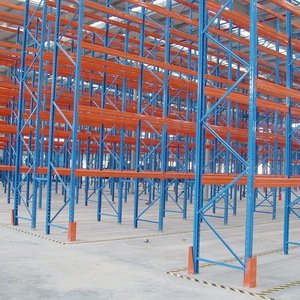
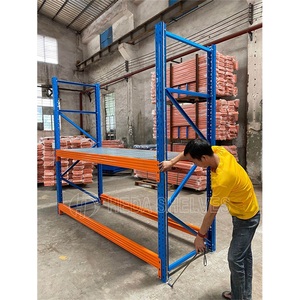
Why precision steel roll-forming, finite element structural verification, and metallurgical traceability govern the total life cycle performance of modern industrial racking installations.
In high-density commercial warehouse engineering, racking failure is rarely the result of sudden catastrophic overload; rather, it originates from structural instability caused by cyclic stress fatigue, poor profile geometry, micro-fractures along cold-bent radiuses, or beam-to-column connector slippage. Premium Chinese rack manufacturers utilize multi-station continuous roll-forming lines that progressively form structural steel strip coils through 18 to 26 continuous rolling passes. This controlled transition ensures that cold-working stresses are distributed uniformly without thinning steel corners or creating residual tension bands along the perforation axis.
Upright columns fabricated from cold-rolled steel grades Q235B (yield strength $\ge 235\text{ MPa}$) and Q355B (yield strength $\ge 355\text{ MPa}$) are engineered with specialized cross-sectional omega ($\Omega$) geometries featuring secondary and tertiary structural stiffening ribs. These internal returns maximize the minimum radius of gyration ($r_{min}$) along both the major X-X and minor Y-Y centroid axes, yielding exceptional axial compression resistance while reducing buckling length sensitivity under extreme load heights exceeding 12 meters.
A frequent error made by overseas procurement managers when evaluating commercial rack manufacturers is relying exclusively on total uncoiled steel weight rather than cross-sectional modulus ($Z$) and steel metallurgical consistency. Sub-tier mills often substitute commercial-grade uncertified secondary hot-rolled pickling coils that feature non-uniform carbon distribution, high sulfur inclusions ($S > 0.045\%$), and inconsistent yield strengths across the coil length. This variance creates differential settlement and catastrophic twisting under sustained long-span beam loading.
Our Tier-1 manufacturing protocol relies exclusively on prime mill continuous cold-rolled carbon structural coils from sovereign producers including Baosteel, Shougang, and Ansteel. Mill Test Certificates (MTCs) conforming to EN 10204 Type 3.1 accompany every primary heat number. Furthermore, beam deflection criteria under maximum rated pallet capacity are rigorously maintained within $\le L/200$ (in accordance with ANSI MH16.1 and SEMA codes) with a minimum structural safety multiplier of $1.65$ based on the ultimate yield limits of the profiled box section.
| Storage Architecture | Space Utilization | Pallet Selectivity | Throughput Rate | Forklift Compatibility | Recommended Industry Scope |
|---|---|---|---|---|---|
| Selective Pallet Racking | 40% – 50% | 100% Direct Access | Rapid / Immediate | Counterbalanced, Reach Truck | FMCG, 3PL Distribution, General Retail, Engineering Spare Parts |
| Very Narrow Aisle (VNA) | 75% – 85% | 100% Direct Access | High / High Lift | Specialized Man-Up / Turret Truck | Pharmaceutical Hubs, High-Ceiling DCs, Electronics Wholesalers |
| Drive-In / Drive-Through | 75% – 85% | LIFO (FILO) | Moderate (Batch Cycles) | Standard Counterbalance, Reach | Cold Storage, Frozen Food Logistics, Seasonal Agricultural Produce |
| Gravity Flow Racking | 80% – 90% | 100% FIFO Strict | Ultra-High (Gravity Powered) | Dual-Aisle Segregated Forklifts | Dairy Processing, Perishable Goods, Beverage Bottling, Pharmaceuticals |
| Radio Shuttle System | 85% – 92% | Configurable FIFO / LIFO | Semi-Automated Continuous | Standard Forklift (Rack-Free Entry) | Raw Material Buffers, Deep Freeze (-25°C), High-Volume SKU Warehouses |
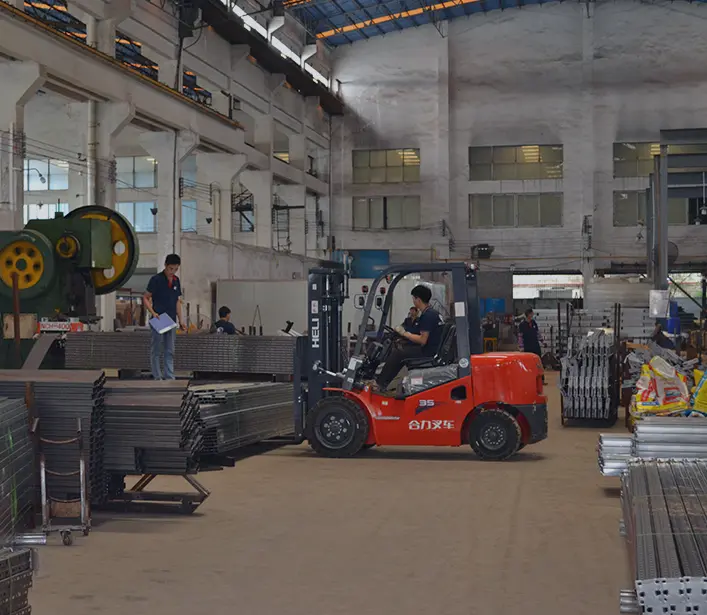
Every structural element is tracked from raw mother coil to electrostatic polymer cure, guaranteeing zero micro-fractures, tight dimensional tolerances, and high structural durability.
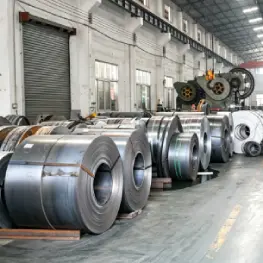
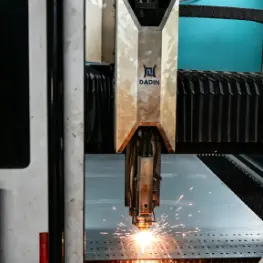
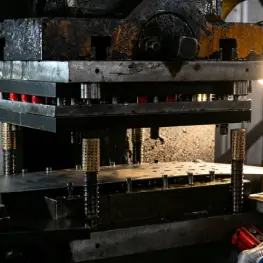
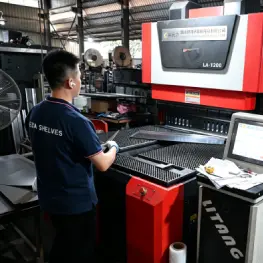
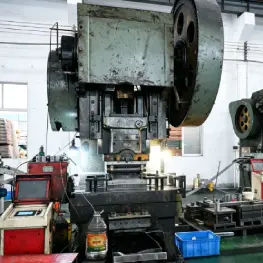
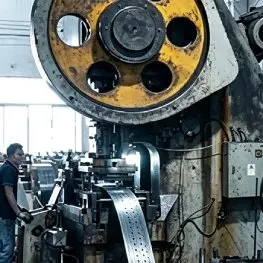
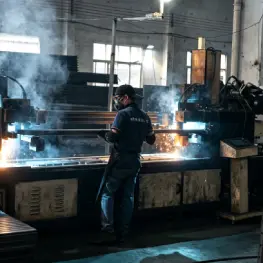
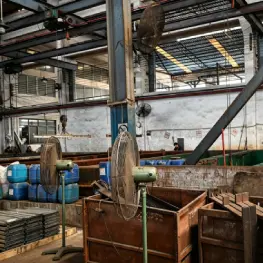
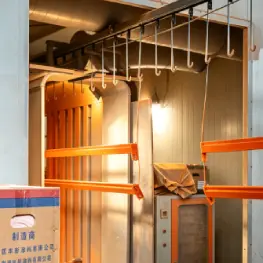
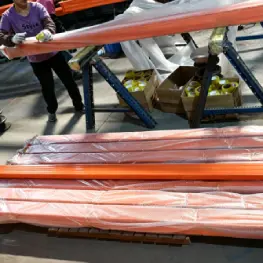
Established in 2001, Guangzhou Heda Shelves Co., Ltd. has expanded into an internationally recognized manufacturer and exporter of commercial racking, heavy pallet systems, and structural mezzanines.
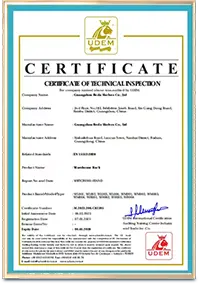
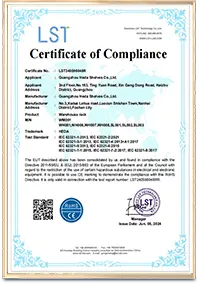
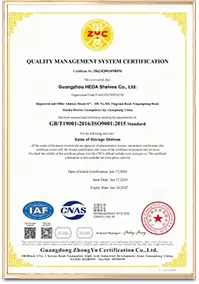
Inspect our valid international certification dossiers verifying structural capacity and chemical safety.
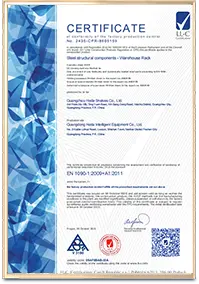
EN 15512 Racking Compliance
Quality Management System
Heavy Metal & Toxin Free Coating
Certified Third-Party Compression
How rapid automation integration, ultra-high-tensile micro-alloyed steels, and green lifecycle audits are transforming warehouse racking specifications worldwide.
The standard reliance on conventional thick-gauge Q235B steel is declining. Modern engineering procurement favors thermomechanically rolled micro-alloyed structural steels (such as Q355MC and Q460MC). By leveraging higher yield strengths with precise grain boundary control, rack structures achieve up to a 15% reduction in deadweight while maintaining identical payload ratings. This lowers ocean shipping container counts and structural slab floor loadings.
Manual forklift operations are rapidly migrating toward semi-automated deep-lane shuttle racks and fully automated storage and retrieval systems (ASRS). Rack specifications now require stricter manufacturing tolerances: upright verticality tolerance must meet $\le 1/1000$ of total height, and beam leveling variance must not exceed $\pm 1.5\text{ mm}$ across the aisle to prevent shuttle wheel slippage or laser scanner positioning errors.
With seismic activity becoming a mandatory design check in regions like New Zealand (NZS 1170.5), the US West Coast (ASCE 7), and Chile, commercial racking is no longer designed via static load equations alone. Global procurement tenders mandate Second-Order Inelastic Pushover Analysis and P-Delta displacement modeling. Base plates now feature oversized ductile anchoring shoes with engineered ductile energy-dissipating bracings.
Environmental regulations and supply chain carbon auditing (such as the EU Carbon Border Adjustment Mechanism, CBAM) are impacting surface finishing lines. Modern facilities are transitioning away from heavy solvent phosphating to closed-loop silane nano-ceramic conversion coatings, paired with TGIC-free polyester powder systems that cure at lower temperatures ($160^\circ\text{C}$ vs $200^\circ\text{C}$), reducing the embedded carbon footprint of steel components.
Procurement teams no longer accept flat 2D layout drawings. The global standard has shifted to Building Information Modeling (BIM) files modeled to Level of Development (LOD) 350. Every upright, flue spacer, row protector, and in-rack sprinkler pipe clearance is collision-tested against warehouse HVAC ducts, architectural column footings, and automated warehouse management systems (WMS) before the steel is cut.
Enterprise warehouse operators are increasingly bypassing domestic trading intermediaries to partner directly with certified tier-1 Chinese manufacturers. Direct factory engagement slashes total equipment capital outlay (CapEx) by 25% to 40%, enables bespoke roll-forming modifications, and provides direct access to the factory's structural calculation packs for local professional engineer (RPEQ/CPEng) sign-offs.
How rack profiles, finishes, and safety accessories are tailored to satisfy distinct vertical logistics challenges.
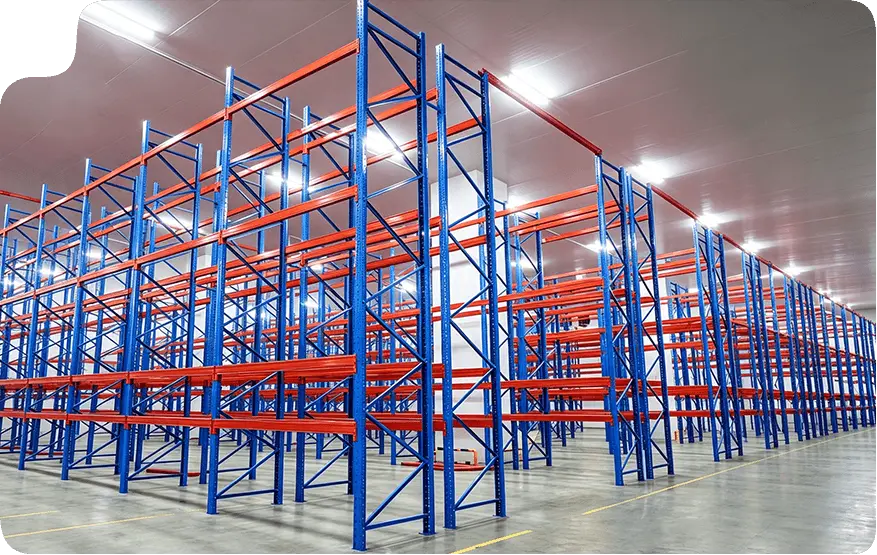
Refrigerated cubic volume represents the highest operating cost per square meter in logistics. High density is non-negotiable.
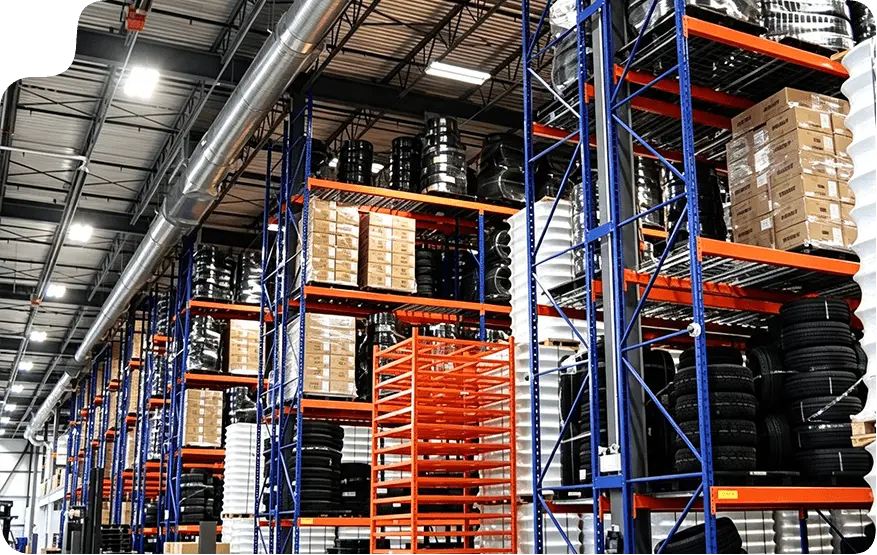
Managing tens of thousands of SKUs ranging from miniature sensor clips to bulky engine blocks and body panels.
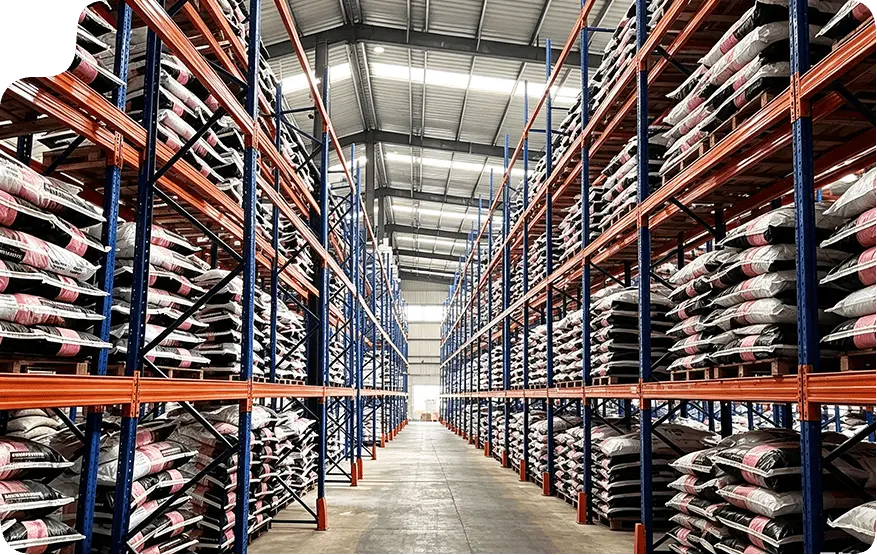
Unobstructed frontal access for long-length structural timber packs, PVC piping, steel bars, and exterior sheet goods.
Detailed technical answers addressing engineering verification, biosecurity controls, standards compliance, and sea logistics.
Our engineering division designs all selective and heavy-duty racking with direct reference to the structural limit state principles outlined in AS 4084:2023 (Steel Storage Racking) and EN 15512 (European Specification for Steel Static Storage Systems). For every major tender, we supply complete design calculations including cross-sectional properties (section modulus, shear centers, moments of inertia), stub column compression capacity curves, and down-aisle connection stiffness ($K_i$) test reports. These documents allow your domestic structural certifier (such as an Australian CPEng or US PE) to formally verify and sign off on site-specific installation signboards.
Yes. For regions subject to elevated peak ground acceleration ($PGA$) under codes such as NZS 1170.5 or ASCE 7, our engineers modify the rack framing. We introduce heavy-gauge cold-rolled Q355B base plates with multi-anchor hole arrays, thicken the bottom upright section, increase the gauge of horizontal and diagonal frame bracings, and install rigid back-to-back row spacers. We also configure spine vertical bracings and plan-view horizontal top ties to dissipate lateral dynamic seismic energies effectively.
For standard ambient warehouses, our automated finishing line employs a 10-stage pre-treatment (pickling, degreasing, zinc phosphating, and deionized water rinsing) followed by electrostatic polyester powder coating cured at $180^\circ\text{C}-200^\circ\text{C}$ (dry film thickness of 60 to 80 microns). For high-humidity coastal zones (such as Queensland or Pacific Islands) or extreme condensation cold storage, we provide heavy-duty pre-galvanized components or ISO 1461 hot-dip galvanizing with zinc coating weights exceeding $500\text{ g/m}^2$, delivering decades of rust-free performance.
We pack all pallet racking beams and upright frame bundles on custom heavy-duty welded steel stillage shoes or export-certified timber treated in strict accordance with ISPM-15. Every timber piece displays clear, legible IPPC heat treatment (HT) stamps. Every container is cleaned and inspected prior to stuffing, accompanied by certified commercial invoices, comprehensive packing lists with individual piece weights, and mill test certificates to ensure rapid clearance without border treatment quarantine delays.
To enable our engineering department to generate an accurate 3D CAD spatial layout and bill of materials, please share: (1) Warehouse architectural floor plan noting column grids, emergency doors, and floor joints; (2) Building clear height to the lowest obstruction (sprinklers, light fixtures, or roof purlins); (3) Pallet specifications including overall dimensions (W × D × H including cargo overhang) and maximum gross weight; (4) Forklift truck model, turning radius, and maximum mast lift elevation; and (5) Specific stock rotation methodology (FIFO or LIFO).
Standard production runs for full container load (FCL) orders typically range between 15 and 25 calendar days, supported by our high 30,000-ton monthly capacity. Direct maritime transit times from our primary loading ports in South China (Guangzhou / Nansha / Shenzhen) average: 12–18 days to Australian ports (Sydney, Melbourne, Brisbane); 16–22 days to New Zealand (Auckland, Tauranga); 18–26 days to US West Coast (Long Beach, Oakland); and 28–35 days to European main ports (Rotterdam, Hamburg).
Connect directly with our senior structural racking engineers. Provide your facility parameters to receive a complimentary 3D layout rendering, structural load table, and comprehensive project bill of materials.