High-Capacity Modular Racking Fleet for Chicagoland Warehouses
From Class A distribution centers in Will County to high-velocity e-commerce sorting hubs near O'Hare International Airport, our high-yield steel systems deliver certified load capacities, tight structural tolerances, and modular scalability.
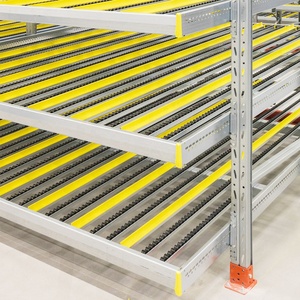
Warehouse Storage Gravity Carton Flow Rack for Box
Continuous dynamic roller tracks designed for strict FIFO carton order picking, eliminating worker replenishment bottlenecks.
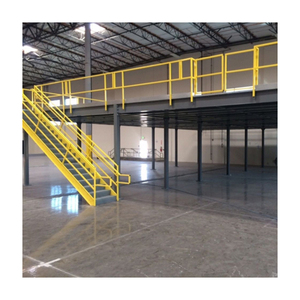
Customized Industrial Storage Pallet Racking 2 Floors Mezzanine
High-load structural steel platform that doubles or triples warehouse square footage over existing floor space footprints.
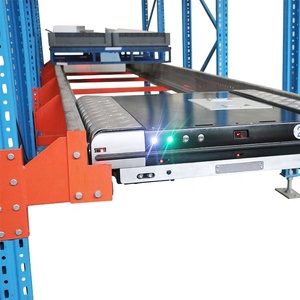
High Density Automated Warehouse Pallet Radio Shuttle System
Deep-lane automated cart runner controlled via wireless RF remote. Minimizes forklift travel and reduces rack impact damages.
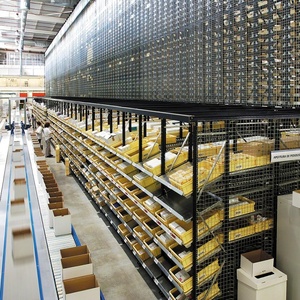
Heavy Duty Adjustable 5-Layer Carton Gravity Flow Rack
CE-certified multi-tier carton flow designed for high-throughput fulfillment centers handling consumer packaged goods and auto parts.
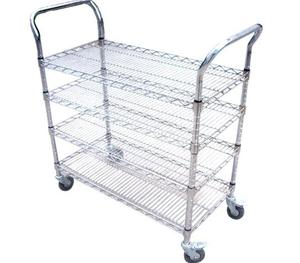
4 Layers Industrial Chrome Wire Basket ESD Shelf Trolley
Anti-static mobile storage trolley with ergonomic handrail, essential for clean assembly, electronics sorting, and sensitive parts picking.
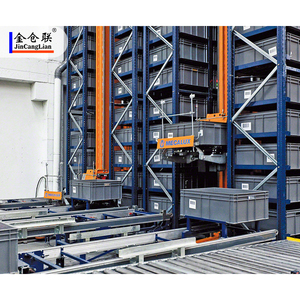
Intelligent Warehouse Steel Pipe ASRS Retrieval System
High-bay crane-automated rack structure designed for long goods, heavy industrial piping, and bulk bar stock retrieval.
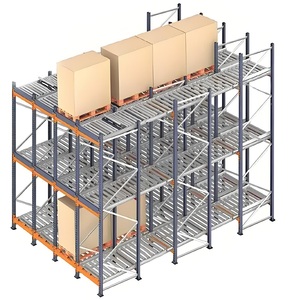
CE Certificated Steel Roller Gravity Pallet Flow Rack
Gravity-driven pallet lanes equipped with centrifugal speed controllers and entry guides for high-capacity grocery & cold chain staging.
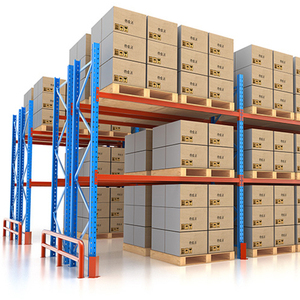
Heavy Duty Single & Double-Depth Selective Pallet Racks
The industry benchmark for 100% pallet accessibility. Configured for GMA 48x40-inch pallets across standard and narrow aisles.
1. The Chicagoland Logistics Real Estate Landscape & Density Imperative
The Greater Chicago industrial market represents one of the world's most vital supply chain epicenters, encompassing over 1.3 billion square feet of industrial inventory. Driven by convergence points of Class I continental railroads, transcontinental interstates (I-55, I-80, I-90, I-94), and O'Hare International Airport's air cargo terminals, Chicagoland serves as the ultimate Midwestern clearinghouse. However, supply chain operators across Cook, DuPage, and Will counties confront intense structural pressures: escalating land costs, stringent zoning restrictions, and rising real estate taxes. These economic factors make horizontal footprint expansion financially unviable, compelling warehouse directors to look upward.
Modern Class A spec builds across Joliet, Elwood, Bolingbrook, and Romeoville routinely feature interior clear heights between 36 and 40 feet. Maximizing these soaring vertical clearances requires precision-engineered modular racking systems capable of withstanding massive cumulative dead loads and dynamic seismic loads. Standard off-the-shelf shelving systems fail to capitalize on the upper cubic volume of these modern facilities. Guangzhou Heda Shelves Co., Ltd. provides modular structural engineering that allows distributors to transition from standard selective configurations into ultra-dense 4-tier to 6-tier pallet profiles, doubling position density without requiring new square footage.
I-80 & I-55 Corridor
Dominated by regional distribution centers requiring heavy-duty selective, double-deep, and drive-in racks handling rapid turn consumer packaged goods (CPG) and wholesale retail freight.
O'Hare Air Cargo Infill
Constrained legacy footprint warehouses where ceiling heights of 24-28 ft demand space-multiplying structural mezzanine platforms and high-speed carton gravity flow pick modules.
Intermodal Logistics Hubs
BNSF Logistics Park Chicago (Elwood) and Union Pacific Global IV (Joliet) staging yards requiring heavy structural racking built for ISO container freight cross-docking operations.
2. Structural Engineering Compliance: ANSI MH16.1, IBC & City of Chicago Codes
Procuring pallet racking for deployment in Illinois requires stringent adherence to American national engineering standards and municipal safety amendments. Unlike unregulated generic shelving, industrial storage racks installed in commercial facilities are governed by the International Building Code (IBC) and the Rack Manufacturers Institute (RMI) specification ANSI MH16.1: Design, Testing and Utilization of Industrial Steel Storage Racks. In the City of Chicago proper, installations must additionally comply with the City of Chicago Building Code (Title 14B), which mandates specific engineering reviews regarding egress width, structural anchoring, and emergency exit distances.
Seismic Considerations in Northeastern Illinois
While Chicago is historically regarded as seismically stable, structural engineers must design rack base plates and anchoring in accordance with USGS seismic hazard maps. Depending on site-specific soil classifications (Class A through F) and proximity to regional seismic zones like the New Madrid Seismic Zone to the south, industrial warehouses are categorized into Seismic Design Categories (SDC A or B). Racking structures must resist horizontal shear forces ($V = C_s \times W$), where base plate anchor bolts undergo combined tension and shear verification to avoid catastrophic upright buckling under localized ground acceleration.
NFPA 13 Fire Sprinkler & Flue Space Geometry
Fire protection compliance enforced by local fire protection districts (e.g., Chicago Fire Department Bureau of Fire Prevention) heavily governs pallet rack layouts. Per NFPA 13 standards for storage racking:
- Longitudinal Flue Space: A continuous vertical clearance of at least 6 inches must be maintained between back-to-back rack rows to allow heat from a fire to trigger ceiling-mounted ESFR (Early Suppression Fast Response) sprinkler heads efficiently.
- Transverse Flue Space: A minimum 3-inch gap between adjacent pallet loads and between pallets and upright frames is mandatory along the aisle face.
- Wire Mesh Decking: Open wire mesh decks with at least 50% open area are legally mandated to prevent water pooling, ensuring sprinkler water cascades down to lower tiers to extinguish base-level fires.
| Engineering Parameter | Standard Specification | HEDA Shelves Manufacturing Standard | Regulatory Verification |
|---|---|---|---|
| Structural Steel Grade | ASTM A36 or A1011 Commercial Grade | Q235B & Q355B High-Yield Cold-Rolled Carbon Steel | Mill Test Certificates (EN 10204 3.1) |
| Deflection Limits | Beam deflection under load: $\le L/180$ | Engineered deflection threshold: $\le L/200$ to $L/250$ | ANSI MH16.1 Section 5.3 |
| Quality Management | Standard domestic fabricator | Certified ISO 9001:2015 System (Cert #18624Q00169R0M) | Annual Global Third-Party Audit |
| Structural Safety Standard | OSHA 1910.176 & ANSI MH16.1 | CE Certified (2435-CPR-8605159) & ANSI Aligned | Independent Laboratory Test Reports |
| Finishing Technology | Single-stage liquid spray | Pickling + Phosphating + Electrostatic Epoxy Powder (80-120μm) | Salt Spray ASTM B117 & RoHS |
3. Specialized Midwest Applications: Cold Chain, E-Commerce & Manufacturing
The Midwestern industrial belt relies on robust cold chain logistics to service vast meatpacking, dairy, and frozen food processing networks extending across Illinois, Wisconsin, Iowa, and Indiana. Cold storage facilities in Bedford Park and Franklin Park operate under severe thermal constraints, where operating temperatures drop to $-20^\circ\text{F}$ ($-29^\circ\text{C}$). At these extreme temperatures, common structural steel can suffer severe embrittlement, reducing yield resistance and accelerating structural fatigue under dynamic lift-truck impacts.
HEDA Shelves formulates heavy-duty upright frames and load beams using micro-alloyed cold-rolled structural steel with high notch toughness. Our electrostatic powder coatings are cured to eliminate micro-cracking and prevent moisture penetration during freeze-thaw condensation cycles. For extreme environments, hot-dip galvanized finishes provide total cathodic protection against aggressive brine solutions, condensation, and chemical washdowns common in USDA-regulated facilities.
Refrigerated Freezers
Drive-in and Radio Shuttle lanes eliminate wasted aisles, preserving thermal mass and drastically cutting refrigerated power expenditures per pallet position.
3PL Mega-Hubs
Selective and double-deep racking profiles with bolted teardrop beam connectors allowing warehouse managers to reconfigure beam elevations quickly as client packaging dimensions shift.
Heavy Industrial Manufacturing
Structural cantilever racking and ASRS automated pipe retrieval racks designed for steel tube producers and agricultural equipment fabricators along the Rock River Valley.
E-Commerce Micro-Fulfillment
Multi-tier industrial mezzanine platforms integrated with carton gravity flow lanes to accommodate high-velocity item-level picking and fast postal parcel sortation.
4. Direct Manufacturer Capabilities & Transpacific Export Infrastructure
Founded in 2001, Guangzhou Heda Shelves Co., Ltd. has expanded over 25 years to become a globally trusted manufacturing partner for warehouse racking systems, serving industrial distributors, large-scale general contractors, and end-user warehouse operators across the globe. Our heavy industrial manufacturing complex covers 30,000 square meters, driven by more than 300 experienced engineers, structural fabricators, and QA inspectors.
Operating an in-house monthly production output surpassing 30,000 metric tons, we maintain total quality oversight over raw coil slitting, precision CNC punching, automated roll-forming, robotic welding, and full-immersion pre-treatment finishing lines. By cutting out third-party domestic middlemen and equipment brokers, we supply Chicago facility operators with direct factory pricing, rapid prototype iterations, and complete structural engineering calculations stamped for local US review.
Midwest Intermodal Delivery: Smooth Port-to-Rail Execution
Exporting heavy modular steel to the landlocked Midwestern United States demands sophisticated multi-modal logistics planning. HEDA Shelves maintains dedicated containerized export protocols engineered to eliminate handling damage and simplify US Customs clearances:
- Intermodal Rail Transport: Shipments originate via direct sea freight lanes to West Coast ports (Los Angeles/Long Beach or Tacoma) connecting to Class I intermodal rail corridors (BNSF / UP), terminating directly at Chicagoland container yards (Joliet, Elwood, Corwith, Bedford Park). Alternatively, all-water routes via the East Coast or Gulf ports provide reliable delivery options.
- ISPM-15 Wood Packing or Custom Steel Stillages: All palletizing uses fumigated heat-treated timber bearing international IPPC stamps or rugged custom steel stillages, avoiding costly US Customs Border Protection (CBP) quarantine holds.
- Pre-Sorted Installation Bundles: Structural components are labeled with waterproof bilingual barcodes and accompanied by CAD erection drawings, enabling local Chicago union or open-shop installation crews to assemble racks smoothly and safely.
5. Chicago Warehouse Racking Procurement FAQ
Clear, direct technical answers addressing the real-world operational, structural, and regulatory questions asked by Chicago industrial plant managers and procurement professionals.
How do we secure City of Chicago building and rack permits?
Racking systems exceeding 8 feet in height are classified as non-building structures under Chicago building codes, requiring a building permit. HEDA Shelves delivers detailed CAD elevation drawings, component section modulus data, and verified beam/upright load capacity calculations that your local Illinois-licensed Professional Engineer (PE) or architect can review and submit directly to the Department of Buildings.
What floor slab thickness is required for heavy pallet racking?
Standard heavy-duty pallet rack upright frames require a reinforced concrete slab of at least 6 to 8 inches thickness, with a compressive concrete strength ($f'c$) of 3,000 to 4,000 PSI. For deep-lane Radio Shuttle or high-bay mezzanine systems imposing heavy point loads, we supply exact base plate footprint diagrams and anchor bolt pull-out calculations to match your geotechnical foundation specifications.
Can your modular racking integrate with US standard teardrop systems?
Yes. We manufacture precision-punched teardrop-compatible patterns as well as proprietary high-strength structural slotted configurations. Our teardrop-compatible punch profile allows complete interchangeability with standard American teardrop beams and uprights, giving you full flexibility to expand, reconfigure, or repair existing storage bays.
How does the racking handle winter condensation and humidity changes?
Chicago's stark seasonal temperature shifts create condensation inside unconditioned cross-dock facilities. HEDA Shelves addresses this through multi-stage industrial metal pre-treatment: automated steel shot-blasting, chemical pickling, and iron phosphating, followed by 80–120μm electrostatic epoxy-polyester powder coating. For outdoor staging yards or cold storage washdowns, hot-dip galvanizing per ASTM A123 ensures total corrosion protection.
What is the typical shipping lead time from factory to a Chicago facility?
Production typically requires 15 to 25 days depending on project tonnage and custom requirements. Ocean transit to West Coast ports paired with intermodal rail to Chicago rail ramps averages 18 to 28 days. In total, complete project delivery runs between 5 and 7 weeks—often faster than domestic steel fabricators experiencing prolonged backlog queues.
What technical data is required to generate a custom 3D CAD layout?
To produce a free engineering optimization plan, our design office requires: (1) Facility CAD architectural floor plan indicating column spacing, dock door locations, and clear ceiling heights; (2) Pallet dimensions ($L \times W \times H$) including pallet load overhang; (3) Maximum load weight per pallet; and (4) Forklift truck specifications (mast type, maximum lift height, and minimum right-angle stacking aisle width).
Transform Your Chicago Warehouse Capacity with Free 3D CAD Layouts
Work directly with an established manufacturer trusted across 10,000+ industrial installations worldwide. Submit your facility dimensions today to receive a complete 3D layout, weight capacity matrix, and direct export quotation within 24 hours.