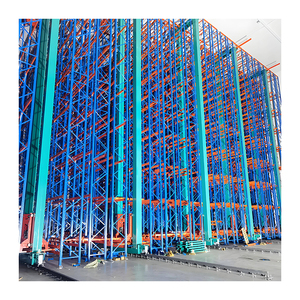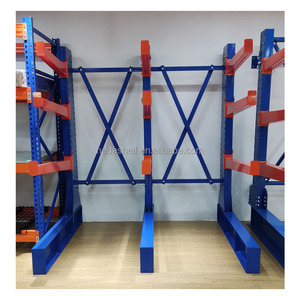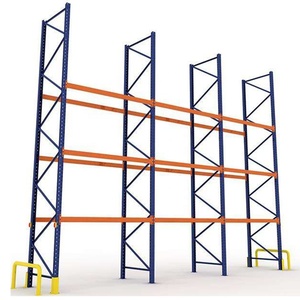
Engineered from premium Q235B and Q355B cold-rolled structural coils. Our high-precision punched slotted uprights deliver infinite versatility, 50mm–75mm pitch adjustability, and strict structural integrity tested under simulated destructive load conditions.
A granular structural dissection of slotted upright profiles, steel metallurgy, roll-forming tolerances, and seismic safety factors for warehouse directors and structural engineers.
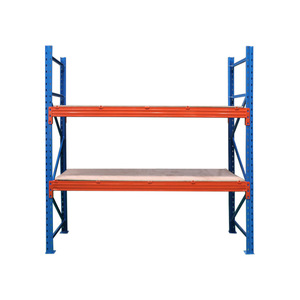
In modern high-density intralogistics, selecting a verified manufacturing exporter for slotted pallet racking transcends baseline unit-cost comparisons. Slotted pallet rack assemblies—characterized by their continuous CNC-punched upright perforations (predominantly teardrop, diamond, or metric butterfly slot geometries)—depend critically on precise geometric cold-forming, steel metallurgical yield limits, and moment-resisting beam-to-column connector efficiency.
Top-tier Chinese manufacturers operate end-to-end continuous roll-forming production lines utilizing prime hot-rolled pickled and oiled (HRPO) or cold-rolled structural steel coils sourced directly from state-owned foundries such as Baosteel, Shougang, or Ansteel. When evaluating slotted pallet racking exporters, structural procurement teams must assess three non-negotiable structural parameters: cross-sectional section modulus ($Z_x, Z_y$), perforation punch concentricity, and beam end-connector claw engagement mechanics.
We utilize certified Q235B ($f_y \ge 235\text{ MPa}$) and high-stress Q355B ($f_y \ge 355\text{ MPa}$) structural steel grades. Mill test certificates (MTCs) accompany every heat number, validating elongation properties over 26%, strict carbon equivalents ($CEV \le 0.38$), and uncompromised Charpy V-notch impact toughness under cold storage thresholds down to -30°C.
Our upright sections undergo cold-forming through up to 24 continuous rolling stations. This multi-pass profile development minimizes internal residual stresses and micro-fissuring along the 90° bend radiuses, ensuring upright flanges maintain true dimensional parallelity ($\pm 0.5\text{mm}$) across 12-meter continuous vertical spans.
Beam end connectors are stamped from 3.5mm–4.5mm heavy-gauge alloy plates featuring 3-claw, 4-claw, and 5-claw high-friction interlocks. Integrated spring-loaded safety locking pins prevent accidental vertical dislodgement from high-reach reach truck mast impacts, exceeding ANSI MH16.1 uplift force ratings.
| Profile Specification | Material Grade | Yield Strength ($R_{eH}$) | Standard Pitch Options | Deflection Limit ($\delta$) | Compliance Reference |
|---|---|---|---|---|---|
| Slotted Upright Column (80/90/100/120mm) | Q235B / Q355B Steel | 235 – 355 N/mm² | 50mm / 75mm / 76.2mm (Teardrop) | $L / 1000$ column drift | AS 4084 / FEM 10.2.02 |
| Interlocking Box Step Beams (80–160mm) | Q235B Double-C Cold Formed | $\ge 235$ N/mm² | Continuous Welded Lip | $L / 200$ span max deflection | EN 15512 / RMI MH16.1 |
| Heavy-Duty Cantilever Arm Sections | Structural I-Beam (IPE/H-Beam) | $\ge 355$ N/mm² | 100mm Bolted Gusset Pitch | $L / 250$ cantilever overhang | AISC 360 / ISO 9001 |
| Mezzanine Structural Primary Joists | C/Z Purling & H-Section | 355 N/mm² | Engineered Column Grid | $L / 300$ dead + live loading | NZS 1170.5 / CE Marked |
“Structural integrity in seismic and high-rack conditions cannot be retrofitted through paint or marketing. It is calculated through elastic-plastic section analysis, verifiable hole reduction factors, and strict adherence to cold-formed thin-walled steel specifications.” — Guangzhou Heda Shelves Engineering Division.
Founded in 2001, Guangzhou Heda Shelves Co., Ltd. operates as an authoritative manufacturing force in Southern China. Our 30,000 m² advanced facility houses 300+ engineering, fabrication, and QC professionals handling large-scale export operations for logistics hubs, cold chains, and retail distributors worldwide.
Unlike export trading agencies that outsource component manufacturing across fragmented workshops, Heda Shelves maintains 100% in-house vertical manufacturing. Our automated production line executes a rigorous 10-Stage Precision Production Cycle: raw coil acoustic thickness gauging → high-speed automated CNC slotted perforation punching → continuous cold roll forming → robotic beam welding → shot-blasting surface conditioning → hot acid pickling and zinc phosphating → automated electrostatic thermoset powder coating → curing ovens (200°C) → coordinate measuring machine (CMM) dimensional audit → export bundling with ISPM-15 compliant packaging.
This closed-loop manufacturing cycle allows our factory to sustain a monthly production throughput exceeding 30,000 metric tons with flawless repeatability. Every shipment destined for international seaports (including Sydney, Melbourne, Brisbane, Auckland, Long Beach, and Rotterdam) is accompanied by exhaustive engineering data packs, structural load tables, calculation reports, and factory inspection test plans (ITP).
How enterprise supply chains, third-party logistics (3PL) conglomerates, and EPC contractors are reshaping their steel storage procurement criteria in an era of automation, trade shifts, and ESG reporting.
Procurement is transitioning from standard Q235B steel to cold-formed micro-alloy steels ($f_y \ge 355\text{–}420\text{ MPa}$). By leveraging higher yield strengths, factories produce slimmer section profiles that reduce rack deadweight by 12%–18% while sustaining identical pallet loads, lowering trans-oceanic freight costs.
Multinational procurement teams increasingly mandate Environmental Product Declarations (EPD) and Scope 1–3 carbon reporting on imported steel structures. Top Chinese exporters are adopting scrap-rich Electric Arc Furnace (EAF) steel and solar-powered continuous coating lines to satisfy carbon tax compliance.
With container freight volatility remaining a critical procurement variable, advanced factories engineer nesting slotted uprights and interlocking box beams that achieve 96% volumetric container cube utilization, packing over 24 metric tons into standard 40ft High Cube containers without surface abrasions.
Paper blueprints are obsolete. Modern RFQs now demand native Revit/BIM files containing precise clash-detection metadata for sprinkler drops, flue-space compliance (NFPA 13), and automated guided vehicle (AGV) navigational clearance, delivered by factory CAD teams within 24–48 hours of project briefing.
From non-linear finite element modeling (FEM) to advanced nanotech anti-corrosive coatings, discover the engineering advancements defining the next generation of industrial warehouse storage.
Modern slotted upright design uses non-linear buckling simulations that factor in perforations, cold-work hardening, and residual stresses. Engineers accurately determine the effective width of thin-walled members, maximizing the load-to-weight ratio while maintaining safety factors above 1.95.
Traditional static slotted racking is evolving into hybrid frames equipped with CNC-punched locating points for Autonomous Mobile Robots (AMRs) and Four-Way Radio Shuttles. Upright columns feature pre-engineered brackets for retrofitting busbars, optical positioning reflectors, and laser interlocks.
To combat severe atmospheric corrosion in coastal and sub-tropical logistics hubs (ISO 12944 C4/C5 marine environments), Chinese factories have developed graphene-enhanced electrostatic powder coatings that boost salt-spray corrosion resistance beyond 1,500 hours without film peeling or blister propagation.
Clear, technically rigorous answers to the critical structural, regulatory, shipping, and installation questions asked by overseas supply chain managers and project engineers.
Every commercial order manufactured by Guangzhou Heda Shelves Co., Ltd. includes an exhaustive Engineering Calculation Verification Dossier. This package comprises: (1) Cross-sectional properties ($I_x, I_y, Z_x, Z_y$) verified through physical coupon tensile tests, (2) Upright frame buckling calculations factoring in perforation reduction under AS 4084-2023 / FEM 10.2.02, (3) Beam end-connector looseness and shear moment test curves, and (4) Site-specific anchor pull-out ratings. These documents provide the requisite engineering data for third-party registered chartered professional engineers (CPEng / PE) in Australia, New Zealand, the United States, or the European Union to issue local structural compliance certificates.
For installations located in seismically active regions, standard static rack designs are insufficient. Our structural engineers calibrate designs using the specific site seismic parameters (including zone factor $Z$, soil site class, and annual probability of exceedance). Structural enhancements include: upgrading upright column steel from Q235B to high-ductility Q355B; increasing footplate thickness from standard 4.0mm to 8.0mm–12.0mm seismic baseplates; utilizing dual high-tensile chemical or mechanical wedge anchors per post; incorporating heavy-duty structural tubular diagonal bracing throughout the rack frames; and installing rigid back-to-back row spacers alongside horizontal spine ties.
The hole pattern dictates vertical beam adjustability and geographical compatibility. 50mm pitch is the dominant European metric standard (common under FEM guidelines), allowing fine vertical adjustments to minimize wasted air space between pallets. 75mm pitch is widely utilized across Australia, New Zealand, and British Commonwealth nations, offering exceptional heavy-load beam connector engagement. 76.2mm (3-inch) Teardrop pitch is the universal North American (RMI) standard, utilizing boltless pin locks with tapered teardrop slots. Guangzhou Heda Shelves operates precision multi-die CNC punching presses capable of manufacturing 50mm, 75mm, and American teardrop patterns on demand, ensuring complete interchangeability with existing warehouse racking fleets.
Customs and quarantine authorities—such as the Department of Agriculture, Fisheries and Forestry (DAFF) in Australia and the Ministry for Primary Industries (MPI) in New Zealand—enforce strict biosecurity protocols. We eliminate clearance friction through two export packaging methodologies: (1) Packing upright frames, beams, and pallet mesh entirely on custom-fabricated all-steel stillages and skids, completely removing solid timber from the shipping container; or (2) Utilizing ISPM-15 heat-treated, certified, and officially stamped timber dunnage accompanied by certified fumigation declarations. Packing lists, commercial invoices, and clean ocean bills of lading are issued with complete tariff classifications (HS Code 7308.90.00).
Standard manufacturing lead times range between 18 to 25 business days depending on paint finish complexity (galvanized uprights vs powder-coated custom RAL tones) and order volume. For sea transit from our South China ports (Guangzhou / Shenzhen), maritime shipping times are approximately: 12–18 days to Sydney/Melbourne; 14–20 days to Auckland/Tauranga; 18–24 days to Singapore/Southeast Asia; and 22–32 days to US West Coast or European ports. Because our packing engineers calculate exact center-of-gravity and nesting clearances, a 40ft High Cube container typically accommodates 22,000kg to 25,500kg of steel components without crushing beam clips or abrading finishes.
Yes. Approximately 45% of our export manufacturing capacity is dedicated to OEM and ODM private-label agreements for established warehouse racking brands and distributor networks in Oceania, Europe, and the Americas. We provide custom profile extrusion tooling, proprietary claw connector stamping, customized brand name embossing on upright columns, bespoke load chart signage, and branded export bundling. Full confidentiality is protected under strict non-disclosure agreements (NDAs).
Partner directly with Guangzhou Heda Shelves Co., Ltd. Provide your warehouse floor plan, ceiling clear height, pallet dimensions, and forklift specifications. Our engineering department will deliver a compliant 3D CAD layout, load capacity calculations, and a door-to-port landed cost breakdown within 24 hours.